InterfacialTimescale
Characteristic timescale to achieve equilibrium at the gas-particle interface for a gas exchanging with an aqueous aerosol droplet — Seinfeld & Pandis (2006), Atmospheric Chemistry and Physics, 2nd ed., Chapter 12, Eqs. 12.61-12.62. Two limiting regimes are computed. For very soluble gases the approach to interfacial equilibrium is controlled by interfacial (accommodation-limited) mass transport, τ_p_soluble ≈ R_p·H*·√(2π·M_A·R·T)/(3α) (Eq. 12.61). For low-solubility gases it is instead controlled by aqueous-phase diffusion within the droplet interior, τ_p_insoluble ≈ R_p²/(π²·D_aq) (Eq. 12.62). Migrated from Aerosol.jl InterfacialTimescale.
Description
Characteristic timescale to achieve equilibrium at the gas-particle interface for a gas exchanging with an aqueous aerosol droplet — Seinfeld & Pandis (2006), Atmospheric Chemistry and Physics, 2nd ed., Chapter 12, Eqs. 12.61-12.62. Two limiting regimes are computed. For very soluble gases the approach to interfacial equilibrium is controlled by interfacial (accommodation-limited) mass transport, τ_p_soluble ≈ R_p·H*·√(2π·M_A·R·T)/(3α) (Eq. 12.61). For low-solubility gases it is instead controlled by aqueous-phase diffusion within the droplet interior, τ_p_insoluble ≈ R_p²/(π²·D_aq) (Eq. 12.62). Migrated from Aerosol.jl InterfacialTimescale.
Reference
Seinfeld, J. H., and Pandis, S. N. (2006). Atmospheric Chemistry and Physics: From Air Pollution to Climate Change, 2nd Edition, John Wiley & Sons, Chapter 12. Interfacial equilibration timescale for very soluble gases: Eq. 12.61; for low-solubility gases: Eq. 12.62.
_source_ref: Aerosol.jl@c8c640bb636b22f2425460e9ed5cba50793bfee1:src/timescales.jl:70
Upstream InterfacialTimescale is an MTK @component (no parameterization). It declares one scalar @constants entry — R (universal gas constant, 8.314 J/(molK)) — six scalar @parameters — R_p (droplet radius, m), α (accommodation coefficient, dimensionless), M_A (molecular weight of species A, kg/mol), T (temperature, K), H_star (effective Henry’s-law coefficient, mol/(m^3Pa)), D_aq (aqueous-phase diffusivity, m^2/s) — and two scalar @variables — τ_p_soluble and τ_p_insoluble (both interfacial timescales, s). The two equations are Eq. 12.61 τ_p_soluble ~ (R_p * H_star * sqrt(2 * π * M_A * R * T)) / (3 * α) (the interfacial-transport-controlled timescale for very soluble gases) and Eq. 12.62 τ_p_insoluble ~ R_p^2 / (π^2 * D_aq) (the aqueous-diffusion-controlled timescale for low-solubility gases). The two outputs are independent — neither equation references the other variable — so the component reports both limiting regimes side by side.
@constants R -> parameter: the upstream @constants R is carried as type: parameter with the fixed default 8.314 — the .esm schema has no constant variable type, so every MTK @constant migrates as a fixed-default parameter (the rig-wide convention applied by the sibling Aerosol.jl migration mean_free_path.esm, which carries its own @constants R the same way, units J/(mol*K) / default 8.314). The upstream symbol name R is kept verbatim. R is one of the .esm schema’s three reserved physical-constant names (R, k_B, N_A); a type: parameter named R is dimensionally checked against the canonical ideal-gas-constant units J/(mol*K). The upstream @constants declares R with exactly u"J/(mol*K)", so the migrated units: "J/(mol*K)" is dimensionally identical to the canonical form and the reserved-name check (_KNOWN_PHYSICAL_CONSTANTS) passes — no rename is needed.
Bare π -> inline literal: unlike R, the constant π is NOT declared in the upstream @constants block — timescales.jl uses the bare Julia π (an Irrational) directly inside the equations (2 * π * ... and π^2). In an MTK symbolic expression Int * Irrational collapses to a Float64 coefficient, so π never becomes a symbolic parameter of the compiled system — it is a numeric literal. It is therefore serialized as the inline numeric literal 3.141592653589793 (the IEEE-754 double Float64(π)) inside the expression AST, matching the sibling Aerosol.jl migration cloud_optical_depth.esm, which likewise carries its upstream bare π as an inline 3.141592653589793. This is deliberately distinct from mean_free_path.esm and droplet_growth.esm, whose upstream sources declare π_val as a @constants and therefore migrate it as a fixed-default type: parameter.
Observed classification: InterfacialTimescale has no D() time-derivative anywhere — it is a purely-algebraic component. τ_p_soluble and τ_p_insoluble are both algebraic outputs (τ_p_soluble ~ ..., τ_p_insoluble ~ ...). After MTK mtkcompile / structural_simplify the compiled system has zero ODE states and both become observed quantities. They are therefore serialized as type: observed with an expression (not type: state with an equation), and the equations array is empty, matching the sibling pure-algebraic Aerosol.jl migrations aqueous_eq.esm (same source file src/timescales.jl), kelvin.esm, and zsr.esm.
Unicode identifiers τ_p_soluble, τ_p_insoluble, and α are kept verbatim from the upstream @variables / @parameters declarations; the ESM identifier pattern permits unicode and the sibling Aerosol.jl migrations (aqueous_eq.esm: τ_s, τ_a; kelvin.esm: σ, ρ_l) keep Greek symbols, so no ASCII rename is applied.
Tests authored from physics: the upstream timescales.jl carries no test file (has_tests: N in the migration tracker). The inline tests block is authored from the closed-form Eqs. 12.61-12.62 — pinning the exact analytic values of both timescales at the upstream default parameterization, and exercising each scaling law: τ_p_soluble linear in droplet radius R_p, inverse in the accommodation coefficient α, linear in the Henry’s-law coefficient H_star (so a more soluble gas has a longer interfacial timescale — the defining behavior of the soluble regime), and proportional to √T; τ_p_insoluble quadratic in R_p and inverse in the aqueous diffusivity D_aq.
Not migrated: timescales.jl defines six independent @components — GasDiffusionTimescale, AqueousDiffusionTimescale, InterfacialTimescale, ReactionTimescale, SolidEquilibrationTimescale, and AqueousEquilibrationTimescale. Only InterfacialTimescale (src/timescales.jl:70) is in scope for this component migration; the other five are separate migration-tracker rows with their own target .esm files under components/aerosol/timescales/ (AqueousEquilibrationTimescale is already migrated as aqueous_eq.esm).
Tolerance rationale (model-level rel=1e-8): the model is two small closed-form algebraic expressions — τ_p_soluble is one sqrt over a five-factor product divided by a two-factor product; τ_p_insoluble is one division of two short products — so float64 evaluation roundoff is at the few-ULP (~1e-15 relative) level; rel=1e-8 leaves ample headroom while still catching a structural regression._
Parameters
| Name | Units | Default | Description |
|---|---|---|---|
R | J/(mol*K) | 8.314 | Universal gas constant — the Eq. 12.61 term R inside the mean-molecular-speed factor √(2π·M_A·R·T). Migrated from the upstream @constants block; the .esm schema has no constant variable type, so it is carried as a fixed-default parameter. Declared with the canonical ideal-gas-constant units J/(mol*K), matching the reserved physical-constant name R. |
R_p | m | 1e-05 | Droplet radius (Eqs. 12.61-12.62 term R_p) — the radius of the aqueous aerosol particle. The interfacial timescale for soluble gases scales linearly with R_p; for low-solubility gases it scales with R_p². |
α | 1 | 1.0 | Mass accommodation coefficient (Eq. 12.61 term α) — the dimensionless probability, in (0, 1], that a gas molecule striking the droplet surface is taken up. It appears in the Eq. 12.61 denominator, so a less efficient surface (smaller α) lengthens the interfacial timescale for soluble gases. |
M_A | kg/mol | 0.029 | Molar mass of the diffusing gas species A (Eq. 12.61 term M_A). It enters the mean-molecular-speed factor √(2π·M_A·R·T); a heavier molecule moves more slowly and lengthens the interfacial timescale. The default 0.029 kg/mol is the molar mass of air. |
T | K | 298.15 | Temperature (Eq. 12.61 term T) of the droplet and surrounding gas. It enters the mean-molecular-speed factor √(2π·M_A·R·T), so τ_p_soluble scales with √T. |
H_star | mol/(m^3*Pa) | 100000.0 | Effective Henry’s-law coefficient (Eq. 12.61 term H*) of the gas in the aqueous phase — the equilibrium ratio of dissolved to gas-phase concentration, augmented by aqueous-phase dissociation/reaction. τ_p_soluble is linear in H*: a more soluble gas takes longer to fill the larger aqueous reservoir, so it has a longer interfacial timescale. |
D_aq | m^2/s | 1e-09 | Aqueous-phase diffusivity (Eq. 12.62 term D_aq) of the dissolved species inside the droplet. It appears in the Eq. 12.62 denominator, so slower aqueous diffusion lengthens the interfacial timescale for low-solubility gases. |
Observed
| Name | Units | Default | Description |
|---|---|---|---|
τ_p_soluble | s | Interfacial equilibration timescale for very soluble gases (Eq. 12.61): τ_p_soluble = R_p·H*·√(2π·M_A·R·T)/(3α). For a highly soluble gas the approach to gas-particle interfacial equilibrium is controlled by interfacial (accommodation-limited) mass transport across the droplet surface. | |
τ_p_insoluble | s | Interfacial equilibration timescale for low-solubility gases (Eq. 12.62): τ_p_insoluble = R_p²/(π²·D_aq). For a poorly soluble gas the approach to gas-particle interfacial equilibrium is controlled by aqueous-phase diffusion within the droplet interior rather than by surface transport. |
Observed expressions
$$ τ_{p\,soluble} = \frac{R_{p} \cdot H_{star} \cdot \sqrt{2 \cdot 3.141592653589793 \cdot M_{A} \cdot R \cdot T}}{3 \cdot α} $$Interfacial equilibration timescale for very soluble gases (Eq. 12.61): τ_p_soluble = R_p·H*·√(2π·M_A·R·T)/(3α). For a highly soluble gas the approach to gas-particle interfacial equilibrium is controlled by interfacial (accommodation-limited) mass transport across the droplet surface.
$$ τ_{p\,insoluble} = \frac{R_{p}^{2}}{3.141592653589793^{2} \cdot D_{aq}} $$Interfacial equilibration timescale for low-solubility gases (Eq. 12.62): τ_p_insoluble = R_p²/(π²·D_aq). For a poorly soluble gas the approach to gas-particle interfacial equilibrium is controlled by aqueous-phase diffusion within the droplet interior rather than by surface transport.
Analyses
soluble_timescale_vs_droplet_radius
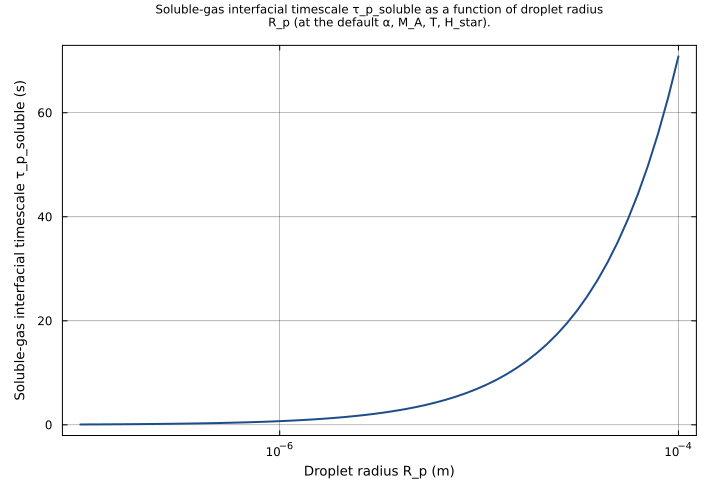
The interfacial timescale for very soluble gases rises linearly with the droplet radius (Eq. 12.61). Sweeping R_p over the 1e-7–1e-4 m range — from a sub-micron aqueous aerosol particle up to a large cloud droplet — at the upstream default parameterization traces the line τ_p_soluble = R_p·H*·√(2π·M_A·R·T)/(3α).
Time span: 0.0 → 1.0
Swept over: R_p
insoluble_timescale_vs_aqueous_diffusivity
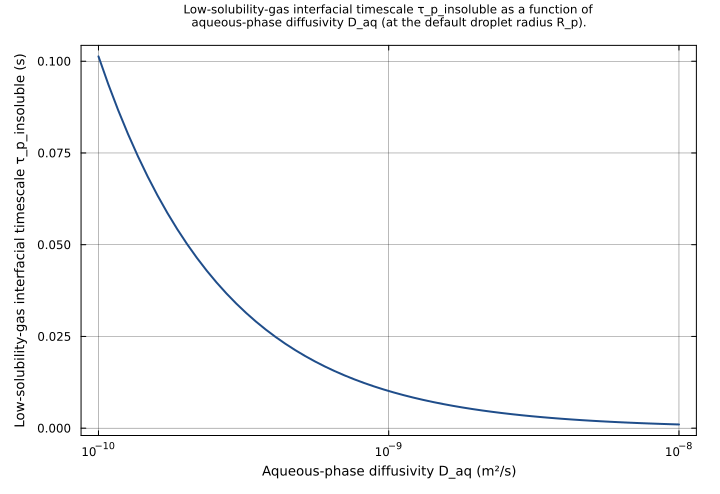
The interfacial timescale for low-solubility gases varies inversely with the aqueous-phase diffusivity (Eq. 12.62). With R_p at its default, sweeping D_aq over the 1e-10–1e-8 m²/s range traces the τ_p_insoluble = R_p²/(π²·D_aq) hyperbola — slower aqueous diffusion lengthens the time to equilibrate the droplet interior.
Time span: 0.0 → 1.0
Swept over: D_aq
soluble_timescale_vs_accommodation_coefficient
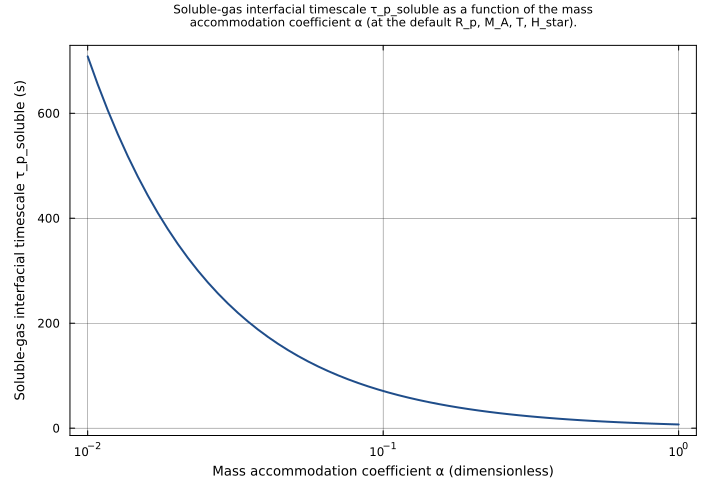
The interfacial timescale for very soluble gases varies inversely with the mass accommodation coefficient (Eq. 12.61). With the other parameters at their defaults, sweeping α over the 1e-2–1.0 range — from a strongly accommodation-limited surface to a perfectly accommodating one — traces the τ_p_soluble = R_p·H*·√(2π·M_A·R·T)/(3α) hyperbola.
Time span: 0.0 → 1.0
Swept over: α
Raw .esm
Raw .esm JSON (this component)
{
  "reference": {
    "citation": "Seinfeld, J. H., and Pandis, S. N. (2006). Atmospheric Chemistry and Physics: From Air Pollution to Climate Change, 2nd Edition, John Wiley & Sons, Chapter 12. Interfacial equilibration timescale for very soluble gases: Eq. 12.61; for low-solubility gases: Eq. 12.62.",
    "notes": "source_ref: Aerosol.jl@c8c640bb636b22f2425460e9ed5cba50793bfee1:src/timescales.jl:70\n\nUpstream `InterfacialTimescale` is an MTK `@component` (no parameterization). It declares one scalar `@constants` entry — `R` (universal gas constant, 8.314 J/(mol*K)) — six scalar `@parameters` — `R_p` (droplet radius, m), `α` (accommodation coefficient, dimensionless), `M_A` (molecular weight of species A, kg/mol), `T` (temperature, K), `H_star` (effective Henry's-law coefficient, mol/(m^3*Pa)), `D_aq` (aqueous-phase diffusivity, m^2/s) — and two scalar `@variables` — `τ_p_soluble` and `τ_p_insoluble` (both interfacial timescales, s). The two equations are Eq. 12.61 `τ_p_soluble ~ (R_p * H_star * sqrt(2 * π * M_A * R * T)) / (3 * α)` (the interfacial-transport-controlled timescale for very soluble gases) and Eq. 12.62 `τ_p_insoluble ~ R_p^2 / (π^2 * D_aq)` (the aqueous-diffusion-controlled timescale for low-solubility gases). The two outputs are independent — neither equation references the other variable — so the component reports both limiting regimes side by side.\n\n@constants R -> parameter: the upstream `@constants` `R` is carried as `type: parameter` with the fixed default 8.314 — the .esm schema has no constant variable type, so every MTK `@constant` migrates as a fixed-default parameter (the rig-wide convention applied by the sibling Aerosol.jl migration `mean_free_path.esm`, which carries its own `@constants` `R` the same way, units `J/(mol*K)` / default 8.314). The upstream symbol name `R` is kept verbatim. `R` is one of the .esm schema's three reserved physical-constant names (`R`, `k_B`, `N_A`); a `type: parameter` named `R` is dimensionally checked against the canonical ideal-gas-constant units `J/(mol*K)`. The upstream `@constants` declares `R` with exactly `u\"J/(mol*K)\"`, so the migrated `units: \"J/(mol*K)\"` is dimensionally identical to the canonical form and the reserved-name check (`_KNOWN_PHYSICAL_CONSTANTS`) passes — no rename is needed.\n\nBare π -> inline literal: unlike `R`, the constant π is NOT declared in the upstream `@constants` block — `timescales.jl` uses the bare Julia `π` (an `Irrational`) directly inside the equations (`2 * π * ...` and `π^2`). In an MTK symbolic expression `Int * Irrational` collapses to a `Float64` coefficient, so π never becomes a symbolic parameter of the compiled system — it is a numeric literal. It is therefore serialized as the inline numeric literal `3.141592653589793` (the IEEE-754 double `Float64(π)`) inside the expression AST, matching the sibling Aerosol.jl migration `cloud_optical_depth.esm`, which likewise carries its upstream bare `π` as an inline `3.141592653589793`. This is deliberately distinct from `mean_free_path.esm` and `droplet_growth.esm`, whose upstream sources declare `π_val` as a `@constants` and therefore migrate it as a fixed-default `type: parameter`.\n\nObserved classification: InterfacialTimescale has no `D()` time-derivative anywhere — it is a purely-algebraic component. `τ_p_soluble` and `τ_p_insoluble` are both algebraic outputs (`τ_p_soluble ~ ...`, `τ_p_insoluble ~ ...`). After MTK `mtkcompile` / `structural_simplify` the compiled system has zero ODE states and both become observed quantities. They are therefore serialized as `type: observed` with an `expression` (not `type: state` with an equation), and the `equations` array is empty, matching the sibling pure-algebraic Aerosol.jl migrations `aqueous_eq.esm` (same source file `src/timescales.jl`), `kelvin.esm`, and `zsr.esm`.\n\nUnicode identifiers `τ_p_soluble`, `τ_p_insoluble`, and `α` are kept verbatim from the upstream `@variables` / `@parameters` declarations; the ESM identifier pattern permits unicode and the sibling Aerosol.jl migrations (`aqueous_eq.esm`: `τ_s`, `τ_a`; `kelvin.esm`: `σ`, `ρ_l`) keep Greek symbols, so no ASCII rename is applied.\n\nTests authored from physics: the upstream `timescales.jl` carries no test file (`has_tests: N` in the migration tracker). The inline `tests` block is authored from the closed-form Eqs. 12.61-12.62 — pinning the exact analytic values of both timescales at the upstream default parameterization, and exercising each scaling law: `τ_p_soluble` linear in droplet radius `R_p`, inverse in the accommodation coefficient `α`, linear in the Henry's-law coefficient `H_star` (so a more soluble gas has a longer interfacial timescale — the defining behavior of the soluble regime), and proportional to √T; `τ_p_insoluble` quadratic in `R_p` and inverse in the aqueous diffusivity `D_aq`.\n\nNot migrated: `timescales.jl` defines six independent `@component`s — `GasDiffusionTimescale`, `AqueousDiffusionTimescale`, `InterfacialTimescale`, `ReactionTimescale`, `SolidEquilibrationTimescale`, and `AqueousEquilibrationTimescale`. Only `InterfacialTimescale` (src/timescales.jl:70) is in scope for this component migration; the other five are separate migration-tracker rows with their own target `.esm` files under `components/aerosol/timescales/` (`AqueousEquilibrationTimescale` is already migrated as `aqueous_eq.esm`).\n\nTolerance rationale (model-level rel=1e-8): the model is two small closed-form algebraic expressions — `τ_p_soluble` is one `sqrt` over a five-factor product divided by a two-factor product; `τ_p_insoluble` is one division of two short products — so float64 evaluation roundoff is at the few-ULP (~1e-15 relative) level; rel=1e-8 leaves ample headroom while still catching a structural regression."
  },
  "variables": {
    "R": {
      "type": "parameter",
      "units": "J/(mol*K)",
      "default": 8.314,
      "description": "Universal gas constant — the Eq. 12.61 term R inside the mean-molecular-speed factor √(2π·M_A·R·T). Migrated from the upstream `@constants` block; the .esm schema has no constant variable type, so it is carried as a fixed-default parameter. Declared with the canonical ideal-gas-constant units J/(mol*K), matching the reserved physical-constant name `R`."
    },
    "R_p": {
      "type": "parameter",
      "units": "m",
      "default": 1e-05,
      "description": "Droplet radius (Eqs. 12.61-12.62 term R_p) — the radius of the aqueous aerosol particle. The interfacial timescale for soluble gases scales linearly with R_p; for low-solubility gases it scales with R_p²."
    },
    "α": {
      "type": "parameter",
      "units": "1",
      "default": 1.0,
      "description": "Mass accommodation coefficient (Eq. 12.61 term α) — the dimensionless probability, in (0, 1], that a gas molecule striking the droplet surface is taken up. It appears in the Eq. 12.61 denominator, so a less efficient surface (smaller α) lengthens the interfacial timescale for soluble gases."
    },
    "M_A": {
      "type": "parameter",
      "units": "kg/mol",
      "default": 0.029,
      "description": "Molar mass of the diffusing gas species A (Eq. 12.61 term M_A). It enters the mean-molecular-speed factor √(2π·M_A·R·T); a heavier molecule moves more slowly and lengthens the interfacial timescale. The default 0.029 kg/mol is the molar mass of air."
    },
    "T": {
      "type": "parameter",
      "units": "K",
      "default": 298.15,
      "description": "Temperature (Eq. 12.61 term T) of the droplet and surrounding gas. It enters the mean-molecular-speed factor √(2π·M_A·R·T), so τ_p_soluble scales with √T."
    },
    "H_star": {
      "type": "parameter",
      "units": "mol/(m^3*Pa)",
      "default": 100000.0,
      "description": "Effective Henry's-law coefficient (Eq. 12.61 term H*) of the gas in the aqueous phase — the equilibrium ratio of dissolved to gas-phase concentration, augmented by aqueous-phase dissociation/reaction. τ_p_soluble is linear in H*: a more soluble gas takes longer to fill the larger aqueous reservoir, so it has a longer interfacial timescale."
    },
    "D_aq": {
      "type": "parameter",
      "units": "m^2/s",
      "default": 1e-09,
      "description": "Aqueous-phase diffusivity (Eq. 12.62 term D_aq) of the dissolved species inside the droplet. It appears in the Eq. 12.62 denominator, so slower aqueous diffusion lengthens the interfacial timescale for low-solubility gases."
    },
    "τ_p_soluble": {
      "type": "unknown",
      "units": "s",
      "description": "Interfacial equilibration timescale for very soluble gases (Eq. 12.61): τ_p_soluble = R_p·H*·√(2π·M_A·R·T)/(3α). For a highly soluble gas the approach to gas-particle interfacial equilibrium is controlled by interfacial (accommodation-limited) mass transport across the droplet surface."
    },
    "τ_p_insoluble": {
      "type": "unknown",
      "units": "s",
      "description": "Interfacial equilibration timescale for low-solubility gases (Eq. 12.62): τ_p_insoluble = R_p²/(π²·D_aq). For a poorly soluble gas the approach to gas-particle interfacial equilibrium is controlled by aqueous-phase diffusion within the droplet interior rather than by surface transport."
    }
  },
  "equations": [
    {
      "lhs": "τ_p_soluble",
      "rhs": {
        "op": "/",
        "args": [
          {
            "op": "*",
            "args": [
              "R_p",
              "H_star",
              {
                "op": "sqrt",
                "args": [
                  {
                    "op": "*",
                    "args": [
                      2,
                      3.141592653589793,
                      "M_A",
                      "R",
                      "T"
                    ]
                  }
                ]
              }
            ]
          },
          {
            "op": "*",
            "args": [
              3,
              "α"
            ]
          }
        ]
      }
    },
    {
      "lhs": "τ_p_insoluble",
      "rhs": {
        "op": "/",
        "args": [
          {
            "op": "^",
            "args": [
              "R_p",
              2
            ]
          },
          {
            "op": "*",
            "args": [
              {
                "op": "^",
                "args": [
                  3.141592653589793,
                  2
                ]
              },
              "D_aq"
            ]
          }
        ]
      }
    }
  ],
  "tolerance": {
    "rel": 1e-08
  },
  "tests": [
    {
      "id": "default_parameters",
      "description": "Eqs. 12.61-12.62 at the upstream default parameterization (R_p = 1e-5 m, α = 1.0, M_A = 0.029 kg/mol, T = 298.15 K, H_star = 1e5 mol/(m³·Pa), D_aq = 1e-9 m²/s, R = 8.314 J/(mol·K)). The soluble-gas timescale evaluates to τ_p_soluble = R_p·H*·√(2π·M_A·R·T)/(3α) = 7.084188 s and the low-solubility timescale to τ_p_insoluble = R_p²/(π²·D_aq) = 0.01013212 s — interfacial equilibration is far slower for a highly soluble gas, whose large aqueous reservoir must be filled through the accommodation-limited surface. Both outputs are algebraic and time-invariant, so the same values are asserted at t = 0 and t = 1.",
      "parameter_overrides": {},
      "time_span": {
        "start": 0.0,
        "end": 1.0
      },
      "assertions": [
        {
          "variable": "τ_p_soluble",
          "time": 0.0,
          "expected": 7.084188283306294
        },
        {
          "variable": "τ_p_soluble",
          "time": 1.0,
          "expected": 7.084188283306294
        },
        {
          "variable": "τ_p_insoluble",
          "time": 0.0,
          "expected": 0.01013211836423378
        },
        {
          "variable": "τ_p_insoluble",
          "time": 1.0,
          "expected": 0.01013211836423378
        }
      ]
    },
    {
      "id": "soluble_larger_droplet",
      "description": "Eq. 12.61 is linear in the droplet radius R_p. Doubling R_p from the 1e-5 m default to 2e-5 m doubles the soluble-gas interfacial timescale from 7.084188 s to τ_p_soluble = 14.168377 s — a larger droplet has proportionally more surface-limited aqueous volume to equilibrate.",
      "parameter_overrides": {
        "R_p": 2e-05
      },
      "time_span": {
        "start": 0.0,
        "end": 1.0
      },
      "assertions": [
        {
          "variable": "τ_p_soluble",
          "time": 0.0,
          "expected": 14.168376566612588
        }
      ]
    },
    {
      "id": "soluble_reduced_accommodation",
      "description": "Eq. 12.61 varies inversely with the mass accommodation coefficient α. Lowering α tenfold from the 1.0 default to 0.1 — a surface that takes up only one in ten impinging molecules — lengthens the soluble-gas interfacial timescale tenfold to τ_p_soluble = 70.841883 s, since uptake is accommodation-limited.",
      "parameter_overrides": {
        "α": 0.1
      },
      "time_span": {
        "start": 0.0,
        "end": 1.0
      },
      "assertions": [
        {
          "variable": "τ_p_soluble",
          "time": 0.0,
          "expected": 70.84188283306294
        }
      ]
    },
    {
      "id": "soluble_high_solubility",
      "description": "Eq. 12.61 is linear in the effective Henry's-law coefficient H*. Raising H_star tenfold from the 1e5 default to 1e6 mol/(m³·Pa) lengthens the soluble-gas interfacial timescale tenfold to τ_p_soluble = 70.841883 s — the defining behavior of the soluble regime: a more soluble gas must fill a larger aqueous reservoir through the surface, so it takes longer to reach interfacial equilibrium.",
      "parameter_overrides": {
        "H_star": 1000000.0
      },
      "time_span": {
        "start": 0.0,
        "end": 1.0
      },
      "assertions": [
        {
          "variable": "τ_p_soluble",
          "time": 0.0,
          "expected": 70.84188283306294
        }
      ]
    },
    {
      "id": "soluble_colder_temperature",
      "description": "Eq. 12.61 carries temperature inside the mean-molecular-speed factor √(2π·M_A·R·T), so τ_p_soluble scales with √T. Cooling from the default 298.15 K to 273.15 K lowers the soluble-gas interfacial timescale to τ_p_soluble = 6.780681 s = 7.084188·√(273.15/298.15) — a colder, slower-moving gas reaches the surface less often but the √T dependence makes the effect weak.",
      "parameter_overrides": {
        "T": 273.15
      },
      "time_span": {
        "start": 0.0,
        "end": 1.0
      },
      "assertions": [
        {
          "variable": "τ_p_soluble",
          "time": 0.0,
          "expected": 6.780680650717945
        }
      ]
    },
    {
      "id": "insoluble_larger_droplet",
      "description": "Eq. 12.62 is quadratic in the droplet radius R_p. Doubling R_p from the 1e-5 m default to 2e-5 m raises the low-solubility interfacial timescale fourfold from 0.01013212 s to τ_p_insoluble = 0.04052847 s — the aqueous-diffusion time grows with the square of the distance the dissolved species must diffuse across the droplet.",
      "parameter_overrides": {
        "R_p": 2e-05
      },
      "time_span": {
        "start": 0.0,
        "end": 1.0
      },
      "assertions": [
        {
          "variable": "τ_p_insoluble",
          "time": 0.0,
          "expected": 0.04052847345693512
        }
      ]
    },
    {
      "id": "insoluble_slower_diffusion",
      "description": "Eq. 12.62 varies inversely with the aqueous-phase diffusivity D_aq. Halving D_aq from the 1e-9 default to 5e-10 m²/s doubles the low-solubility interfacial timescale from 0.01013212 s to τ_p_insoluble = 0.02026424 s — slower diffusion within the droplet lengthens the time to equilibrate the interior.",
      "parameter_overrides": {
        "D_aq": 5e-10
      },
      "time_span": {
        "start": 0.0,
        "end": 1.0
      },
      "assertions": [
        {
          "variable": "τ_p_insoluble",
          "time": 0.0,
          "expected": 0.02026423672846756
        }
      ]
    }
  ],
  "analyses": [
    {
      "id": "soluble_timescale_vs_droplet_radius",
      "description": "The interfacial timescale for very soluble gases rises linearly with the droplet radius (Eq. 12.61). Sweeping R_p over the 1e-7–1e-4 m range — from a sub-micron aqueous aerosol particle up to a large cloud droplet — at the upstream default parameterization traces the line τ_p_soluble = R_p·H*·√(2π·M_A·R·T)/(3α).",
      "parameters": {},
      "time_span": {
        "start": 0.0,
        "end": 1.0
      },
      "parameter_sweep": {
        "type": "cartesian",
        "dimensions": [
          {
            "parameter": "R_p",
            "range": {
              "start": 1e-07,
              "stop": 0.0001,
              "count": 60,
              "scale": "log"
            }
          }
        ]
      },
      "plots": [
        {
          "id": "tau_soluble_vs_R_p",
          "type": "line",
          "description": "Soluble-gas interfacial timescale τ_p_soluble as a function of droplet radius R_p (at the default α, M_A, T, H_star).",
          "x": {
            "variable": "R_p",
            "label": "Droplet radius R_p (m)"
          },
          "y": {
            "variable": "τ_p_soluble",
            "label": "Soluble-gas interfacial timescale τ_p_soluble (s)"
          }
        }
      ]
    },
    {
      "id": "insoluble_timescale_vs_aqueous_diffusivity",
      "description": "The interfacial timescale for low-solubility gases varies inversely with the aqueous-phase diffusivity (Eq. 12.62). With R_p at its default, sweeping D_aq over the 1e-10–1e-8 m²/s range traces the τ_p_insoluble = R_p²/(π²·D_aq) hyperbola — slower aqueous diffusion lengthens the time to equilibrate the droplet interior.",
      "parameters": {},
      "time_span": {
        "start": 0.0,
        "end": 1.0
      },
      "parameter_sweep": {
        "type": "cartesian",
        "dimensions": [
          {
            "parameter": "D_aq",
            "range": {
              "start": 1e-10,
              "stop": 1e-08,
              "count": 60,
              "scale": "log"
            }
          }
        ]
      },
      "plots": [
        {
          "id": "tau_insoluble_vs_D_aq",
          "type": "line",
          "description": "Low-solubility-gas interfacial timescale τ_p_insoluble as a function of aqueous-phase diffusivity D_aq (at the default droplet radius R_p).",
          "x": {
            "variable": "D_aq",
            "label": "Aqueous-phase diffusivity D_aq (m²/s)"
          },
          "y": {
            "variable": "τ_p_insoluble",
            "label": "Low-solubility-gas interfacial timescale τ_p_insoluble (s)"
          }
        }
      ]
    },
    {
      "id": "soluble_timescale_vs_accommodation_coefficient",
      "description": "The interfacial timescale for very soluble gases varies inversely with the mass accommodation coefficient (Eq. 12.61). With the other parameters at their defaults, sweeping α over the 1e-2–1.0 range — from a strongly accommodation-limited surface to a perfectly accommodating one — traces the τ_p_soluble = R_p·H*·√(2π·M_A·R·T)/(3α) hyperbola.",
      "parameters": {},
      "time_span": {
        "start": 0.0,
        "end": 1.0
      },
      "parameter_sweep": {
        "type": "cartesian",
        "dimensions": [
          {
            "parameter": "α",
            "range": {
              "start": 0.01,
              "stop": 1.0,
              "count": 60,
              "scale": "log"
            }
          }
        ]
      },
      "plots": [
        {
          "id": "tau_soluble_vs_alpha",
          "type": "line",
          "description": "Soluble-gas interfacial timescale τ_p_soluble as a function of the mass accommodation coefficient α (at the default R_p, M_A, T, H_star).",
          "x": {
            "variable": "α",
            "label": "Mass accommodation coefficient α (dimensionless)"
          },
          "y": {
            "variable": "τ_p_soluble",
            "label": "Soluble-gas interfacial timescale τ_p_soluble (s)"
          }
        }
      ]
    }
  ]
}