SulfateFormationFe
ModelingToolkit implementation of the aqueous-phase S(IV)→S(VI) oxidation rate catalyzed by dissolved Fe(III), from Seinfeld & Pandis (2006), Atmospheric Chemistry and Physics, 2nd ed., Chapter 7, Eq. 7.92. The component reports a single diagnostic, the Fe(III)-catalyzed oxidation rate R_Fe = k·[Fe(III)]·[S(IV)]/[H+], for the low-pH (pH 0-3.6) regime: the rate rises in proportion to the dissolved-iron catalyst and the total S(IV) substrate, and falls inversely with the hydrogen-ion concentration. Migrated from Aerosol.jl SulfateFormationFe. Purely algebraic: no differential states, one observed output and an empty equations array.
Description
ModelingToolkit implementation of the aqueous-phase S(IV)→S(VI) oxidation rate catalyzed by dissolved Fe(III), from Seinfeld & Pandis (2006), Atmospheric Chemistry and Physics, 2nd ed., Chapter 7, Eq. 7.92. The component reports a single diagnostic, the Fe(III)-catalyzed oxidation rate R_Fe = k·[Fe(III)]·[S(IV)]/[H+], for the low-pH (pH 0-3.6) regime: the rate rises in proportion to the dissolved-iron catalyst and the total S(IV) substrate, and falls inversely with the hydrogen-ion concentration. Migrated from Aerosol.jl SulfateFormationFe. Purely algebraic: no differential states, one observed output and an empty equations array.
Reference
Seinfeld, J. H., and Pandis, S. N. (2006). Atmospheric Chemistry and Physics: From Air Pollution to Climate Change, 2nd Edition, John Wiley & Sons, Chapter 7, Section 7.5.3. Fe(III)-catalyzed S(IV) oxidation, low-pH regime: Eq. 7.92.
_source_ref: Aerosol.jl@c8c640bb636b22f2425460e9ed5cba50793bfee1:src/sulfate_formation.jl:189
Upstream SulfateFormationFe is an MTK @component with one @constants entry (k_low_pH, the low-pH Fe(III) rate constant), four time-indexed @variables (H_plus, Fe_III, S_IV_total, R_Fe), and a single equation:
• Eq. 7.92: R_Fe ~ k_low_pH * Fe_III * S_IV_total / H_plus — S(IV) oxidation rate by Fe(III)-catalyzed dissolved O2 in the low-pH (pH 0-3.6) regime.
The equation is algebraic (a plain lhs ~ rhs with no D(·) time derivative); the component has no differential state anywhere.
Scope (upstream simplification): Seinfeld & Pandis Section 7.5.3 gives four pH-regime rate laws for the Fe(III)-catalyzed pathway (Eq. 7.92 pH 0-3.6, Eq. 7.93 pH≈4, Eq. 7.94 pH 5-6, Eq. 7.95 pH 7). The upstream component deliberately implements only the low-pH law Eq. 7.92, “most relevant for typical cloud droplet conditions” per its docstring; this migration preserves that single-regime scope symbol-for-symbol. The default H_plus = 1.0 mol/m^3 (pH 3) is chosen inside the pH 0-3.6 validity window.
Observability classification: observed-only. With no differential state, MTK mtkcompile/structural_simplify reduces the raw 4-unknown / 1-equation System(eqs, t) to zero ODE states plus the algebraically-recovered output R_Fe. R_Fe is therefore encoded as type: observed, carrying its defining relation in its expression field, and the equations array is empty — the post-mtkcompile representation, matching sibling observed-only migrations reaction.esm and aqueous_eq.esm.
Input handling: H_plus, Fe_III and S_IV_total are upstream @variables that carry no defining equation — they are model inputs supplied by coupling within the full SulfateFormation system. The ESS schema has no “connected input” variable type, so each migrates as type: parameter with a fixed, physically-representative default — the convention applied across the migrated component set for connected @variable inputs. Re-typing the three inputs as parameters leaves R_Fe as a pure function of parameters, which is exactly the observed-only form above.
Constant handling: the upstream @constants k_low_pH = 6.0 migrates as a type: parameter with a fixed default — the ESS schema has no constant variable type, so every @constant becomes a fixed-default parameter. No unit conversion is applied: k_low_pH stays 6.0 s^-1 because the concentration ratio Fe_III·S_IV_total/H_plus carries a single net factor of 1000 between mol/L and mol/m^3 units, the same factor by which the rate R_Fe scales, so the rate constant is invariant under the concentration-unit choice. (Contrast the sibling O3/H2O2/Mn rate constants, which DO carry explicit /1000 or /1e6 factors in the source because their concentration products do not cancel a single power.)
Tests: the upstream test suite (test/aqueous_chemistry_test.jl, “SulfateFormation structure”) exercises this component only structurally — it asserts sys isa System and length(equations(sys)) >= 1, with no numeric assertions on R_Fe. The seven inline tests below are therefore authored directly from the analytic formula R_Fe = k·[Fe(III)]·[S(IV)]/[H+], evaluated in float64 at the declared defaults or a single-parameter override. Because R_Fe is algebraic and time-independent, default_conditions asserts at both t=0 and t=1 to confirm time-invariance; the remaining tests assert at t=0. Coverage sweeps the catalyst (Fe_III ×10 / ×0.1), the substrate (S_IV_total ×10 / ×0.1), and the acidity (strongly/weakly acidic, spanning the pH 0-3.6 regime), confirming the proportionalities R_Fe ∝ [Fe(III)], R_Fe ∝ [S(IV)] and R_Fe ∝ 1/[H+] respectively.
Tolerance rationale (model-level rel=1e-9): observed-only algebraic system, no ODE integration. R_Fe is a three-factor product followed by a division; float64 round-off is ~1e-16 relative, so rel=1e-9 leaves seven orders of magnitude of headroom and absorbs any associativity difference in the n-ary product k·Fe·S_IV. The pinned expected values are the exact analytic results of the textbook formula, so the migration is checkable against Eq. 7.92, not merely against a prior solver run.
Unit balance (verified):
R_Fe k_low_pH * Fe_III * S_IV_total / H_plus: s^-1 · (mol/m^3) · (mol/m^3) / (mol/m^3) = s^-1 · mol/m^3 = mol/(m^3·s) = mol/m^3/s
SI throughout; no unit conversion at parse or runtime._
Parameters
| Name | Units | Default | Description |
|---|---|---|---|
k_low_pH | s^-1 | 6.0 | Rate constant for the Fe(III)-catalyzed S(IV) oxidation in the low-pH regime (pH 0-3.6), Seinfeld & Pandis (2006) Eq. 7.92. Carried as a fixed-default parameter because the ESS schema has no constant variable type; the upstream value is the MTK @constant k_low_pH = 6.0 s^-1. |
H_plus | mol/m^3 | 1.0 | Hydrogen ion concentration [H+] of the cloud/fog droplet aqueous phase. An upstream model input (an @variable with no defining equation) re-typed as a parameter on migration. The default 1.0 mol/m^3 corresponds to pH 3, mid-range of the pH 0-3.6 regime for which this low-pH rate law is valid. |
Fe_III | mol/m^3 | 0.001 | Dissolved Fe(III) concentration — the catalyst of the oxidation pathway. An upstream model input re-typed as a parameter on migration. The default 1.0e-3 mol/m^3 (1 μM) is a representative cloud-water dissolved-iron concentration. |
S_IV_total | mol/m^3 | 0.01 | Total dissolved S(IV) concentration (SO2·H2O + HSO3- + SO3^2-) — the substrate oxidized to S(VI). An upstream model input re-typed as a parameter on migration. The default 1.0e-2 mol/m^3 (10 μM) is a representative cloud-water S(IV) loading. |
Observed
| Name | Units | Default | Description |
|---|---|---|---|
R_Fe | mol/m^3/s | S(IV) oxidation rate by Fe(III)-catalyzed dissolved O2 in the aqueous phase (Seinfeld & Pandis 2006, Eq. 7.92, low-pH regime): R_Fe = k·[Fe(III)]·[S(IV)]/[H+]. The rate rises in proportion to the dissolved-iron catalyst Fe_III and the total S(IV) substrate, and falls inversely with the hydrogen-ion concentration H_plus. |
Observed expressions
$$ R_{Fe} = \frac{k_{low\,pH} \cdot Fe_{III} \cdot S_{IV\,total}}{H_{plus}} $$S(IV) oxidation rate by Fe(III)-catalyzed dissolved O2 in the aqueous phase (Seinfeld & Pandis 2006, Eq. 7.92, low-pH regime): R_Fe = k·[Fe(III)]·[S(IV)]/[H+]. The rate rises in proportion to the dissolved-iron catalyst Fe_III and the total S(IV) substrate, and falls inversely with the hydrogen-ion concentration H_plus.
Analyses
iron_concentration_sweep
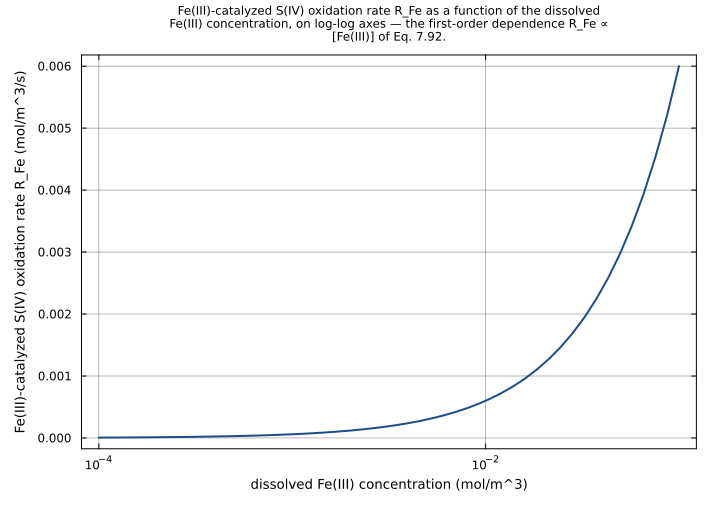
Sweep the dissolved Fe(III) catalyst concentration over three orders of magnitude (1.0e-4 to 1.0e-1 mol/m^3, ~0.1 to 100 μM, logarithmically) with H_plus and S_IV_total at their defaults. The Fe(III)-catalyzed oxidation rate R_Fe = k·[Fe(III)]·[S(IV)]/[H+] is first-order in the catalyst, so it rises linearly with Fe_III — a straight line on log-log axes.
Time span: 0.0 → 1.0
Swept over: Fe_III
acidity_sweep
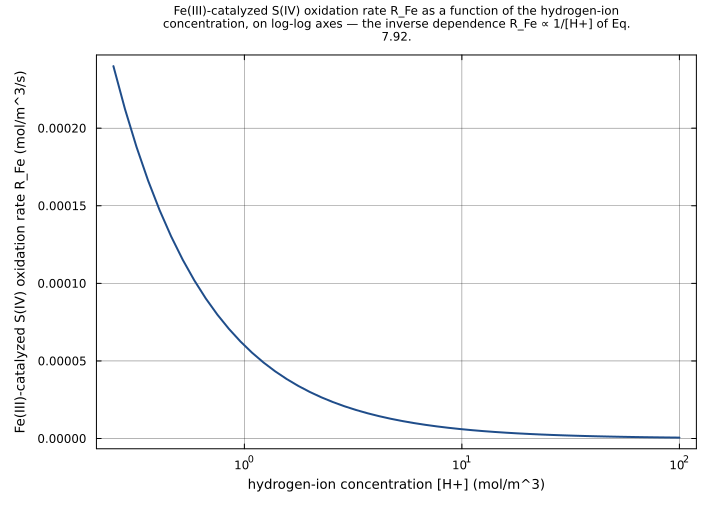
Sweep the hydrogen-ion concentration over the low-pH regime (0.25 to 100.0 mol/m^3, i.e. pH 3.6 down to pH 1.0, logarithmically) with Fe_III and S_IV_total at their defaults. R_Fe = k·[Fe(III)]·[S(IV)]/[H+] varies inversely with acidity, so it falls as 1/[H+] — a straight line of slope −1 on log-log axes.
Time span: 0.0 → 1.0
Swept over: H_plus
siv_concentration_sweep
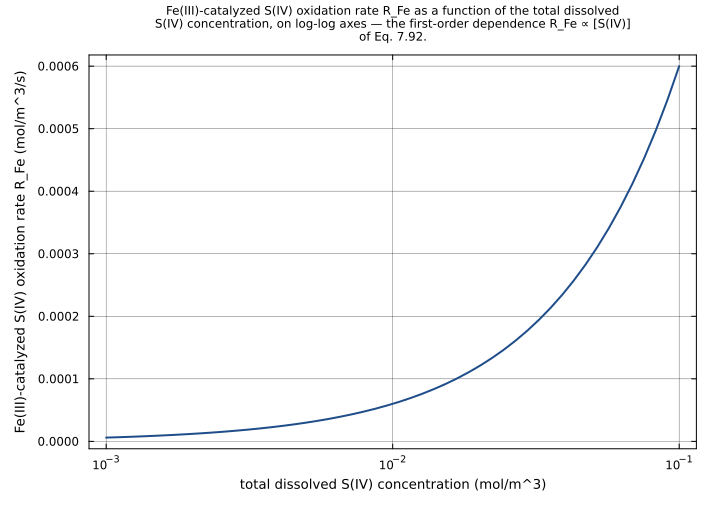
Sweep the total dissolved S(IV) substrate concentration over two orders of magnitude (1.0e-3 to 1.0e-1 mol/m^3, ~1 to 100 μM, logarithmically) with H_plus and Fe_III at their defaults. R_Fe = k·[Fe(III)]·[S(IV)]/[H+] is first-order in the substrate, so it rises linearly with S_IV_total — a straight line on log-log axes.
Time span: 0.0 → 1.0
Swept over: S_IV_total
Raw .esm
Raw .esm JSON (this component)
{
  "reference": {
    "citation": "Seinfeld, J. H., and Pandis, S. N. (2006). Atmospheric Chemistry and Physics: From Air Pollution to Climate Change, 2nd Edition, John Wiley & Sons, Chapter 7, Section 7.5.3. Fe(III)-catalyzed S(IV) oxidation, low-pH regime: Eq. 7.92.",
    "notes": "source_ref: Aerosol.jl@c8c640bb636b22f2425460e9ed5cba50793bfee1:src/sulfate_formation.jl:189\n\nUpstream `SulfateFormationFe` is an MTK `@component` with one `@constants` entry (k_low_pH, the low-pH Fe(III) rate constant), four time-indexed `@variables` (H_plus, Fe_III, S_IV_total, R_Fe), and a single equation:\n  • Eq. 7.92: R_Fe ~ k_low_pH * Fe_III * S_IV_total / H_plus — S(IV) oxidation rate by Fe(III)-catalyzed dissolved O2 in the low-pH (pH 0-3.6) regime.\nThe equation is algebraic (a plain `lhs ~ rhs` with no `D(·)` time derivative); the component has no differential state anywhere.\n\nScope (upstream simplification): Seinfeld & Pandis Section 7.5.3 gives four pH-regime rate laws for the Fe(III)-catalyzed pathway (Eq. 7.92 pH 0-3.6, Eq. 7.93 pH≈4, Eq. 7.94 pH 5-6, Eq. 7.95 pH 7). The upstream component deliberately implements only the low-pH law Eq. 7.92, \"most relevant for typical cloud droplet conditions\" per its docstring; this migration preserves that single-regime scope symbol-for-symbol. The default H_plus = 1.0 mol/m^3 (pH 3) is chosen inside the pH 0-3.6 validity window.\n\nObservability classification: observed-only. With no differential state, MTK `mtkcompile`/`structural_simplify` reduces the raw 4-unknown / 1-equation `System(eqs, t)` to zero ODE states plus the algebraically-recovered output R_Fe. R_Fe is therefore encoded as `type: observed`, carrying its defining relation in its `expression` field, and the `equations` array is empty — the post-`mtkcompile` representation, matching sibling observed-only migrations reaction.esm and aqueous_eq.esm.\n\nInput handling: H_plus, Fe_III and S_IV_total are upstream `@variables` that carry no defining equation — they are model inputs supplied by coupling within the full `SulfateFormation` system. The ESS schema has no \"connected input\" variable type, so each migrates as `type: parameter` with a fixed, physically-representative default — the convention applied across the migrated component set for connected `@variable` inputs. Re-typing the three inputs as parameters leaves R_Fe as a pure function of parameters, which is exactly the observed-only form above.\n\nConstant handling: the upstream `@constants k_low_pH = 6.0` migrates as a `type: parameter` with a fixed default — the ESS schema has no constant variable type, so every `@constant` becomes a fixed-default parameter. No unit conversion is applied: k_low_pH stays 6.0 s^-1 because the concentration ratio Fe_III·S_IV_total/H_plus carries a single net factor of 1000 between mol/L and mol/m^3 units, the same factor by which the rate R_Fe scales, so the rate constant is invariant under the concentration-unit choice. (Contrast the sibling O3/H2O2/Mn rate constants, which DO carry explicit /1000 or /1e6 factors in the source because their concentration products do not cancel a single power.)\n\nTests: the upstream test suite (test/aqueous_chemistry_test.jl, \"SulfateFormation structure\") exercises this component only structurally — it asserts `sys isa System` and `length(equations(sys)) >= 1`, with no numeric assertions on R_Fe. The seven inline tests below are therefore authored directly from the analytic formula R_Fe = k·[Fe(III)]·[S(IV)]/[H+], evaluated in float64 at the declared defaults or a single-parameter override. Because R_Fe is algebraic and time-independent, `default_conditions` asserts at both t=0 and t=1 to confirm time-invariance; the remaining tests assert at t=0. Coverage sweeps the catalyst (Fe_III ×10 / ×0.1), the substrate (S_IV_total ×10 / ×0.1), and the acidity (strongly/weakly acidic, spanning the pH 0-3.6 regime), confirming the proportionalities R_Fe ∝ [Fe(III)], R_Fe ∝ [S(IV)] and R_Fe ∝ 1/[H+] respectively.\n\nTolerance rationale (model-level rel=1e-9): observed-only algebraic system, no ODE integration. R_Fe is a three-factor product followed by a division; float64 round-off is ~1e-16 relative, so rel=1e-9 leaves seven orders of magnitude of headroom and absorbs any associativity difference in the n-ary product k·Fe·S_IV. The pinned expected values are the exact analytic results of the textbook formula, so the migration is checkable against Eq. 7.92, not merely against a prior solver run.\n\nUnit balance (verified):\n  R_Fe `k_low_pH * Fe_III * S_IV_total / H_plus`: s^-1 · (mol/m^3) · (mol/m^3) / (mol/m^3) = s^-1 · mol/m^3 = mol/(m^3·s) = mol/m^3/s\nSI throughout; no unit conversion at parse or runtime."
  },
  "tolerance": {
    "rel": 1e-09
  },
  "variables": {
    "k_low_pH": {
      "type": "parameter",
      "units": "s^-1",
      "default": 6.0,
      "description": "Rate constant for the Fe(III)-catalyzed S(IV) oxidation in the low-pH regime (pH 0-3.6), Seinfeld & Pandis (2006) Eq. 7.92. Carried as a fixed-default parameter because the ESS schema has no constant variable type; the upstream value is the MTK `@constant` k_low_pH = 6.0 s^-1."
    },
    "H_plus": {
      "type": "parameter",
      "units": "mol/m^3",
      "default": 1.0,
      "description": "Hydrogen ion concentration [H+] of the cloud/fog droplet aqueous phase. An upstream model input (an `@variable` with no defining equation) re-typed as a parameter on migration. The default 1.0 mol/m^3 corresponds to pH 3, mid-range of the pH 0-3.6 regime for which this low-pH rate law is valid."
    },
    "Fe_III": {
      "type": "parameter",
      "units": "mol/m^3",
      "default": 0.001,
      "description": "Dissolved Fe(III) concentration — the catalyst of the oxidation pathway. An upstream model input re-typed as a parameter on migration. The default 1.0e-3 mol/m^3 (1 μM) is a representative cloud-water dissolved-iron concentration."
    },
    "S_IV_total": {
      "type": "parameter",
      "units": "mol/m^3",
      "default": 0.01,
      "description": "Total dissolved S(IV) concentration (SO2·H2O + HSO3- + SO3^2-) — the substrate oxidized to S(VI). An upstream model input re-typed as a parameter on migration. The default 1.0e-2 mol/m^3 (10 μM) is a representative cloud-water S(IV) loading."
    },
    "R_Fe": {
      "type": "unknown",
      "units": "mol/m^3/s",
      "description": "S(IV) oxidation rate by Fe(III)-catalyzed dissolved O2 in the aqueous phase (Seinfeld & Pandis 2006, Eq. 7.92, low-pH regime): R_Fe = k·[Fe(III)]·[S(IV)]/[H+]. The rate rises in proportion to the dissolved-iron catalyst Fe_III and the total S(IV) substrate, and falls inversely with the hydrogen-ion concentration H_plus."
    }
  },
  "equations": [
    {
      "lhs": "R_Fe",
      "rhs": {
        "op": "/",
        "args": [
          {
            "op": "*",
            "args": [
              "k_low_pH",
              "Fe_III",
              "S_IV_total"
            ]
          },
          "H_plus"
        ]
      }
    }
  ],
  "tests": [
    {
      "id": "default_conditions",
      "description": "All parameters at their declared defaults: k_low_pH = 6.0 s^-1, H_plus = 1.0 mol/m^3 (pH 3), Fe_III = 1.0e-3 mol/m^3, S_IV_total = 1.0e-2 mol/m^3. The Fe(III)-catalyzed oxidation rate is R_Fe = k·[Fe(III)]·[S(IV)]/[H+] = 6.0·1.0e-3·1.0e-2/1.0 = 6.0e-5 mol/m^3/s. R_Fe is algebraic and time-independent, so the assertion is repeated at t=0 and t=1 to confirm time-invariance.",
      "time_span": {
        "start": 0.0,
        "end": 1.0
      },
      "assertions": [
        {
          "variable": "R_Fe",
          "time": 0.0,
          "expected": 6e-05
        },
        {
          "variable": "R_Fe",
          "time": 1.0,
          "expected": 6e-05
        }
      ]
    },
    {
      "id": "elevated_iron",
      "description": "Iron-rich droplet: Fe_III raised to 1.0e-2 mol/m^3 (10x the default, ~10 μM dissolved iron) with H_plus and S_IV_total at their defaults. R_Fe is first-order in the catalyst, so the rate rises 10x to R_Fe = 6.0·1.0e-2·1.0e-2/1.0 = 6.0e-4 mol/m^3/s. Confirms R_Fe ∝ [Fe(III)] (Eq. 7.92).",
      "parameter_overrides": {
        "Fe_III": 0.01
      },
      "time_span": {
        "start": 0.0,
        "end": 1.0
      },
      "assertions": [
        {
          "variable": "R_Fe",
          "time": 0.0,
          "expected": 0.0006
        }
      ]
    },
    {
      "id": "depleted_iron",
      "description": "Iron-poor droplet: Fe_III lowered to 1.0e-4 mol/m^3 (0.1x the default, ~0.1 μM dissolved iron) with H_plus and S_IV_total at their defaults. The rate falls 10x to R_Fe = 6.0·1.0e-4·1.0e-2/1.0 = 6.0e-6 mol/m^3/s. Mirror image of `elevated_iron`.",
      "parameter_overrides": {
        "Fe_III": 0.0001
      },
      "time_span": {
        "start": 0.0,
        "end": 1.0
      },
      "assertions": [
        {
          "variable": "R_Fe",
          "time": 0.0,
          "expected": 6e-06
        }
      ]
    },
    {
      "id": "elevated_siv",
      "description": "High S(IV) loading: S_IV_total raised to 1.0e-1 mol/m^3 (10x the default, ~100 μM total dissolved S(IV)) with H_plus and Fe_III at their defaults. R_Fe is first-order in the substrate, so the rate rises 10x to R_Fe = 6.0·1.0e-3·1.0e-1/1.0 = 6.0e-4 mol/m^3/s. Confirms R_Fe ∝ [S(IV)] (Eq. 7.92).",
      "parameter_overrides": {
        "S_IV_total": 0.1
      },
      "time_span": {
        "start": 0.0,
        "end": 1.0
      },
      "assertions": [
        {
          "variable": "R_Fe",
          "time": 0.0,
          "expected": 0.0006
        }
      ]
    },
    {
      "id": "depleted_siv",
      "description": "Low S(IV) loading: S_IV_total lowered to 1.0e-3 mol/m^3 (0.1x the default, ~1 μM total dissolved S(IV)) with H_plus and Fe_III at their defaults. The rate falls 10x to R_Fe = 6.0·1.0e-3·1.0e-3/1.0 = 6.0e-6 mol/m^3/s. Mirror image of `elevated_siv`.",
      "parameter_overrides": {
        "S_IV_total": 0.001
      },
      "time_span": {
        "start": 0.0,
        "end": 1.0
      },
      "assertions": [
        {
          "variable": "R_Fe",
          "time": 0.0,
          "expected": 6e-06
        }
      ]
    },
    {
      "id": "strongly_acidic",
      "description": "Strongly acidic droplet: H_plus raised to 10.0 mol/m^3 (pH 2.0, the acidic end of the pH 0-3.6 regime) with Fe_III and S_IV_total at their defaults. R_Fe varies inversely with acidity, so the rate falls 10x to R_Fe = 6.0·1.0e-3·1.0e-2/10.0 = 6.0e-6 mol/m^3/s. Confirms R_Fe ∝ 1/[H+] (Eq. 7.92).",
      "parameter_overrides": {
        "H_plus": 10.0
      },
      "time_span": {
        "start": 0.0,
        "end": 1.0
      },
      "assertions": [
        {
          "variable": "R_Fe",
          "time": 0.0,
          "expected": 6e-06
        }
      ]
    },
    {
      "id": "weakly_acidic",
      "description": "Weakly acidic droplet: H_plus lowered to 0.25 mol/m^3 (pH ≈ 3.6, the upper boundary of the pH 0-3.6 regime) with Fe_III and S_IV_total at their defaults. The smaller [H+] raises the rate to R_Fe = 6.0·1.0e-3·1.0e-2/0.25 = 2.4e-4 mol/m^3/s. Mirror image of `strongly_acidic`.",
      "parameter_overrides": {
        "H_plus": 0.25
      },
      "time_span": {
        "start": 0.0,
        "end": 1.0
      },
      "assertions": [
        {
          "variable": "R_Fe",
          "time": 0.0,
          "expected": 0.00024
        }
      ]
    }
  ],
  "analyses": [
    {
      "id": "iron_concentration_sweep",
      "description": "Sweep the dissolved Fe(III) catalyst concentration over three orders of magnitude (1.0e-4 to 1.0e-1 mol/m^3, ~0.1 to 100 μM, logarithmically) with H_plus and S_IV_total at their defaults. The Fe(III)-catalyzed oxidation rate R_Fe = k·[Fe(III)]·[S(IV)]/[H+] is first-order in the catalyst, so it rises linearly with Fe_III — a straight line on log-log axes.",
      "time_span": {
        "start": 0.0,
        "end": 1.0
      },
      "parameter_sweep": {
        "type": "cartesian",
        "dimensions": [
          {
            "parameter": "Fe_III",
            "range": {
              "start": 0.0001,
              "stop": 0.1,
              "count": 50,
              "scale": "log"
            }
          }
        ]
      },
      "plots": [
        {
          "id": "rate_vs_iron",
          "type": "line",
          "description": "Fe(III)-catalyzed S(IV) oxidation rate R_Fe as a function of the dissolved Fe(III) concentration, on log-log axes — the first-order dependence R_Fe ∝ [Fe(III)] of Eq. 7.92.",
          "x": {
            "variable": "Fe_III",
            "label": "dissolved Fe(III) concentration (mol/m^3)"
          },
          "y": {
            "variable": "R_Fe",
            "label": "Fe(III)-catalyzed S(IV) oxidation rate R_Fe (mol/m^3/s)"
          }
        }
      ]
    },
    {
      "id": "acidity_sweep",
      "description": "Sweep the hydrogen-ion concentration over the low-pH regime (0.25 to 100.0 mol/m^3, i.e. pH 3.6 down to pH 1.0, logarithmically) with Fe_III and S_IV_total at their defaults. R_Fe = k·[Fe(III)]·[S(IV)]/[H+] varies inversely with acidity, so it falls as 1/[H+] — a straight line of slope −1 on log-log axes.",
      "time_span": {
        "start": 0.0,
        "end": 1.0
      },
      "parameter_sweep": {
        "type": "cartesian",
        "dimensions": [
          {
            "parameter": "H_plus",
            "range": {
              "start": 0.25,
              "stop": 100.0,
              "count": 50,
              "scale": "log"
            }
          }
        ]
      },
      "plots": [
        {
          "id": "rate_vs_acidity",
          "type": "line",
          "description": "Fe(III)-catalyzed S(IV) oxidation rate R_Fe as a function of the hydrogen-ion concentration, on log-log axes — the inverse dependence R_Fe ∝ 1/[H+] of Eq. 7.92.",
          "x": {
            "variable": "H_plus",
            "label": "hydrogen-ion concentration [H+] (mol/m^3)"
          },
          "y": {
            "variable": "R_Fe",
            "label": "Fe(III)-catalyzed S(IV) oxidation rate R_Fe (mol/m^3/s)"
          }
        }
      ]
    },
    {
      "id": "siv_concentration_sweep",
      "description": "Sweep the total dissolved S(IV) substrate concentration over two orders of magnitude (1.0e-3 to 1.0e-1 mol/m^3, ~1 to 100 μM, logarithmically) with H_plus and Fe_III at their defaults. R_Fe = k·[Fe(III)]·[S(IV)]/[H+] is first-order in the substrate, so it rises linearly with S_IV_total — a straight line on log-log axes.",
      "time_span": {
        "start": 0.0,
        "end": 1.0
      },
      "parameter_sweep": {
        "type": "cartesian",
        "dimensions": [
          {
            "parameter": "S_IV_total",
            "range": {
              "start": 0.001,
              "stop": 0.1,
              "count": 50,
              "scale": "log"
            }
          }
        ]
      },
      "plots": [
        {
          "id": "rate_vs_siv",
          "type": "line",
          "description": "Fe(III)-catalyzed S(IV) oxidation rate R_Fe as a function of the total dissolved S(IV) concentration, on log-log axes — the first-order dependence R_Fe ∝ [S(IV)] of Eq. 7.92.",
          "x": {
            "variable": "S_IV_total",
            "label": "total dissolved S(IV) concentration (mol/m^3)"
          },
          "y": {
            "variable": "R_Fe",
            "label": "Fe(III)-catalyzed S(IV) oxidation rate R_Fe (mol/m^3/s)"
          }
        }
      ]
    }
  ]
}