NH4NO3Equilibrium
ModelingToolkit implementation of ammonium nitrate (NH4NO3) gas-aerosol equilibrium from Seinfeld & Pandis (2006), Atmospheric Chemistry and Physics, 2nd ed., Chapter 10, Section 10.4.3. NH4NO3 is a semi-volatile aerosol species whose gas-particle partitioning depends strongly on temperature and relative humidity. The component evaluates three temperature- and humidity-dependent quantities: the natural log of the solid-phase dissociation constant ln(Kp) for NH3(g) + HNO3(g) <-> NH4NO3(s) (Eq. 10.91), the deliquescence relative humidity DRH of NH4NO3 (Eq. 10.88), and a phase indicator that is 1 when the ambient RH exceeds the DRH (aqueous aerosol) and 0 otherwise (solid aerosol). Migrated from Aerosol.jl NH4NO3Equilibrium. Purely algebraic: no differential states, three observed outputs and an empty equations array.
Description
ModelingToolkit implementation of ammonium nitrate (NH4NO3) gas-aerosol equilibrium from Seinfeld & Pandis (2006), Atmospheric Chemistry and Physics, 2nd ed., Chapter 10, Section 10.4.3. NH4NO3 is a semi-volatile aerosol species whose gas-particle partitioning depends strongly on temperature and relative humidity. The component evaluates three temperature- and humidity-dependent quantities: the natural log of the solid-phase dissociation constant ln(Kp) for NH3(g) + HNO3(g) <-> NH4NO3(s) (Eq. 10.91), the deliquescence relative humidity DRH of NH4NO3 (Eq. 10.88), and a phase indicator that is 1 when the ambient RH exceeds the DRH (aqueous aerosol) and 0 otherwise (solid aerosol). Migrated from Aerosol.jl NH4NO3Equilibrium. Purely algebraic: no differential states, three observed outputs and an empty equations array.
Reference
Seinfeld, J. H., and Pandis, S. N. (2006). Atmospheric Chemistry and Physics: From Air Pollution to Climate Change, 2nd Edition, John Wiley & Sons, Chapter 10, Section 10.4.3. Solid NH4NO3 dissociation constant: Eq. 10.91; NH4NO3 deliquescence RH: Eq. 10.88.
_source_ref: Aerosol.jl@c8c640bb636b22f2425460e9ed5cba50793bfee1:src/seinfeld_pandis_ch10/nh4no3_equilibrium.jl:68
Upstream NH4NO3Equilibrium is a flat MTK @component – System(eqs, t; name) with no subsystems – implementing Seinfeld & Pandis (2006) Section 10.4.3, the ammonium-nitrate gas-aerosol equilibrium. It declares two scalar @parameters (T, temperature; RH, relative humidity 0-1), a six-entry @constants block (T_ref, c1_Kp, c2_Kp, c3_Kp, c1_DRH, c2_DRH), and three scalar @variables (ln_Kp, DRH_out, is_aqueous). The three equations are ln_Kp ~ c1_Kp - c2_Kp/T - c3_Kp*log(T/T_ref) (Eq. 10.91, the solid NH4NO3 dissociation constant Kp in ppb^2 units), DRH_out ~ exp(c1_DRH/T + c2_DRH)/100 (Eq. 10.88, the NH4NO3 deliquescence RH), and is_aqueous ~ ifelse(RH > DRH_out, 1, 0) (the phase indicator). They are kept in upstream order, which is already a valid topological order (ln_Kp and DRH_out depend only on parameters; is_aqueous consumes DRH_out).
Observed classification: ln_Kp, DRH_out and is_aqueous are all algebraic outputs (plain lhs ~ rhs; no time derivative anywhere in the component). After MTK structural_simplify / mtkcompile the compiled system has zero ODE states and all three become observed quantities. They are therefore serialized as type: observed carrying an expression (not type: state with an equation), and the equations array is empty – matching the sibling purely-algebraic Aerosol.jl migrations zsr.esm and critical_ssa.esm. The is_aqueous observed references the DRH_out observed inside its ifelse condition; the observed set is a small DAG resolved DRH_out -> is_aqueous.
Constants. The upstream @constants block (T_ref, c1_Kp, c2_Kp, c3_Kp, c1_DRH, c2_DRH) migrates as fixed-default parameters: the ESM schema has no constant variable type, so every @constant becomes a parameter carrying its numeric value as default. None of the six constant names, nor the two genuine @parameters (T, RH), collides with the schema’s reserved physical-constant names (R, k_B, N_A).
Inputs. T and RH are the two upstream @parameters and migrate as parameters; their migrated defaults (T = 298 K, RH = 0.5) are the upstream @parameters defaults verbatim.
Units. ln_Kp is the natural log of a constant expressed in ppb^2 units and so is dimensionless (upstream unit = u"1"); DRH_out and is_aqueous are likewise dimensionless. ESM units fields are descriptive only – the runners perform no dimensional analysis – so the mixed-unit form of Eq. 10.91 (a dimensionless 84.6, a K-valued 24220 divided by T, and a dimensionless log term) carries through as written.
Not migrated. The file-level helpers nh4no3_Kp, nh4no3_K_AN, ionic_strength_fraction, equilibrium_constant_temperature and get_equilibrium_constant, and the EQUILIBRIUM_CONSTANTS Table-10.7 dictionary, are plain Julia functions and data – not MTK components – and are out of scope for this component migration (the migration target is the @component at nh4no3_equilibrium.jl:68). The component docstring’s “Variables” section additionally lists Kp, K_AN and Y, but the implemented @variables block declares only ln_Kp, DRH_out and is_aqueous; only the three implemented variables are migrated.
Phase boundary. is_aqueous is a step function of the strict inequality RH > DRH_out. Its value (exactly 0 or 1, the ifelse literals) is robust, but the branch taken is sensitive to round-off when RH lands within a few ULP of DRH_out. Every test and example holds RH a comfortable margin (>= 0.06) away from the DRH curve, so both conforming runners select the same branch.
Tolerance rationale (model-level rel=1e-8): a closed-form explicit algebraic system – one log, one exp, a few divisions and a comparison. The expected values are the Float64 evaluation of Eqs. 10.88 and 10.91; rel=1e-8 absorbs last-ULP round-off in log/exp, eight orders of magnitude above the ~1e-16 relative agreement expected between conforming runners. The is_aqueous = 0 assertions additionally carry a tight per-assertion abs=1e-12 because the relative check alone is ill-conditioned at expected = 0._
Parameters
| Name | Units | Default | Description |
|---|---|---|---|
T | K | 298.0 | Air temperature. Drives both the Eq. 10.91 dissociation constant and the Eq. 10.88 deliquescence RH. |
RH | 1 | 0.5 | Relative humidity, expressed as a fraction in [0, 1]. Compared against the deliquescence RH to set the aerosol phase. |
T_ref | K | 298.0 | Reference temperature for the log(T/T_ref) term of Eq. 10.91 (upstream @constant). |
c1_Kp | 1 | 84.6 | Constant term of the Eq. 10.91 ln(Kp) expression (upstream @constant). |
c2_Kp | K | 24220.0 | Temperature coefficient of the 1/T term in Eq. 10.91 (upstream @constant). |
c3_Kp | 1 | 6.1 | Coefficient of the log(T/T_ref) term in Eq. 10.91 (upstream @constant). |
c1_DRH | K | 723.7 | Temperature coefficient of the 1/T term in the Eq. 10.88 deliquescence-RH expression (upstream @constant). |
c2_DRH | 1 | 1.6954 | Constant term of the Eq. 10.88 deliquescence-RH expression (upstream @constant). |
Observed
| Name | Units | Default | Description |
|---|---|---|---|
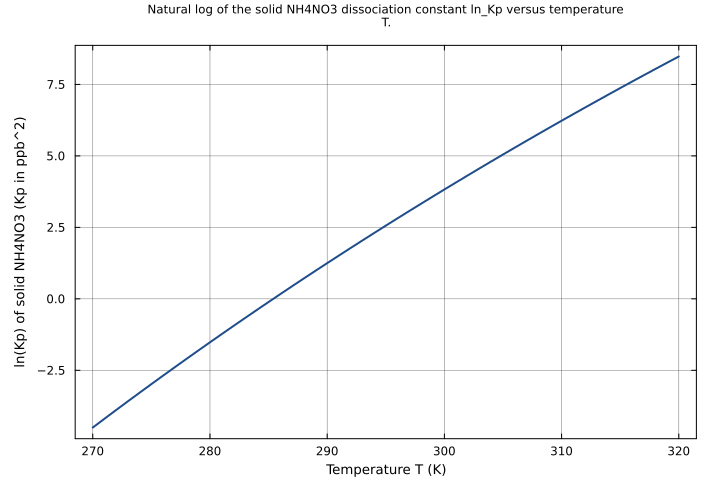
ln_Kp | 1 | Natural log of the solid-phase NH4NO3 dissociation constant Kp (Kp in ppb^2; equilibrium NH3(g) + HNO3(g) <-> NH4NO3(s), Eq. 10.91). Rises strongly with temperature. | |
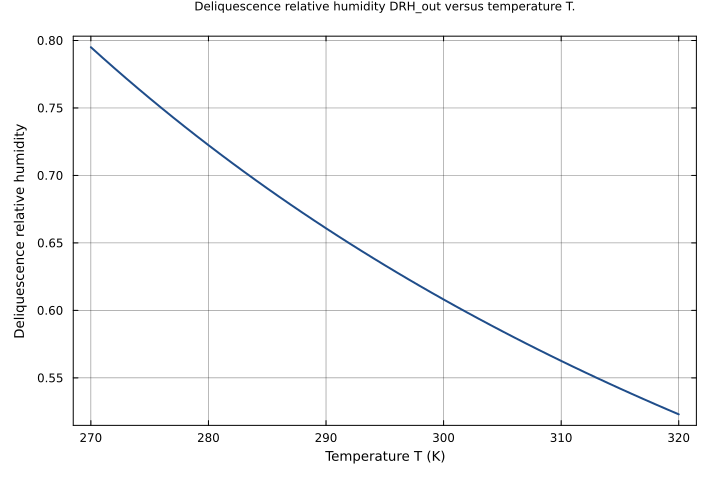
DRH_out | 1 | Deliquescence relative humidity of NH4NO3 – the RH at which solid NH4NO3 takes up water and dissolves into an aqueous solution (Eq. 10.88). Falls with temperature. | |
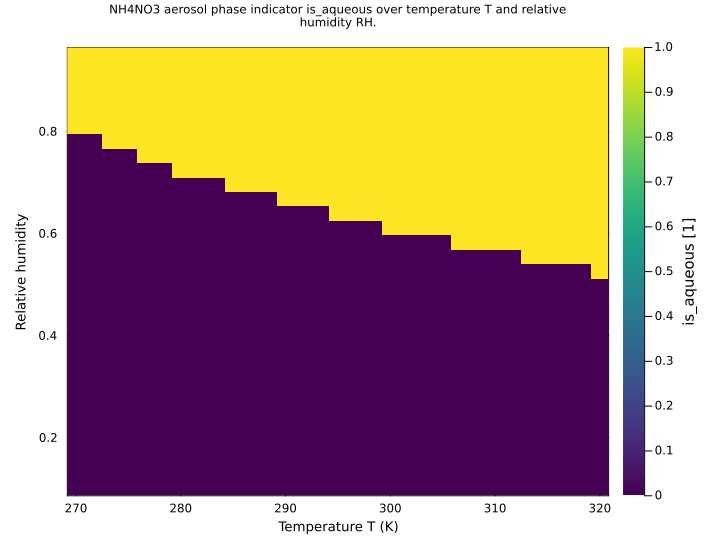
is_aqueous | 1 | Phase indicator: 1 when the ambient RH exceeds the deliquescence RH (aqueous aerosol), 0 otherwise (solid aerosol). |
Observed expressions
$$ ln_{Kp} = c1_{Kp} - \frac{c2_{Kp}}{T} - c3_{Kp} \cdot \ln\left(\frac{T}{T_{ref}}\right) $$Natural log of the solid-phase NH4NO3 dissociation constant Kp (Kp in ppb^2; equilibrium NH3(g) + HNO3(g) <-> NH4NO3(s), Eq. 10.91). Rises strongly with temperature.
$$ DRH_{out} = \frac{e^{\frac{c1_{DRH}}{T} + c2_{DRH}}}{100.0} $$Deliquescence relative humidity of NH4NO3 – the RH at which solid NH4NO3 takes up water and dissolves into an aqueous solution (Eq. 10.88). Falls with temperature.
$$ is_{aqueous} = \mathrm{ifelse}\left(\mathrm{>}\left(RH, DRH_{out}\right), 1.0, 0.0\right) $$Phase indicator: 1 when the ambient RH exceeds the deliquescence RH (aqueous aerosol), 0 otherwise (solid aerosol).
Analyses
dissociation_constant_vs_temperature
Log of the solid NH4NO3 dissociation constant as a function of temperature (Eq. 10.91). Sweeping T from 270 to 320 K traces the steep rise of ln_Kp – the equilibrium NH3(g) + HNO3(g) <-> NH4NO3(s) shifts strongly toward the gas phase as the air warms. RH is fixed at the default 0.5 and does not enter Eq. 10.91.
Time span: 0.0 → 1.0
Swept over: T
deliquescence_rh_vs_temperature
Deliquescence relative humidity of NH4NO3 as a function of temperature (Eq. 10.88). Sweeping T from 270 to 320 K shows DRH_out falling monotonically – warmer air lowers the RH threshold at which solid NH4NO3 deliquesces into an aqueous droplet.
Time span: 0.0 → 1.0
Swept over: T
phase_diagram
NH4NO3 aerosol phase over the temperature-humidity plane. The is_aqueous indicator is evaluated on a Cartesian grid of T (270-320 K) and RH (0.1-0.95); the heatmap renders the deliquescence boundary of Eq. 10.88 – aqueous (is_aqueous = 1) above the falling DRH_out(T) curve, solid (is_aqueous = 0) below it.
Time span: 0.0 → 1.0
Swept over: T, RH
Raw .esm
Raw .esm JSON (this component)
{
  "reference": {
    "citation": "Seinfeld, J. H., and Pandis, S. N. (2006). Atmospheric Chemistry and Physics: From Air Pollution to Climate Change, 2nd Edition, John Wiley & Sons, Chapter 10, Section 10.4.3. Solid NH4NO3 dissociation constant: Eq. 10.91; NH4NO3 deliquescence RH: Eq. 10.88.",
    "notes": "source_ref: Aerosol.jl@c8c640bb636b22f2425460e9ed5cba50793bfee1:src/seinfeld_pandis_ch10/nh4no3_equilibrium.jl:68\n\nUpstream `NH4NO3Equilibrium` is a flat MTK `@component` -- `System(eqs, t; name)` with no subsystems -- implementing Seinfeld & Pandis (2006) Section 10.4.3, the ammonium-nitrate gas-aerosol equilibrium. It declares two scalar `@parameters` (T, temperature; RH, relative humidity 0-1), a six-entry `@constants` block (T_ref, c1_Kp, c2_Kp, c3_Kp, c1_DRH, c2_DRH), and three scalar `@variables` (ln_Kp, DRH_out, is_aqueous). The three equations are ln_Kp ~ c1_Kp - c2_Kp/T - c3_Kp*log(T/T_ref) (Eq. 10.91, the solid NH4NO3 dissociation constant Kp in ppb^2 units), DRH_out ~ exp(c1_DRH/T + c2_DRH)/100 (Eq. 10.88, the NH4NO3 deliquescence RH), and is_aqueous ~ ifelse(RH > DRH_out, 1, 0) (the phase indicator). They are kept in upstream order, which is already a valid topological order (ln_Kp and DRH_out depend only on parameters; is_aqueous consumes DRH_out).\n\nObserved classification: ln_Kp, DRH_out and is_aqueous are all algebraic outputs (plain `lhs ~ rhs`; no time derivative anywhere in the component). After MTK structural_simplify / mtkcompile the compiled system has zero ODE states and all three become observed quantities. They are therefore serialized as `type: observed` carrying an `expression` (not `type: state` with an equation), and the `equations` array is empty -- matching the sibling purely-algebraic Aerosol.jl migrations zsr.esm and critical_ssa.esm. The is_aqueous observed references the DRH_out observed inside its ifelse condition; the observed set is a small DAG resolved DRH_out -> is_aqueous.\n\nConstants. The upstream `@constants` block (T_ref, c1_Kp, c2_Kp, c3_Kp, c1_DRH, c2_DRH) migrates as fixed-default `parameter`s: the ESM schema has no `constant` variable type, so every `@constant` becomes a parameter carrying its numeric value as `default`. None of the six constant names, nor the two genuine `@parameters` (T, RH), collides with the schema's reserved physical-constant names (R, k_B, N_A).\n\nInputs. T and RH are the two upstream `@parameters` and migrate as parameters; their migrated defaults (T = 298 K, RH = 0.5) are the upstream `@parameters` defaults verbatim.\n\nUnits. ln_Kp is the natural log of a constant expressed in ppb^2 units and so is dimensionless (upstream `unit = u\"1\"`); DRH_out and is_aqueous are likewise dimensionless. ESM `units` fields are descriptive only -- the runners perform no dimensional analysis -- so the mixed-unit form of Eq. 10.91 (a dimensionless 84.6, a K-valued 24220 divided by T, and a dimensionless log term) carries through as written.\n\nNot migrated. The file-level helpers `nh4no3_Kp`, `nh4no3_K_AN`, `ionic_strength_fraction`, `equilibrium_constant_temperature` and `get_equilibrium_constant`, and the `EQUILIBRIUM_CONSTANTS` Table-10.7 dictionary, are plain Julia functions and data -- not MTK components -- and are out of scope for this component migration (the migration target is the `@component` at nh4no3_equilibrium.jl:68). The component docstring's \"Variables\" section additionally lists Kp, K_AN and Y, but the implemented `@variables` block declares only ln_Kp, DRH_out and is_aqueous; only the three implemented variables are migrated.\n\nPhase boundary. is_aqueous is a step function of the strict inequality RH > DRH_out. Its value (exactly 0 or 1, the ifelse literals) is robust, but the branch taken is sensitive to round-off when RH lands within a few ULP of DRH_out. Every test and example holds RH a comfortable margin (>= 0.06) away from the DRH curve, so both conforming runners select the same branch.\n\nTolerance rationale (model-level rel=1e-8): a closed-form explicit algebraic system -- one log, one exp, a few divisions and a comparison. The expected values are the Float64 evaluation of Eqs. 10.88 and 10.91; rel=1e-8 absorbs last-ULP round-off in log/exp, eight orders of magnitude above the ~1e-16 relative agreement expected between conforming runners. The is_aqueous = 0 assertions additionally carry a tight per-assertion abs=1e-12 because the relative check alone is ill-conditioned at expected = 0."
  },
  "tolerance": {
    "rel": 1e-08
  },
  "variables": {
    "T": {
      "type": "parameter",
      "units": "K",
      "default": 298.0,
      "description": "Air temperature. Drives both the Eq. 10.91 dissociation constant and the Eq. 10.88 deliquescence RH."
    },
    "RH": {
      "type": "parameter",
      "units": "1",
      "default": 0.5,
      "description": "Relative humidity, expressed as a fraction in [0, 1]. Compared against the deliquescence RH to set the aerosol phase."
    },
    "T_ref": {
      "type": "parameter",
      "units": "K",
      "default": 298.0,
      "description": "Reference temperature for the log(T/T_ref) term of Eq. 10.91 (upstream @constant)."
    },
    "c1_Kp": {
      "type": "parameter",
      "units": "1",
      "default": 84.6,
      "description": "Constant term of the Eq. 10.91 ln(Kp) expression (upstream @constant)."
    },
    "c2_Kp": {
      "type": "parameter",
      "units": "K",
      "default": 24220.0,
      "description": "Temperature coefficient of the 1/T term in Eq. 10.91 (upstream @constant)."
    },
    "c3_Kp": {
      "type": "parameter",
      "units": "1",
      "default": 6.1,
      "description": "Coefficient of the log(T/T_ref) term in Eq. 10.91 (upstream @constant)."
    },
    "c1_DRH": {
      "type": "parameter",
      "units": "K",
      "default": 723.7,
      "description": "Temperature coefficient of the 1/T term in the Eq. 10.88 deliquescence-RH expression (upstream @constant)."
    },
    "c2_DRH": {
      "type": "parameter",
      "units": "1",
      "default": 1.6954,
      "description": "Constant term of the Eq. 10.88 deliquescence-RH expression (upstream @constant)."
    },
    "ln_Kp": {
      "type": "unknown",
      "units": "1",
      "description": "Natural log of the solid-phase NH4NO3 dissociation constant Kp (Kp in ppb^2; equilibrium NH3(g) + HNO3(g) <-> NH4NO3(s), Eq. 10.91). Rises strongly with temperature."
    },
    "DRH_out": {
      "type": "unknown",
      "units": "1",
      "description": "Deliquescence relative humidity of NH4NO3 -- the RH at which solid NH4NO3 takes up water and dissolves into an aqueous solution (Eq. 10.88). Falls with temperature."
    },
    "is_aqueous": {
      "type": "unknown",
      "units": "1",
      "description": "Phase indicator: 1 when the ambient RH exceeds the deliquescence RH (aqueous aerosol), 0 otherwise (solid aerosol)."
    }
  },
  "equations": [
    {
      "lhs": "ln_Kp",
      "rhs": {
        "op": "-",
        "args": [
          {
            "op": "-",
            "args": [
              "c1_Kp",
              {
                "op": "/",
                "args": [
                  "c2_Kp",
                  "T"
                ]
              }
            ]
          },
          {
            "op": "*",
            "args": [
              "c3_Kp",
              {
                "op": "log",
                "args": [
                  {
                    "op": "/",
                    "args": [
                      "T",
                      "T_ref"
                    ]
                  }
                ]
              }
            ]
          }
        ]
      }
    },
    {
      "lhs": "DRH_out",
      "rhs": {
        "op": "/",
        "args": [
          {
            "op": "exp",
            "args": [
              {
                "op": "+",
                "args": [
                  {
                    "op": "/",
                    "args": [
                      "c1_DRH",
                      "T"
                    ]
                  },
                  "c2_DRH"
                ]
              }
            ]
          },
          100.0
        ]
      }
    },
    {
      "lhs": "is_aqueous",
      "rhs": {
        "op": "ifelse",
        "args": [
          {
            "op": ">",
            "args": [
              "RH",
              "DRH_out"
            ]
          },
          1.0,
          0.0
        ]
      }
    }
  ],
  "tests": [
    {
      "id": "default_298K_solid",
      "description": "Upstream default parameterization: T = 298 K, RH = 0.5. Anchors Eq. 10.91 -- at T = T_ref the log term vanishes, so ln_Kp = 84.6 - 24220/298 = 3.3248 (the upstream NH4NO3-Equilibrium-Constants testitem checks ln_Kp(298) ~ 3.32) -- and Eq. 10.88, DRH_out = exp(723.7/298 + 1.6954)/100 = 0.6180 (upstream checks nh4no3_drh(298) ~ 0.618). With RH = 0.5 below the 0.618 deliquescence RH the aerosol is solid, is_aqueous = 0. All three outputs are algebraic and time-invariant, so ln_Kp and is_aqueous are re-checked at t = 1.",
      "parameter_overrides": {},
      "time_span": {
        "start": 0.0,
        "end": 1.0
      },
      "assertions": [
        {
          "variable": "ln_Kp",
          "time": 0.0,
          "expected": 3.3248322147650953
        },
        {
          "variable": "DRH_out",
          "time": 0.0,
          "expected": 0.6180124376651474
        },
        {
          "variable": "is_aqueous",
          "time": 0.0,
          "expected": 0.0,
          "tolerance": {
            "abs": 1e-12
          }
        },
        {
          "variable": "ln_Kp",
          "time": 1.0,
          "expected": 3.3248322147650953
        },
        {
          "variable": "is_aqueous",
          "time": 1.0,
          "expected": 0.0,
          "tolerance": {
            "abs": 1e-12
          }
        }
      ]
    },
    {
      "id": "warm_310K",
      "description": "Warm air, T = 310 K. The Eq. 10.91 dissociation constant rises strongly with temperature -- ln_Kp climbs from the 298 K value of 3.32 to 6.23 -- while the Eq. 10.88 deliquescence RH falls from 0.618 to 0.563. With RH = 0.5 still below DRH_out the aerosol remains solid (is_aqueous = 0).",
      "parameter_overrides": {
        "T": 310.0,
        "RH": 0.5
      },
      "time_span": {
        "start": 0.0,
        "end": 1.0
      },
      "assertions": [
        {
          "variable": "ln_Kp",
          "time": 0.0,
          "expected": 6.230146994995379
        },
        {
          "variable": "DRH_out",
          "time": 0.0,
          "expected": 0.5625619278792913
        },
        {
          "variable": "is_aqueous",
          "time": 0.0,
          "expected": 0.0,
          "tolerance": {
            "abs": 1e-12
          }
        }
      ]
    },
    {
      "id": "cold_280K",
      "description": "Cold air, T = 280 K. The Eq. 10.91 dissociation constant drops sharply -- ln_Kp goes negative (-1.52), i.e. Kp < 1 ppb^2, so NH4NO3 is far more stable as a solid than at 298 K -- and the Eq. 10.88 deliquescence RH rises to 0.722. RH = 0.5 stays well below DRH_out, so is_aqueous = 0.",
      "parameter_overrides": {
        "T": 280.0,
        "RH": 0.5
      },
      "time_span": {
        "start": 0.0,
        "end": 1.0
      },
      "assertions": [
        {
          "variable": "ln_Kp",
          "time": 0.0,
          "expected": -1.519946311649461
        },
        {
          "variable": "DRH_out",
          "time": 0.0,
          "expected": 0.7224353609252703
        },
        {
          "variable": "is_aqueous",
          "time": 0.0,
          "expected": 0.0,
          "tolerance": {
            "abs": 1e-12
          }
        }
      ]
    },
    {
      "id": "aqueous_phase_high_rh",
      "description": "Phase determination above the deliquescence point: T = 298 K, RH = 0.8. ln_Kp and DRH_out are unchanged from the default case (they depend only on T), but RH = 0.8 now exceeds the 0.618 deliquescence RH, so the NH4NO3 aerosol is aqueous and is_aqueous = 1.",
      "parameter_overrides": {
        "T": 298.0,
        "RH": 0.8
      },
      "time_span": {
        "start": 0.0,
        "end": 1.0
      },
      "assertions": [
        {
          "variable": "ln_Kp",
          "time": 0.0,
          "expected": 3.3248322147650953
        },
        {
          "variable": "DRH_out",
          "time": 0.0,
          "expected": 0.6180124376651474
        },
        {
          "variable": "is_aqueous",
          "time": 0.0,
          "expected": 1.0
        }
      ]
    },
    {
      "id": "solid_phase_low_rh",
      "description": "Phase determination well below the deliquescence point: T = 298 K, RH = 0.3. With RH far under the 0.618 deliquescence RH the aerosol is solid and is_aqueous = 0 -- the dry counterpart of aqueous_phase_high_rh at the same temperature.",
      "parameter_overrides": {
        "T": 298.0,
        "RH": 0.3
      },
      "time_span": {
        "start": 0.0,
        "end": 1.0
      },
      "assertions": [
        {
          "variable": "ln_Kp",
          "time": 0.0,
          "expected": 3.3248322147650953
        },
        {
          "variable": "DRH_out",
          "time": 0.0,
          "expected": 0.6180124376651474
        },
        {
          "variable": "is_aqueous",
          "time": 0.0,
          "expected": 0.0,
          "tolerance": {
            "abs": 1e-12
          }
        }
      ]
    },
    {
      "id": "warm_aqueous_320K",
      "description": "Combined warm-and-humid case, T = 320 K, RH = 0.7. ln_Kp reaches 8.48 (Eq. 10.91) and the deliquescence RH drops to 0.523 (Eq. 10.88); because warming lowers DRH_out, RH = 0.7 now sits above it and the aerosol is aqueous (is_aqueous = 1) -- the same RH that would be solid at a colder temperature.",
      "parameter_overrides": {
        "T": 320.0,
        "RH": 0.7
      },
      "time_span": {
        "start": 0.0,
        "end": 1.0
      },
      "assertions": [
        {
          "variable": "ln_Kp",
          "time": 0.0,
          "expected": 8.47801219334095
        },
        {
          "variable": "DRH_out",
          "time": 0.0,
          "expected": 0.5229822857299338
        },
        {
          "variable": "is_aqueous",
          "time": 0.0,
          "expected": 1.0
        }
      ]
    }
  ],
  "analyses": [
    {
      "id": "dissociation_constant_vs_temperature",
      "description": "Log of the solid NH4NO3 dissociation constant as a function of temperature (Eq. 10.91). Sweeping T from 270 to 320 K traces the steep rise of ln_Kp -- the equilibrium NH3(g) + HNO3(g) <-> NH4NO3(s) shifts strongly toward the gas phase as the air warms. RH is fixed at the default 0.5 and does not enter Eq. 10.91.",
      "parameters": {
        "RH": 0.5
      },
      "time_span": {
        "start": 0.0,
        "end": 1.0
      },
      "parameter_sweep": {
        "type": "cartesian",
        "dimensions": [
          {
            "parameter": "T",
            "range": {
              "start": 270.0,
              "stop": 320.0,
              "count": 51,
              "scale": "linear"
            }
          }
        ]
      },
      "plots": [
        {
          "id": "ln_kp_vs_T",
          "type": "line",
          "description": "Natural log of the solid NH4NO3 dissociation constant ln_Kp versus temperature T.",
          "x": {
            "variable": "T",
            "label": "Temperature T (K)"
          },
          "y": {
            "variable": "ln_Kp",
            "label": "ln(Kp) of solid NH4NO3 (Kp in ppb^2)"
          }
        }
      ]
    },
    {
      "id": "deliquescence_rh_vs_temperature",
      "description": "Deliquescence relative humidity of NH4NO3 as a function of temperature (Eq. 10.88). Sweeping T from 270 to 320 K shows DRH_out falling monotonically -- warmer air lowers the RH threshold at which solid NH4NO3 deliquesces into an aqueous droplet.",
      "parameters": {
        "RH": 0.5
      },
      "time_span": {
        "start": 0.0,
        "end": 1.0
      },
      "parameter_sweep": {
        "type": "cartesian",
        "dimensions": [
          {
            "parameter": "T",
            "range": {
              "start": 270.0,
              "stop": 320.0,
              "count": 51,
              "scale": "linear"
            }
          }
        ]
      },
      "plots": [
        {
          "id": "drh_vs_T",
          "type": "line",
          "description": "Deliquescence relative humidity DRH_out versus temperature T.",
          "x": {
            "variable": "T",
            "label": "Temperature T (K)"
          },
          "y": {
            "variable": "DRH_out",
            "label": "Deliquescence relative humidity"
          }
        }
      ]
    },
    {
      "id": "phase_diagram",
      "description": "NH4NO3 aerosol phase over the temperature-humidity plane. The is_aqueous indicator is evaluated on a Cartesian grid of T (270-320 K) and RH (0.1-0.95); the heatmap renders the deliquescence boundary of Eq. 10.88 -- aqueous (is_aqueous = 1) above the falling DRH_out(T) curve, solid (is_aqueous = 0) below it.",
      "time_span": {
        "start": 0.0,
        "end": 1.0
      },
      "parameter_sweep": {
        "type": "cartesian",
        "dimensions": [
          {
            "parameter": "T",
            "range": {
              "start": 270.0,
              "stop": 320.0,
              "count": 31,
              "scale": "linear"
            }
          },
          {
            "parameter": "RH",
            "range": {
              "start": 0.1,
              "stop": 0.95,
              "count": 31,
              "scale": "linear"
            }
          }
        ]
      },
      "plots": [
        {
          "id": "phase_heatmap",
          "type": "heatmap",
          "description": "NH4NO3 aerosol phase indicator is_aqueous over temperature T and relative humidity RH.",
          "x": {
            "variable": "T",
            "label": "Temperature T (K)"
          },
          "y": {
            "variable": "RH",
            "label": "Relative humidity"
          },
          "value": {
            "variable": "is_aqueous",
            "reduce": "final"
          }
        }
      ]
    }
  ]
}