AerosolLayerRadiativeForcing
Aerosol layer radiative forcing from two-stream scattering-absorbing model — Seinfeld & Pandis (2006) Ch. 24 §24.1, Eqs. 24.1–24.10.
Description
Aerosol layer radiative forcing from two-stream scattering-absorbing model — Seinfeld & Pandis (2006) Ch. 24 §24.1, Eqs. 24.1–24.10.
Reference
Seinfeld, J. H., and Pandis, S. N. (2006). Atmospheric Chemistry and Physics: From Air Pollution to Climate Change, 2nd Edition, Chapter 24, Section 24.1, Equations 24.1–24.10.
_source_ref: Aerosol.jl@c8c640bb:src/aerosol_radiative_forcing.jl:36 Two-stream scattering-absorbing aerosol layer model. Five algebraic equations in a causal chain: r_aer (Eq. 24.1 auxiliary — fraction reflected upward) and t_aer (Eq. 24.1 — fraction transmitted downward) are computed from τ, ω, β; R_as (Eq. 24.5 — total aerosol-surface reflectance) follows from r_aer, t_aer, R_s; ΔR_p (Eq. 24.9 — change in planetary albedo) scales R_as−R_s by the clear-sky fraction and atmospheric transmittance; ΔF (Eq. 24.10 — change in radiative flux) multiplies ΔR_p by F_0. MTK structural_simplify eliminates all five variables to observed algebraic bindings (zero ODE states). The conservation identity r_aer + t_aer = exp(−τ) + ω·(1−exp(−τ)) reduces to exactly 1 for ω=1 (nonabsorbing aerosol). Sign convention: ΔF > 0 means cooling (increased outgoing flux); ΔF < 0 means heating (reduced outgoing flux — absorbing aerosol with ω < ω_crit).
Tolerance rationale (model-level rel=1e-8 / abs=1e-12): the five-step algebraic chain involves exp(−τ), a square (t_aer²), and one division; float64 roundoff accumulates at most ~5–10×ε₆₄ across the chain. rel=1e-8 sits safely above this floor while remaining tight enough to catch formula errors. abs=1e-12 floors the near-zero limit at τ→0 where r_aer→0 and ΔF→0._
Parameters
| Name | Units | Default | Description |
|---|---|---|---|
F_0 | W/m^2 | 1370.0 | Incident solar flux |
τ | 1 | 0.1 | Aerosol optical depth (dimensionless) |
ω | 1 | 0.95 | Single-scattering albedo (dimensionless) |
β | 1 | 0.29 | Upscatter fraction (dimensionless) |
R_s | 1 | 0.15 | Surface albedo (dimensionless) |
A_c | 1 | 0.6 | Cloud fraction (dimensionless) |
T_a | 1 | 0.76 | Atmospheric transmittance (dimensionless) |
Observed
| Name | Units | Default | Description |
|---|---|---|---|
r_aer | 1 | Fraction of light reflected upward by aerosol layer, r_aer = (1 − exp(−τ))·ω·β — Eq. 24.1 auxiliary. | |
t_aer | 1 | Fraction of light transmitted downward through aerosol layer, t_aer = exp(−τ) + ω·(1−β)·(1−exp(−τ)) — Eq. 24.1. | |
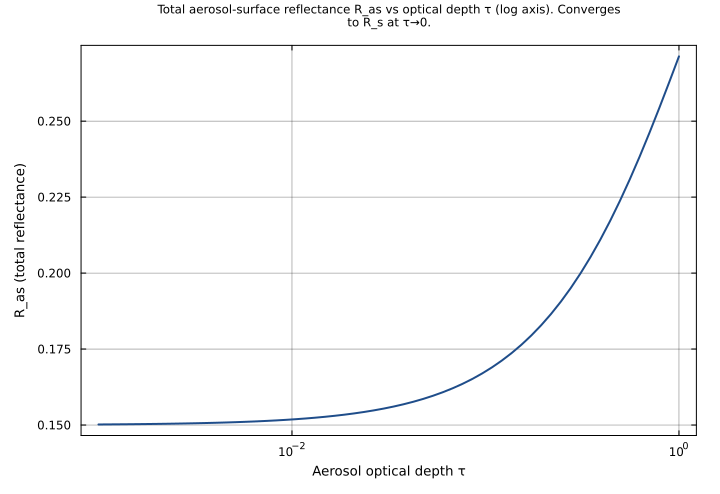
R_as | 1 | Total reflectance of the aerosol-surface system, R_as = r_aer + t_aer²·R_s / (1 − R_s·r_aer) — Eq. 24.5. | |
ΔR_p | 1 | Change in planetary albedo due to the aerosol layer, ΔR_p = (1−A_c)·T_a²·(R_as−R_s) — Eq. 24.9. | |
ΔF | W/m^2 | Change in outgoing radiative flux due to the aerosol layer, ΔF = F_0·ΔR_p — Eq. 24.10. Positive = cooling (more reflection); negative = heating (absorption dominates). |
Observed expressions
$$ r_{aer} = \left(1 + \left(-1\right) \cdot e^{\left(-1\right) \cdot τ}\right) \cdot ω \cdot β $$Fraction of light reflected upward by aerosol layer, r_aer = (1 − exp(−τ))·ω·β — Eq. 24.1 auxiliary.
$$ t_{aer} = e^{\left(-1\right) \cdot τ} + ω \cdot \left(1 + \left(-1\right) \cdot β\right) \cdot \left(1 + \left(-1\right) \cdot e^{\left(-1\right) \cdot τ}\right) $$Fraction of light transmitted downward through aerosol layer, t_aer = exp(−τ) + ω·(1−β)·(1−exp(−τ)) — Eq. 24.1.
$$ R_{as} = r_{aer} + \frac{t_{aer}^{2} \cdot R_{s}}{1 + \left(-1\right) \cdot R_{s} \cdot r_{aer}} $$Total reflectance of the aerosol-surface system, R_as = r_aer + t_aer²·R_s / (1 − R_s·r_aer) — Eq. 24.5.
$$ ΔR_{p} = \left(1 + \left(-1\right) \cdot A_{c}\right) \cdot T_{a}^{2} \cdot \left(R_{as} + \left(-1\right) \cdot R_{s}\right) $$Change in planetary albedo due to the aerosol layer, ΔR_p = (1−A_c)·T_a²·(R_as−R_s) — Eq. 24.9.
$$ ΔF = F_{0} \cdot ΔR_{p} $$Change in outgoing radiative flux due to the aerosol layer, ΔF = F_0·ΔR_p — Eq. 24.10. Positive = cooling (more reflection); negative = heating (absorption dominates).
Analyses
forcing_vs_optical_depth
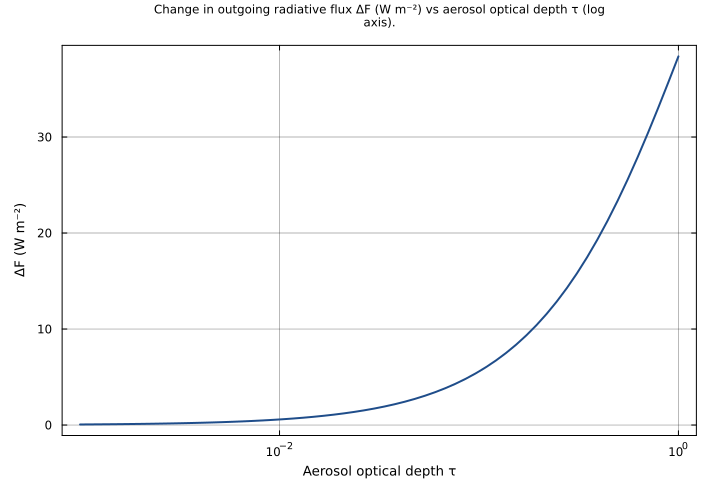
Aerosol radiative forcing ΔF as a function of aerosol optical depth τ at default scattering parameters (ω=0.95, β=0.29, R_s=0.15, A_c=0.6, T_a=0.76, F_0=1370 W/m²). The curve rises from ~0 at τ→0 (no aerosol) and saturates at large τ as the layer becomes optically thick. Reproduces the qualitative behaviour discussed in Seinfeld & Pandis (2006) §24.1.
Time span: 0.0 → 1.0
Swept over: τ
cooling_heating_transition_vs_ssa
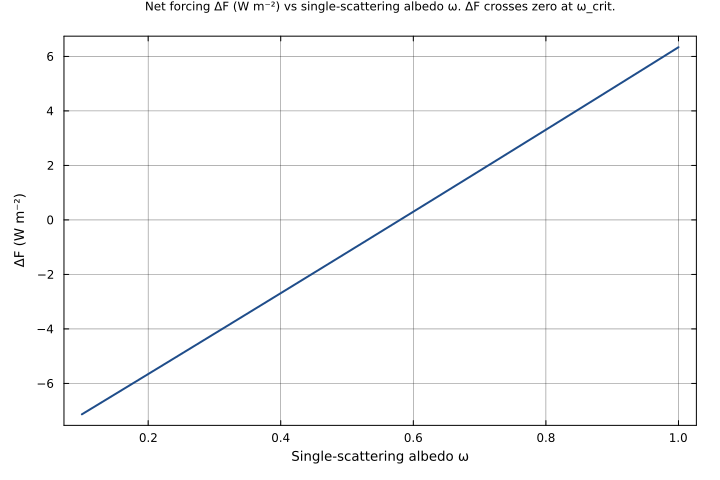
Net radiative forcing ΔF as a function of single-scattering albedo ω at fixed τ=0.1, β=0.29, R_s=0.15. As ω decreases from 1 (pure scattering) toward 0 (pure absorption), the aerosol transitions from cooling (ΔF > 0) to heating (ΔF < 0) at the critical SSA ω_crit ≈ 0.589 for these surface conditions — the same threshold computed by CriticalSingleScatteringAlbedo.
Time span: 0.0 → 1.0
Swept over: ω
layer_reflectance_components
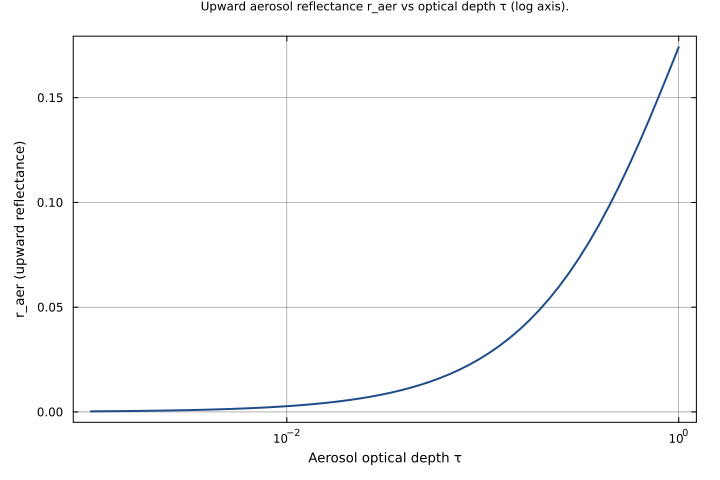
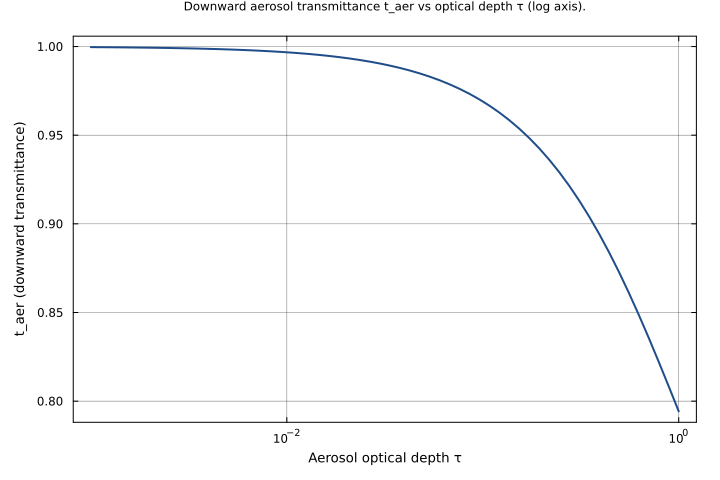
Aerosol layer reflection (r_aer), transmission (t_aer), and total aerosol-surface reflectance (R_as) as a function of optical depth τ. Shows how the layer increasingly intercepts and scatters incident radiation with growing τ, and how R_as diverges from the bare surface albedo R_s = 0.15.
Time span: 0.0 → 1.0
Swept over: τ
Raw .esm
Raw .esm JSON (this component)
{
"reference": {
"citation": "Seinfeld, J. H., and Pandis, S. N. (2006). Atmospheric Chemistry and Physics: From Air Pollution to Climate Change, 2nd Edition, Chapter 24, Section 24.1, Equations 24.1–24.10.",
"notes": "source_ref: Aerosol.jl@c8c640bb:src/aerosol_radiative_forcing.jl:36\nTwo-stream scattering-absorbing aerosol layer model. Five algebraic equations in a causal chain: r_aer (Eq. 24.1 auxiliary — fraction reflected upward) and t_aer (Eq. 24.1 — fraction transmitted downward) are computed from τ, ω, β; R_as (Eq. 24.5 — total aerosol-surface reflectance) follows from r_aer, t_aer, R_s; ΔR_p (Eq. 24.9 — change in planetary albedo) scales R_as−R_s by the clear-sky fraction and atmospheric transmittance; ΔF (Eq. 24.10 — change in radiative flux) multiplies ΔR_p by F_0. MTK structural_simplify eliminates all five variables to observed algebraic bindings (zero ODE states). The conservation identity r_aer + t_aer = exp(−τ) + ω·(1−exp(−τ)) reduces to exactly 1 for ω=1 (nonabsorbing aerosol). Sign convention: ΔF > 0 means cooling (increased outgoing flux); ΔF < 0 means heating (reduced outgoing flux — absorbing aerosol with ω < ω_crit).\n\nTolerance rationale (model-level rel=1e-8 / abs=1e-12): the five-step algebraic chain involves exp(−τ), a square (t_aer²), and one division; float64 roundoff accumulates at most ~5–10×ε₆₄ across the chain. rel=1e-8 sits safely above this floor while remaining tight enough to catch formula errors. abs=1e-12 floors the near-zero limit at τ→0 where r_aer→0 and ΔF→0."
},
"variables": {
"F_0": {
"type": "parameter",
"units": "W/m^2",
"default": 1370.0,
"description": "Incident solar flux"
},
"τ": {
"type": "parameter",
"units": "1",
"default": 0.1,
"description": "Aerosol optical depth (dimensionless)"
},
"ω": {
"type": "parameter",
"units": "1",
"default": 0.95,
"description": "Single-scattering albedo (dimensionless)"
},
"β": {
"type": "parameter",
"units": "1",
"default": 0.29,
"description": "Upscatter fraction (dimensionless)"
},
"R_s": {
"type": "parameter",
"units": "1",
"default": 0.15,
"description": "Surface albedo (dimensionless)"
},
"A_c": {
"type": "parameter",
"units": "1",
"default": 0.6,
"description": "Cloud fraction (dimensionless)"
},
"T_a": {
"type": "parameter",
"units": "1",
"default": 0.76,
"description": "Atmospheric transmittance (dimensionless)"
},
"r_aer": {
"type": "unknown",
"units": "1",
"description": "Fraction of light reflected upward by aerosol layer, r_aer = (1 − exp(−τ))·ω·β — Eq. 24.1 auxiliary."
},
"t_aer": {
"type": "unknown",
"units": "1",
"description": "Fraction of light transmitted downward through aerosol layer, t_aer = exp(−τ) + ω·(1−β)·(1−exp(−τ)) — Eq. 24.1."
},
"R_as": {
"type": "unknown",
"units": "1",
"description": "Total reflectance of the aerosol-surface system, R_as = r_aer + t_aer²·R_s / (1 − R_s·r_aer) — Eq. 24.5."
},
"ΔR_p": {
"type": "unknown",
"units": "1",
"description": "Change in planetary albedo due to the aerosol layer, ΔR_p = (1−A_c)·T_a²·(R_as−R_s) — Eq. 24.9."
},
"ΔF": {
"type": "unknown",
"units": "W/m^2",
"description": "Change in outgoing radiative flux due to the aerosol layer, ΔF = F_0·ΔR_p — Eq. 24.10. Positive = cooling (more reflection); negative = heating (absorption dominates)."
}
},
"equations": [
{
"lhs": "r_aer",
"rhs": {
"op": "*",
"args": [
{
"op": "*",
"args": [
{
"op": "+",
"args": [
1,
{
"op": "*",
"args": [
-1,
{
"op": "exp",
"args": [
{
"op": "*",
"args": [
-1,
"τ"
]
}
]
}
]
}
]
},
"ω"
]
},
"β"
]
}
},
{
"lhs": "t_aer",
"rhs": {
"op": "+",
"args": [
{
"op": "exp",
"args": [
{
"op": "*",
"args": [
-1,
"τ"
]
}
]
},
{
"op": "*",
"args": [
{
"op": "*",
"args": [
"ω",
{
"op": "+",
"args": [
1,
{
"op": "*",
"args": [
-1,
"β"
]
}
]
}
]
},
{
"op": "+",
"args": [
1,
{
"op": "*",
"args": [
-1,
{
"op": "exp",
"args": [
{
"op": "*",
"args": [
-1,
"τ"
]
}
]
}
]
}
]
}
]
}
]
}
},
{
"lhs": "R_as",
"rhs": {
"op": "+",
"args": [
"r_aer",
{
"op": "/",
"args": [
{
"op": "*",
"args": [
{
"op": "^",
"args": [
"t_aer",
2
]
},
"R_s"
]
},
{
"op": "+",
"args": [
1,
{
"op": "*",
"args": [
-1,
{
"op": "*",
"args": [
"R_s",
"r_aer"
]
}
]
}
]
}
]
}
]
}
},
{
"lhs": "ΔR_p",
"rhs": {
"op": "*",
"args": [
{
"op": "*",
"args": [
{
"op": "+",
"args": [
1,
{
"op": "*",
"args": [
-1,
"A_c"
]
}
]
},
{
"op": "^",
"args": [
"T_a",
2
]
}
]
},
{
"op": "+",
"args": [
"R_as",
{
"op": "*",
"args": [
-1,
"R_s"
]
}
]
}
]
}
},
{
"lhs": "ΔF",
"rhs": {
"op": "*",
"args": [
"F_0",
"ΔR_p"
]
}
}
],
"tolerance": {
"rel": 1e-08,
"abs": 1e-12
},
"tests": [
{
"id": "default_params_all_vars",
"description": "Baseline: all default parameters (τ=0.1, ω=0.95, β=0.29, R_s=0.15, A_c=0.6, T_a=0.76, F_0=1370 W/m²). Exercises the full five-step algebraic chain at canonical mid-tropospheric aerosol conditions. Upstream 'Aerosol Layer Forcing - Limiting Cases' testitem uses these defaults via the solve_system helper.",
"parameter_overrides": {},
"time_span": {
"start": 0.0,
"end": 1.0
},
"assertions": [
{
"variable": "r_aer",
"time": 0.0,
"expected": 0.02621729133109315
},
{
"variable": "t_aer",
"time": 0.0,
"expected": 0.9690245795707049
},
{
"variable": "R_as",
"time": 0.0,
"expected": 0.16762468452648646
},
{
"variable": "ΔR_p",
"time": 0.0,
"expected": 0.0040720071129994335
},
{
"variable": "ΔF",
"time": 0.0,
"expected": 5.578649744809224
},
{
"variable": "r_aer",
"time": 1.0,
"expected": 0.02621729133109315
},
{
"variable": "t_aer",
"time": 1.0,
"expected": 0.9690245795707049
},
{
"variable": "ΔF",
"time": 1.0,
"expected": 5.578649744809224
}
]
},
{
"id": "tau_near_zero_no_aerosol",
"description": "Optical-depth-zero limit: τ = 1×10⁻¹⁰ ≈ 0. Upstream 'Aerosol Layer Forcing - Limiting Cases' Case 1 asserts r_aer ≈ 0 (atol=1e-8), t_aer ≈ 1 (atol=1e-8), ΔR_p ≈ 0 (atol=1e-8). We pin the exact float64 analytic values. At τ→0: r_aer→0, t_aer→1, R_as→R_s, so ΔR_p→0 and ΔF→0.",
"parameter_overrides": {
"τ": 1e-10
},
"time_span": {
"start": 0.0,
"end": 1.0
},
"assertions": [
{
"variable": "r_aer",
"time": 0.0,
"expected": 2.755000227949722e-11
},
{
"variable": "t_aer",
"time": 0.0,
"expected": 0.99999999996745
},
{
"variable": "R_as",
"time": 0.0,
"expected": 0.15000000001840486
},
{
"variable": "ΔR_p",
"time": 0.0,
"expected": 4.252259078185717e-12
},
{
"variable": "ΔF",
"time": 0.0,
"expected": 5.825594937114432e-09
}
]
},
{
"id": "omega_unity_energy_conservation",
"description": "Nonabsorbing aerosol: ω = 1. Upstream 'Aerosol Layer Forcing - Limiting Cases' Case 2 asserts r_aer + t_aer ≈ 1 (rtol=0.01). For ω=1 the identity r_aer + t_aer = exp(−τ) + (1−exp(−τ)) = 1 holds exactly in float64. We pin the individual components to confirm the conservation law and chain result.",
"parameter_overrides": {
"ω": 1.0
},
"time_span": {
"start": 0.0,
"end": 1.0
},
"assertions": [
{
"variable": "r_aer",
"time": 0.0,
"expected": 0.027597148769571738
},
{
"variable": "t_aer",
"time": 0.0,
"expected": 0.9724028512304282
},
{
"variable": "R_as",
"time": 0.0,
"expected": 0.17002182176509895
},
{
"variable": "ΔR_p",
"time": 0.0,
"expected": 0.004625841700608462
},
{
"variable": "ΔF",
"time": 0.0,
"expected": 6.337403129833593
}
]
},
{
"id": "small_tau_linear_regime",
"description": "Small optical depth: τ = 0.01. Upstream 'Aerosol Layer Forcing - Limiting Cases' Case 3 asserts r_aer ≈ τ·ω·β = 0.002755 (rtol=0.05) — the linear approximation r ≈ τωβ for small τ. We pin the exact float64 value r_aer = (1−exp(−0.01))·0.95·0.29, which differs from the linear approximation by ~0.5%.",
"parameter_overrides": {
"τ": 0.01
},
"time_span": {
"start": 0.0,
"end": 1.0
},
"assertions": [
{
"variable": "r_aer",
"time": 0.0,
"expected": 0.002741270802104186
},
{
"variable": "t_aer",
"time": 0.0,
"expected": 0.9967612208853542
},
{
"variable": "R_as",
"time": 0.0,
"expected": 0.15183251544260082
},
{
"variable": "ΔR_p",
"time": 0.0,
"expected": 0.0004233843678584944
},
{
"variable": "ΔF",
"time": 0.0,
"expected": 0.5800365839661373
}
]
},
{
"id": "absorbing_aerosol_heating",
"description": "Strongly absorbing aerosol: ω = 0.4. Upstream 'Direct Forcing - Cooling vs Heating' asserts ΔR_p < 0 (aerosol absorbs enough to reduce outgoing flux → net heating). The critical SSA for default R_s=0.15, β=0.29 is ω_crit ≈ 0.589 (CriticalSingleScatteringAlbedo model); ω=0.4 lies well below ω_crit so the aerosol layer reduces planetary albedo relative to the clean surface. We pin the exact negative value.",
"parameter_overrides": {
"ω": 0.4
},
"time_span": {
"start": 0.0,
"end": 1.0
},
"assertions": [
{
"variable": "r_aer",
"time": 0.0,
"expected": 0.011038859507828696
},
{
"variable": "t_aer",
"time": 0.0,
"expected": 0.931863591313747
},
{
"variable": "R_as",
"time": 0.0,
"expected": 0.14151036091632538
},
{
"variable": "ΔR_p",
"time": 0.0,
"expected": -0.0019614462138921834
},
{
"variable": "ΔF",
"time": 0.0,
"expected": -2.6871813130322915
}
]
},
{
"id": "high_optical_depth",
"description": "Higher aerosol loading: τ = 0.5. The optically thicker layer reflects substantially more, driving a significantly larger cooling effect. Exercises the nonlinear regime where the linear approximation r_aer ≈ τωβ breaks down.",
"parameter_overrides": {
"τ": 0.5
},
"time_span": {
"start": 0.0,
"end": 1.0
},
"assertions": [
{
"variable": "r_aer",
"time": 0.0,
"expected": 0.10840080324916948
},
{
"variable": "t_aer",
"time": 0.0,
"expected": 0.8719257297364622
},
{
"variable": "R_as",
"time": 0.0,
"expected": 0.2243238984712188
},
{
"variable": "ΔR_p",
"time": 0.0,
"expected": 0.017171793502790397
},
{
"variable": "ΔF",
"time": 0.0,
"expected": 23.525357098822845
}
]
},
{
"id": "clear_sky_no_clouds",
"description": "Clear-sky condition: A_c = 0. Without cloud shielding the full atmospheric column is exposed to the aerosol; ΔR_p is 2.5× larger than the default (A_c=0.6 case) because the (1−A_c) prefactor rises from 0.4 to 1.",
"parameter_overrides": {
"A_c": 0.0
},
"time_span": {
"start": 0.0,
"end": 1.0
},
"assertions": [
{
"variable": "ΔR_p",
"time": 0.0,
"expected": 0.010180017782498583
},
{
"variable": "ΔF",
"time": 0.0,
"expected": 13.946624362023059
}
]
},
{
"id": "bright_surface_Rs_0p3",
"description": "Brighter surface: R_s = 0.3 (e.g. desert or snow-free grassland). The larger surface albedo raises R_as via the multiple-reflection term t_aer²·R_s/(1−R_s·r_aer), but also raises the baseline R_s subtracted in ΔR_p, yielding a smaller net forcing change than the dark-surface default.",
"parameter_overrides": {
"R_s": 0.3
},
"time_span": {
"start": 0.0,
"end": 1.0
},
"assertions": [
{
"variable": "r_aer",
"time": 0.0,
"expected": 0.02621729133109315
},
{
"variable": "t_aer",
"time": 0.0,
"expected": 0.9690245795707049
},
{
"variable": "R_as",
"time": 0.0,
"expected": 0.3101530903433569
},
{
"variable": "ΔR_p",
"time": 0.0,
"expected": 0.002345769992929185
},
{
"variable": "ΔF",
"time": 0.0,
"expected": 3.2137048903129837
}
]
},
{
"id": "high_transmittance_Ta_0p9",
"description": "Higher atmospheric transmittance: T_a = 0.9 (cleaner atmosphere). Since ΔR_p ∝ T_a², increasing T_a from 0.76 to 0.9 raises the forcing magnitude by a factor of (0.9/0.76)² ≈ 1.40.",
"parameter_overrides": {
"T_a": 0.9
},
"time_span": {
"start": 0.0,
"end": 1.0
},
"assertions": [
{
"variable": "ΔR_p",
"time": 0.0,
"expected": 0.0057103977865816165
},
{
"variable": "ΔF",
"time": 0.0,
"expected": 7.823244967616815
}
]
}
],
"analyses": [
{
"id": "forcing_vs_optical_depth",
"description": "Aerosol radiative forcing ΔF as a function of aerosol optical depth τ at default scattering parameters (ω=0.95, β=0.29, R_s=0.15, A_c=0.6, T_a=0.76, F_0=1370 W/m²). The curve rises from ~0 at τ→0 (no aerosol) and saturates at large τ as the layer becomes optically thick. Reproduces the qualitative behaviour discussed in Seinfeld & Pandis (2006) §24.1.",
"time_span": {
"start": 0.0,
"end": 1.0
},
"parameter_sweep": {
"type": "cartesian",
"dimensions": [
{
"parameter": "τ",
"range": {
"start": 0.001,
"stop": 1.0,
"count": 60,
"scale": "log"
}
}
]
},
"plots": [
{
"id": "deltaF_vs_tau",
"type": "line",
"description": "Change in outgoing radiative flux ΔF (W m⁻²) vs aerosol optical depth τ (log axis).",
"x": {
"variable": "τ",
"label": "Aerosol optical depth τ"
},
"y": {
"variable": "ΔF",
"label": "ΔF (W m⁻²)"
}
}
]
},
{
"id": "cooling_heating_transition_vs_ssa",
"description": "Net radiative forcing ΔF as a function of single-scattering albedo ω at fixed τ=0.1, β=0.29, R_s=0.15. As ω decreases from 1 (pure scattering) toward 0 (pure absorption), the aerosol transitions from cooling (ΔF > 0) to heating (ΔF < 0) at the critical SSA ω_crit ≈ 0.589 for these surface conditions — the same threshold computed by CriticalSingleScatteringAlbedo.",
"parameters": {
"τ": 0.1,
"β": 0.29,
"R_s": 0.15
},
"time_span": {
"start": 0.0,
"end": 1.0
},
"parameter_sweep": {
"type": "cartesian",
"dimensions": [
{
"parameter": "ω",
"range": {
"start": 0.1,
"stop": 1.0,
"count": 60,
"scale": "linear"
}
}
]
},
"plots": [
{
"id": "deltaF_vs_omega",
"type": "line",
"description": "Net forcing ΔF (W m⁻²) vs single-scattering albedo ω. ΔF crosses zero at ω_crit.",
"x": {
"variable": "ω",
"label": "Single-scattering albedo ω"
},
"y": {
"variable": "ΔF",
"label": "ΔF (W m⁻²)"
}
}
]
},
{
"id": "layer_reflectance_components",
"description": "Aerosol layer reflection (r_aer), transmission (t_aer), and total aerosol-surface reflectance (R_as) as a function of optical depth τ. Shows how the layer increasingly intercepts and scatters incident radiation with growing τ, and how R_as diverges from the bare surface albedo R_s = 0.15.",
"time_span": {
"start": 0.0,
"end": 1.0
},
"parameter_sweep": {
"type": "cartesian",
"dimensions": [
{
"parameter": "τ",
"range": {
"start": 0.001,
"stop": 1.0,
"count": 60,
"scale": "log"
}
}
]
},
"plots": [
{
"id": "r_aer_vs_tau",
"type": "line",
"description": "Upward aerosol reflectance r_aer vs optical depth τ (log axis).",
"x": {
"variable": "τ",
"label": "Aerosol optical depth τ"
},
"y": {
"variable": "r_aer",
"label": "r_aer (upward reflectance)"
}
},
{
"id": "t_aer_vs_tau",
"type": "line",
"description": "Downward aerosol transmittance t_aer vs optical depth τ (log axis).",
"x": {
"variable": "τ",
"label": "Aerosol optical depth τ"
},
"y": {
"variable": "t_aer",
"label": "t_aer (downward transmittance)"
}
},
{
"id": "R_as_vs_tau",
"type": "line",
"description": "Total aerosol-surface reflectance R_as vs optical depth τ (log axis). Converges to R_s at τ→0.",
"x": {
"variable": "τ",
"label": "Aerosol optical depth τ"
},
"y": {
"variable": "R_as",
"label": "R_as (total reflectance)"
}
}
]
}
]
}