SettlingVelocity
Terminal settling velocity and relaxation time for aerosol single-particle dynamics. Migrated from Aerosol.jl@c8c640bb src/single_particle_dynamics.jl:113 (`SettlingVelocity` @component). Computes the terminal settling velocity v_t and the relaxation time τ (time constant for velocity adjustment) for a spherical particle falling under gravity in a viscous fluid (Seinfeld & Pandis 2006, Chapter 9, Eqs. 9.38 and 9.42).
Description
Terminal settling velocity and relaxation time for aerosol single-particle dynamics. Migrated from Aerosol.jl@c8c640bb src/single_particle_dynamics.jl:113 (SettlingVelocity @component). Computes the terminal settling velocity v_t and the relaxation time τ (time constant for velocity adjustment) for a spherical particle falling under gravity in a viscous fluid (Seinfeld & Pandis 2006, Chapter 9, Eqs. 9.38 and 9.42).
Reference
_source_ref: Aerosol.jl@c8c640bb636b22f2425460e9ed5cba50793bfee1:src/single_particle_dynamics.jl:113
Upstream SettlingVelocity is an MTK @component with one constant (g = 9.807 m/s²), four @parameters (D_p, ρ_p, μ, C_c) and two variables (v_t, τ). The equations are:
• v_t ~ (D_p^2 * ρ_p * g * C_c) / (18 * μ) (Eq. 9.42 — terminal settling velocity)
• τ ~ (ρ_p * D_p^2 * C_c) / (18 * μ) (Eq. 9.38 — relaxation time)
Both equations are algebraic (no derivatives), making this an observed-only component. Note that v_t = τ * g, so the two outputs share the same denominator.
Observability classification: observed-only — every output is given by a single algebraic equation in which the output appears only on the LHS. Both v_t and τ are fully determined by parameters alone; they are independent outputs (no variable reuse between equations) and migrate as type: state with explicit equations, matching the sibling single_particle_dynamics.jl migrations mean_free_path.esm, slip.esm, stokes.esm, mobility.esm and aerodynamic_diameter.esm. Test scenarios use time_span: [0, 1] and sample at t=0.
Constant g (9.807 m/s²) migrates as type: parameter carrying its numeric default, consistent with how π_val is handled in mobility.esm and mean_free_path.esm. The name g is not one of the ESS schema’s reserved physical-constant names.
Tolerance rationale (model-level rel=1e-9): observed-only algebraic system (no ODE integration); both equations are products and divisions of parameters. Floating-point round-off is ~1e-15. 1e-9 leaves comfortable headroom._
Parameters
| Name | Units | Default | Description |
|---|---|---|---|
g | m/s^2 | 9.807 | Gravitational acceleration |
D_p | m | 1e-06 | Particle diameter |
ρ_p | kg/m^3 | 1000.0 | Particle density |
μ | kg/(m*s) | 1.8e-05 | Dynamic viscosity of air |
C_c | 1 | 1.0 | Slip correction factor (dimensionless) |
Observed
| Name | Units | Default | Description |
|---|---|---|---|
v_t | m/s | Terminal settling velocity | |
τ | s | Relaxation time |
Observed expressions
$$ v_{t} = \frac{D_{p}^{2} \cdot ρ_{p} \cdot g \cdot C_{c}}{18 \cdot μ} $$Terminal settling velocity
$$ τ = \frac{ρ_{p} \cdot D_{p}^{2} \cdot C_{c}}{18 \cdot μ} $$Relaxation time
Analyses
size_dependence
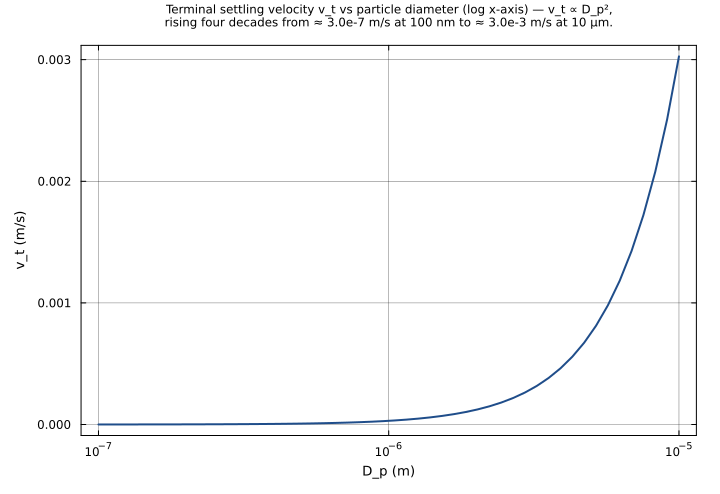
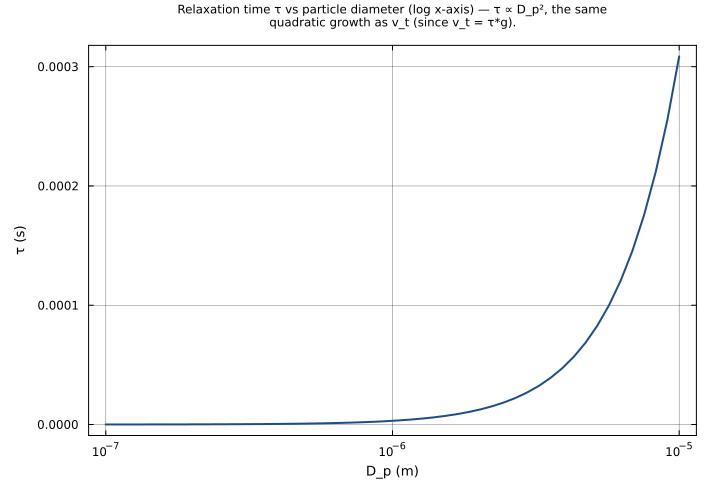
Sweep particle diameter D_p from 100 nm to 10 μm (log scale) at default conditions (ρ_p = 1000 kg/m³, μ = 1.8e-5 kg/(m·s), C_c = 1.0, g = 9.807 m/s²). Both τ and v_t scale as D_p², rising four decades across the range. At 100 nm v_t ≈ 3.0e-7 m/s (negligible settling); at 10 μm v_t ≈ 3.0e-3 m/s (≈ 0.3 cm/s, gravitational settling is significant).
Time span: 0.0 → 1.0
Swept over: D_p
Raw .esm
Raw .esm JSON (this component)
{
  "reference": {
    "notes": "source_ref: Aerosol.jl@c8c640bb636b22f2425460e9ed5cba50793bfee1:src/single_particle_dynamics.jl:113\nUpstream `SettlingVelocity` is an MTK `@component` with one constant (g = 9.807 m/s²), four `@parameters` (D_p, ρ_p, μ, C_c) and two variables (v_t, τ). The equations are:\n  • v_t ~ (D_p^2 * ρ_p * g * C_c) / (18 * μ)  (Eq. 9.42 — terminal settling velocity)\n  • τ   ~ (ρ_p * D_p^2 * C_c) / (18 * μ)       (Eq. 9.38 — relaxation time)\nBoth equations are algebraic (no derivatives), making this an observed-only component. Note that v_t = τ * g, so the two outputs share the same denominator.\n\nObservability classification: observed-only — every output is given by a single algebraic equation in which the output appears only on the LHS. Both v_t and τ are fully determined by parameters alone; they are independent outputs (no variable reuse between equations) and migrate as `type: state` with explicit `equations`, matching the sibling single_particle_dynamics.jl migrations mean_free_path.esm, slip.esm, stokes.esm, mobility.esm and aerodynamic_diameter.esm. Test scenarios use `time_span: [0, 1]` and sample at t=0.\n\nConstant g (9.807 m/s²) migrates as `type: parameter` carrying its numeric default, consistent with how π_val is handled in mobility.esm and mean_free_path.esm. The name `g` is not one of the ESS schema's reserved physical-constant names.\n\nTolerance rationale (model-level rel=1e-9): observed-only algebraic system (no ODE integration); both equations are products and divisions of parameters. Floating-point round-off is ~1e-15. 1e-9 leaves comfortable headroom."
  },
  "tolerance": {
    "rel": 1e-09
  },
  "variables": {
    "g": {
      "type": "parameter",
      "units": "m/s^2",
      "default": 9.807,
      "description": "Gravitational acceleration"
    },
    "D_p": {
      "type": "parameter",
      "units": "m",
      "default": 1e-06,
      "description": "Particle diameter"
    },
    "ρ_p": {
      "type": "parameter",
      "units": "kg/m^3",
      "default": 1000.0,
      "description": "Particle density"
    },
    "μ": {
      "type": "parameter",
      "units": "kg/(m*s)",
      "default": 1.8e-05,
      "description": "Dynamic viscosity of air"
    },
    "C_c": {
      "type": "parameter",
      "units": "1",
      "default": 1.0,
      "description": "Slip correction factor (dimensionless)"
    },
    "v_t": {
      "type": "unknown",
      "units": "m/s",
      "description": "Terminal settling velocity"
    },
    "τ": {
      "type": "unknown",
      "units": "s",
      "description": "Relaxation time"
    }
  },
  "equations": [
    {
      "lhs": "v_t",
      "rhs": {
        "op": "/",
        "args": [
          {
            "op": "*",
            "args": [
              {
                "op": "*",
                "args": [
                  {
                    "op": "*",
                    "args": [
                      {
                        "op": "^",
                        "args": [
                          "D_p",
                          2
                        ]
                      },
                      "ρ_p"
                    ]
                  },
                  "g"
                ]
              },
              "C_c"
            ]
          },
          {
            "op": "*",
            "args": [
              18,
              "μ"
            ]
          }
        ]
      }
    },
    {
      "lhs": "τ",
      "rhs": {
        "op": "/",
        "args": [
          {
            "op": "*",
            "args": [
              {
                "op": "*",
                "args": [
                  "ρ_p",
                  {
                    "op": "^",
                    "args": [
                      "D_p",
                      2
                    ]
                  }
                ]
              },
              "C_c"
            ]
          },
          {
            "op": "*",
            "args": [
              18,
              "μ"
            ]
          }
        ]
      }
    }
  ],
  "tests": [
    {
      "id": "default_conditions",
      "description": "Default conditions: D_p = 1.0e-6 m, ρ_p = 1000 kg/m³, μ = 1.8e-5 kg/(m·s), C_c = 1.0, g = 9.807 m/s². Relaxation time τ = ρ_p*D_p²*C_c/(18μ) = 1e-9/3.24e-4 ≈ 3.0864e-6 s; terminal settling velocity v_t = τ*g ≈ 3.0269e-5 m/s. For a 1 μm particle in air at standard conditions with no slip correction, gravity barely overcomes drag — settling is extremely slow.",
      "time_span": {
        "start": 0.0,
        "end": 1.0
      },
      "assertions": [
        {
          "variable": "τ",
          "time": 0.0,
          "expected": 3.08641975308642e-06
        },
        {
          "variable": "v_t",
          "time": 0.0,
          "expected": 3.0268518518518523e-05
        }
      ]
    },
    {
      "id": "table_9_4_1um",
      "description": "1 μm particle from Table 9.4 (Seinfeld & Pandis 2006): D_p = 1.0e-6 m, ρ_p = 1000 kg/m³, C_c = 1.164 (Cunningham slip correction at 298 K, 1 atm). τ = ρ_p*D_p²*C_c/(18μ) = 1.164e-9/3.24e-4 ≈ 3.5926e-6 s, which matches the tabulated value of ≈ 3.6e-6 s. v_t = τ*g ≈ 3.5233e-5 m/s. Mirrors the upstream `SettlingVelocity relaxation time from Table 9.4` test.",
      "parameter_overrides": {
        "C_c": 1.164
      },
      "time_span": {
        "start": 0.0,
        "end": 1.0
      },
      "assertions": [
        {
          "variable": "τ",
          "time": 0.0,
          "expected": 3.5925925925925922e-06
        },
        {
          "variable": "v_t",
          "time": 0.0,
          "expected": 3.5232555555555556e-05
        }
      ]
    },
    {
      "id": "table_9_4_10um",
      "description": "10 μm particle from Table 9.4: D_p = 1.0e-5 m, ρ_p = 1000 kg/m³, C_c = 1.016 (near-continuum regime). τ ∝ D_p², so a 10× larger diameter raises τ by 100×: τ ≈ 3.1358e-4 s (≈ 3.14e-4 s in the table). v_t = τ*g ≈ 3.075e-3 m/s ≈ 0.3 cm/s. Mirrors the upstream `SettlingVelocity relaxation time from Table 9.4` test.",
      "parameter_overrides": {
        "D_p": 1e-05,
        "C_c": 1.016
      },
      "time_span": {
        "start": 0.0,
        "end": 1.0
      },
      "assertions": [
        {
          "variable": "τ",
          "time": 0.0,
          "expected": 0.0003135802469135803
        },
        {
          "variable": "v_t",
          "time": 0.0,
          "expected": 0.003075281481481482
        }
      ]
    },
    {
      "id": "large_particle",
      "description": "Large particle (D_p = 1.0e-5 m = 10 μm) at unit slip correction C_c = 1.0: τ = ρ_p*D_p²/(18μ) ≈ 3.0864e-4 s — 100× the 1 μm default, confirming the D_p² scaling. v_t ≈ 3.0269e-3 m/s ≈ 0.3 cm/s. Larger particles settle measurably faster.",
      "parameter_overrides": {
        "D_p": 1e-05
      },
      "time_span": {
        "start": 0.0,
        "end": 1.0
      },
      "assertions": [
        {
          "variable": "τ",
          "time": 0.0,
          "expected": 0.000308641975308642
        },
        {
          "variable": "v_t",
          "time": 0.0,
          "expected": 0.003026851851851852
        }
      ]
    },
    {
      "id": "dense_slip_corrected",
      "description": "Dense particle (ρ_p = 2000 kg/m³) with slip correction C_c = 1.5: τ scales linearly with both ρ_p and C_c, giving τ = 3.0864e-6 × 2 × 1.5 ≈ 9.2593e-6 s. v_t = τ*g ≈ 9.0806e-5 m/s. Denser and more rarefied particles settle faster at the same size.",
      "parameter_overrides": {
        "ρ_p": 2000.0,
        "C_c": 1.5
      },
      "time_span": {
        "start": 0.0,
        "end": 1.0
      },
      "assertions": [
        {
          "variable": "τ",
          "time": 0.0,
          "expected": 9.25925925925926e-06
        },
        {
          "variable": "v_t",
          "time": 0.0,
          "expected": 9.080555555555556e-05
        }
      ]
    }
  ],
  "analyses": [
    {
      "id": "size_dependence",
      "description": "Sweep particle diameter D_p from 100 nm to 10 μm (log scale) at default conditions (ρ_p = 1000 kg/m³, μ = 1.8e-5 kg/(m·s), C_c = 1.0, g = 9.807 m/s²). Both τ and v_t scale as D_p², rising four decades across the range. At 100 nm v_t ≈ 3.0e-7 m/s (negligible settling); at 10 μm v_t ≈ 3.0e-3 m/s (≈ 0.3 cm/s, gravitational settling is significant).",
      "initial_state": {},
      "time_span": {
        "start": 0.0,
        "end": 1.0
      },
      "parameter_sweep": {
        "type": "cartesian",
        "dimensions": [
          {
            "parameter": "D_p",
            "range": {
              "start": 1e-07,
              "stop": 1e-05,
              "count": 50,
              "scale": "log"
            }
          }
        ]
      },
      "plots": [
        {
          "id": "settling_velocity_vs_diameter",
          "type": "line",
          "description": "Terminal settling velocity v_t vs particle diameter (log x-axis) — v_t ∝ D_p², rising four decades from ≈ 3.0e-7 m/s at 100 nm to ≈ 3.0e-3 m/s at 10 μm.",
          "x": {
            "variable": "D_p",
            "label": "D_p (m)"
          },
          "y": {
            "variable": "v_t",
            "label": "v_t (m/s)"
          }
        },
        {
          "id": "relaxation_time_vs_diameter",
          "type": "line",
          "description": "Relaxation time τ vs particle diameter (log x-axis) — τ ∝ D_p², the same quadratic growth as v_t (since v_t = τ*g).",
          "x": {
            "variable": "D_p",
            "label": "D_p (m)"
          },
          "y": {
            "variable": "τ",
            "label": "τ (s)"
          }
        }
      ]
    }
  ]
}