FHHAdsorption
FHH (Frenkel-Halsey-Hill) adsorption isotherm for multilayer adsorption on flat surfaces governed by van der Waals forces. Relates adsorbed volume to the gas-phase saturation ratio via two empirical parameters. From Seinfeld and Pandis (2006), Chapter 14, Section 14.5.3, Equation 14.46.
Description
FHH (Frenkel-Halsey-Hill) adsorption isotherm for multilayer adsorption on flat surfaces governed by van der Waals forces. Relates adsorbed volume to the gas-phase saturation ratio via two empirical parameters. From Seinfeld and Pandis (2006), Chapter 14, Section 14.5.3, Equation 14.46.
Reference
Seinfeld, J. H. and Pandis, S. N. (2006) Atmospheric Chemistry and Physics, 2nd Edition, Chapter 14, Section 14.5.3, Eq. 14.46 — FHH multilayer adsorption isotherm. Migrated from Aerosol.jl src/organic_aerosol.jl FHHAdsorption (esm-esy).
_source_ref: Aerosol.jl@main:src/organic_aerosol.jl:314
Upstream FHHAdsorption is an MTK @component with three parameters (V_m, A_FHH, B_FHH), and two variables (S, V). The equation is:
• V ~ V_m * (A_FHH / (-log(S)))^B_FHH (Eq. 14.46 — FHH isotherm)
The equation is algebraic (no derivatives), making this an observed-only component.
Observability classification: observed-only — the single output V is given by an algebraic equation. Test scenarios use time_span: [0, 1] and sample at t=0.
ESM representation note: in the upstream MTK component S is an @variable supplied externally as the input; in this .esm it is represented as a parameter (not a state) so the system is well-posed under the schema’s equation-count rule (one equation per state) and to match the observed-only pattern used elsewhere in this rig (see components/aerosol/organic/bet.esm). Tests vary S via parameter_overrides, and the saturation_sweep example sweeps S as a parameter dimension.
Domain constraint: S must satisfy 0 < S < 1 so that -log(S) > 0 and the adsorbed volume is well-defined and positive.
Tolerance rationale (model-level rel=1e-9): observed-only algebraic system (no ODE integration); the equation involves logarithm and power. Floating-point round-off is ~1e-15. 1e-9 leaves comfortable headroom._
Parameters
| Name | Units | Default | Description |
|---|---|---|---|
V_m | m^3 | 1.0 | Gas volume for monolayer formation |
A_FHH | 1 | 2.25 | FHH adsorption coefficient (dimensionless). Controls the saturation-ratio dependence. |
B_FHH | 1 | 0.4 | FHH adsorption exponent (dimensionless). Typically related to the surface-adsorbate interaction strength. |
S | 1 | 0.5 | Gas-phase saturation ratio p/p_sat (dimensionless, 0 < S < 1). Input parameter — the observed-only model has one algebraic equation for V given S. |
Observed
| Name | Units | Default | Description |
|---|---|---|---|
V | m^3 | Volume of gas adsorbed |
Observed expressions
$$ V = V_{m} \cdot \frac{A_{FHH}}{\left(-1\right) \cdot \ln\left(S\right)}^{B_{FHH}} $$Volume of gas adsorbed
Analyses
saturation_sweep
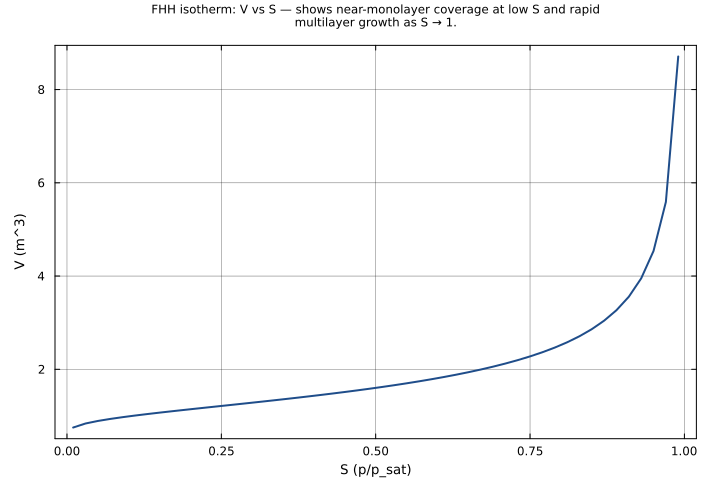
Sweep saturation ratio from 0.01 to 0.99 to show the characteristic FHH isotherm shape (rapid multilayer growth as S approaches 1 due to the power-law divergence of -log(S)).
Time span: 0.0 → 1.0
Swept over: S
Raw .esm
Raw .esm JSON (this component)
{
  "reference": {
    "citation": "Seinfeld, J. H. and Pandis, S. N. (2006) Atmospheric Chemistry and Physics, 2nd Edition, Chapter 14, Section 14.5.3, Eq. 14.46 — FHH multilayer adsorption isotherm. Migrated from Aerosol.jl src/organic_aerosol.jl `FHHAdsorption` (esm-esy).",
    "notes": "source_ref: Aerosol.jl@main:src/organic_aerosol.jl:314\nUpstream `FHHAdsorption` is an MTK `@component` with three parameters (V_m, A_FHH, B_FHH), and two variables (S, V). The equation is:\n  • V ~ V_m * (A_FHH / (-log(S)))^B_FHH  (Eq. 14.46 — FHH isotherm)\nThe equation is algebraic (no derivatives), making this an observed-only component.\n\nObservability classification: observed-only — the single output V is given by an algebraic equation. Test scenarios use `time_span: [0, 1]` and sample at t=0.\n\nESM representation note: in the upstream MTK component S is an `@variable` supplied externally as the input; in this .esm it is represented as a `parameter` (not a state) so the system is well-posed under the schema's equation-count rule (one equation per state) and to match the observed-only pattern used elsewhere in this rig (see components/aerosol/organic/bet.esm). Tests vary S via `parameter_overrides`, and the `saturation_sweep` example sweeps S as a parameter dimension.\n\nDomain constraint: S must satisfy 0 < S < 1 so that -log(S) > 0 and the adsorbed volume is well-defined and positive.\n\nTolerance rationale (model-level rel=1e-9): observed-only algebraic system (no ODE integration); the equation involves logarithm and power. Floating-point round-off is ~1e-15. 1e-9 leaves comfortable headroom."
  },
  "tolerance": {
    "rel": 1e-09
  },
  "variables": {
    "V_m": {
      "type": "parameter",
      "units": "m^3",
      "default": 1.0,
      "description": "Gas volume for monolayer formation"
    },
    "A_FHH": {
      "type": "parameter",
      "units": "1",
      "default": 2.25,
      "description": "FHH adsorption coefficient (dimensionless). Controls the saturation-ratio dependence."
    },
    "B_FHH": {
      "type": "parameter",
      "units": "1",
      "default": 0.4,
      "description": "FHH adsorption exponent (dimensionless). Typically related to the surface-adsorbate interaction strength."
    },
    "S": {
      "type": "parameter",
      "units": "1",
      "default": 0.5,
      "description": "Gas-phase saturation ratio p/p_sat (dimensionless, 0 < S < 1). Input parameter — the observed-only model has one algebraic equation for V given S."
    },
    "V": {
      "type": "unknown",
      "units": "m^3",
      "description": "Volume of gas adsorbed"
    }
  },
  "equations": [
    {
      "lhs": "V",
      "rhs": {
        "op": "*",
        "args": [
          "V_m",
          {
            "op": "^",
            "args": [
              {
                "op": "/",
                "args": [
                  "A_FHH",
                  {
                    "op": "*",
                    "args": [
                      -1,
                      {
                        "op": "log",
                        "args": [
                          "S"
                        ]
                      }
                    ]
                  }
                ]
              },
              "B_FHH"
            ]
          }
        ]
      }
    }
  ],
  "tests": [
    {
      "id": "default_conditions",
      "description": "Default conditions: V_m = 1.0 m^3, A_FHH = 2.25, B_FHH = 0.4, S = 0.5. V = 1.0 * (2.25 / (-log(0.5)))^0.4 = (2.25/0.6931...)^0.4 = 3.2461^0.4 = 1.6016 m^3.",
      "time_span": {
        "start": 0.0,
        "end": 1.0
      },
      "parameter_overrides": {
        "S": 0.5
      },
      "assertions": [
        {
          "variable": "V",
          "time": 0.0,
          "expected": 1.6015585593609674,
          "tolerance": {
            "rel": 1e-06
          }
        }
      ]
    },
    {
      "id": "low_saturation",
      "description": "Low saturation: S = 0.1. V = (2.25 / (-log(0.1)))^0.4 = (2.25/2.3026)^0.4 = 0.9772^0.4 = 0.9908 m^3. Near-monolayer regime.",
      "time_span": {
        "start": 0.0,
        "end": 1.0
      },
      "parameter_overrides": {
        "S": 0.1
      },
      "assertions": [
        {
          "variable": "V",
          "time": 0.0,
          "expected": 0.9908016742099569,
          "tolerance": {
            "rel": 1e-06
          }
        }
      ]
    },
    {
      "id": "high_saturation",
      "description": "High saturation: S = 0.9. V = (2.25 / (-log(0.9)))^0.4 = (2.25/0.1054)^0.4 = 21.36^0.4 = 3.403 m^3. Thick multilayer regime near saturation.",
      "time_span": {
        "start": 0.0,
        "end": 1.0
      },
      "parameter_overrides": {
        "S": 0.9
      },
      "assertions": [
        {
          "variable": "V",
          "time": 0.0,
          "expected": 3.402529131880669,
          "tolerance": {
            "rel": 1e-06
          }
        }
      ]
    }
  ],
  "analyses": [
    {
      "id": "saturation_sweep",
      "description": "Sweep saturation ratio from 0.01 to 0.99 to show the characteristic FHH isotherm shape (rapid multilayer growth as S approaches 1 due to the power-law divergence of -log(S)).",
      "initial_state": {},
      "parameters": {
        "V_m": 1.0,
        "A_FHH": 2.25,
        "B_FHH": 0.4
      },
      "time_span": {
        "start": 0.0,
        "end": 1.0
      },
      "parameter_sweep": {
        "type": "cartesian",
        "dimensions": [
          {
            "parameter": "S",
            "range": {
              "start": 0.01,
              "stop": 0.99,
              "count": 50
            }
          }
        ]
      },
      "plots": [
        {
          "id": "fhh_isotherm",
          "type": "line",
          "description": "FHH isotherm: V vs S — shows near-monolayer coverage at low S and rapid multilayer growth as S → 1.",
          "x": {
            "variable": "S",
            "label": "S (p/p_sat)"
          },
          "y": {
            "variable": "V",
            "label": "V (m^3)"
          }
        }
      ]
    }
  ]
}