MeanMolecularSpeed
Mean molecular speed of gas molecules using kinetic theory (Seinfeld & Pandis 2006, Chapter 12, Eq. 12.24). Computes c̄ = √(8kT/(πm_A)) where m_A = M_A/N_Av is the molecular mass and k_B, N_Av are folded as numeric literals. Migrated from Aerosol.jl src/mass_transfer.jl `MeanMolecularSpeed` (esm-1i9).
Description
Mean molecular speed of gas molecules using kinetic theory (Seinfeld & Pandis 2006, Chapter 12, Eq. 12.24). Computes c̄ = √(8kT/(πm_A)) where m_A = M_A/N_Av is the molecular mass and k_B, N_Av are folded as numeric literals. Migrated from Aerosol.jl src/mass_transfer.jl MeanMolecularSpeed (esm-1i9).
Reference
Seinfeld, J. H. and Pandis, S. N. (2006) Atmospheric Chemistry and Physics, 2nd Edition, Chapter 12, Eq. 12.24 — mean molecular speed c̄ = √(8kT/(πm_A)). Migrated from Aerosol.jl src/mass_transfer.jl MeanMolecularSpeed (esm-1i9).
_source_ref: Aerosol.jl@YeW6d:src/mass_transfer.jl:12
Upstream MeanMolecularSpeed is an MTK @component with 2 constants (k_B=1.380649e-23 J/K, N_Av=6.02214076e23 mol⁻¹), 2 parameters (T=298.15 K, M_A=0.029 kg/mol), and 1 algebraic variable c_bar(t) [m/s]. The single equation is:
c_bar ~ sqrt(8 * k_B * T * N_Av / (π * M_A))
The two constants k_B and N_Av appear only in the product k_B * N_Av = R (the universal gas constant, 8.314462618 J/(mol·K)); they are folded into the expression as their exact literal values from the source. π is inlined as the Float64 literal 3.141592653589793.
Topological note: c_bar depends only on parameters T and M_A, so it resolves immediately with no ODE integration needed. The system is purely algebraic (observed variable only).
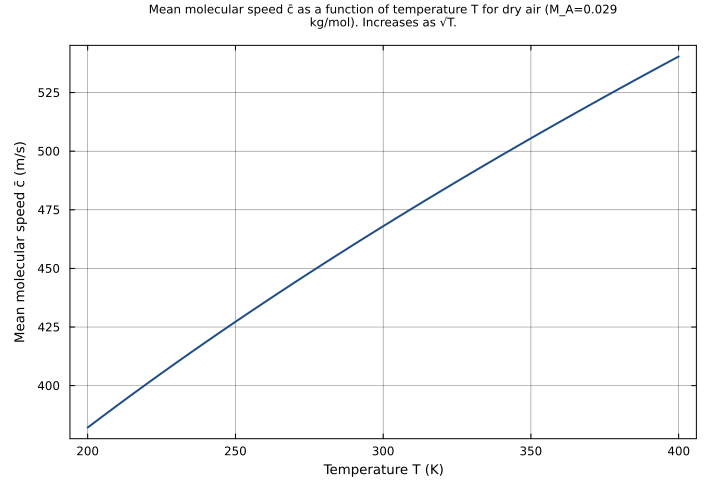
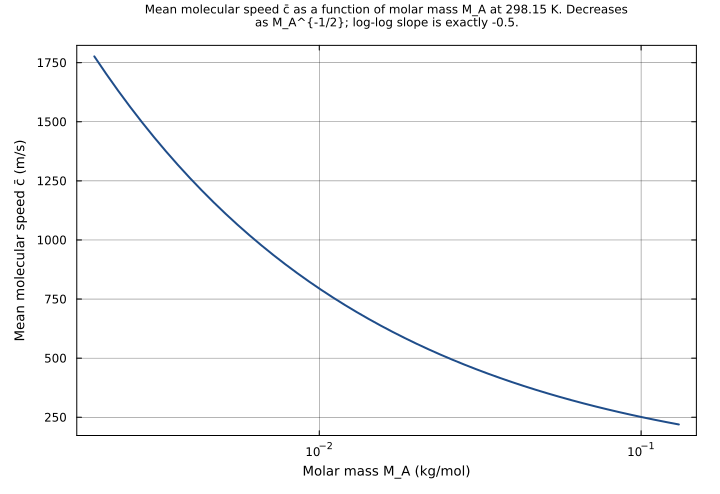
Physics: Eq. 12.24 from kinetic theory — c̄ = √(8kT/(πm_A)) where m_A = M_A/N_Av is the molecular mass of species A. For air (M_A=0.029 kg/mol) at T=298.15 K, c̄ ≈ 466.56 m/s. Lighter molecules are faster (c̄ ∝ M_A^{-1/2}); hotter gas is faster (c̄ ∝ T^{1/2}). This is the thermal speed used in the Knudsen-number and uptake-coefficient calculations downstream.
Tolerance rationale (model-level rel=1e-9): purely algebraic system with a single sqrt expression over products of parameters. Float64 round-off is ~1e-15 relative; rel=1e-9 leaves six orders of magnitude headroom._
Parameters
| Name | Units | Default | Description |
|---|---|---|---|
T | K | 298.15 | Temperature of the gas. Typical atmospheric range 200–320 K. Mean molecular speed scales as √T. |
M_A | kg/mol | 0.029 | Molar mass of species A. Default 0.029 kg/mol is representative of dry air. For individual trace gases use the species-specific value (e.g. 0.064 kg/mol for SO₂). Mean molecular speed scales as M_A^{-1/2}. |
Observed
| Name | Units | Default | Description |
|---|---|---|---|
c_bar | m/s | Mean molecular speed: c̄ = √(8 k_B N_Av T / (π M_A)) = √(8 R T / (π M_A)). Positive-definite for T > 0. For air at 298 K, c̄ ≈ 466.56 m/s; for H₂ at 298 K, c̄ ≈ 1769.5 m/s. |
Observed expressions
$$ c_{bar} = \sqrt{\frac{8 \cdot 1.380649 \times 10^{-23} \cdot 6.02214076 \times 10^{23} \cdot T}{3.141592653589793 \cdot M_{A}}} $$Mean molecular speed: c̄ = √(8 k_B N_Av T / (π M_A)) = √(8 R T / (π M_A)). Positive-definite for T > 0. For air at 298 K, c̄ ≈ 466.56 m/s; for H₂ at 298 K, c̄ ≈ 1769.5 m/s.
Analyses
speed_vs_temperature
Sweep temperature from 200 K to 400 K at M_A=0.029 kg/mol. c̄ ∝ √T; the slope in a log-log plot is exactly 0.5. Covers the full atmospheric temperature range from the polar stratosphere to the tropical boundary layer.
Time span: 0.0 → 1.0
Swept over: T
speed_vs_molar_mass
Sweep molar mass M_A from 0.002 kg/mol (H₂) to 0.131 kg/mol (Xe) at T=298.15 K. c̄ ∝ M_A^{-1/2}; lighter molecules are faster. Covers the range of atmospheric trace gases and noble gases.
Time span: 0.0 → 1.0
Swept over: M_A
Raw .esm
Raw .esm JSON (this component)
{
  "reference": {
    "citation": "Seinfeld, J. H. and Pandis, S. N. (2006) Atmospheric Chemistry and Physics, 2nd Edition, Chapter 12, Eq. 12.24 — mean molecular speed c̄ = √(8kT/(πm_A)). Migrated from Aerosol.jl src/mass_transfer.jl `MeanMolecularSpeed` (esm-1i9).",
    "notes": "source_ref: Aerosol.jl@YeW6d:src/mass_transfer.jl:12\n\nUpstream `MeanMolecularSpeed` is an MTK `@component` with 2 constants (k_B=1.380649e-23 J/K, N_Av=6.02214076e23 mol⁻¹), 2 parameters (T=298.15 K, M_A=0.029 kg/mol), and 1 algebraic variable c_bar(t) [m/s]. The single equation is:\n  c_bar ~ sqrt(8 * k_B * T * N_Av / (π * M_A))\n\nThe two constants k_B and N_Av appear only in the product k_B * N_Av = R (the universal gas constant, 8.314462618 J/(mol·K)); they are folded into the expression as their exact literal values from the source. π is inlined as the Float64 literal 3.141592653589793.\n\nTopological note: c_bar depends only on parameters T and M_A, so it resolves immediately with no ODE integration needed. The system is purely algebraic (observed variable only).\n\nPhysics: Eq. 12.24 from kinetic theory — c̄ = √(8kT/(πm_A)) where m_A = M_A/N_Av is the molecular mass of species A. For air (M_A=0.029 kg/mol) at T=298.15 K, c̄ ≈ 466.56 m/s. Lighter molecules are faster (c̄ ∝ M_A^{-1/2}); hotter gas is faster (c̄ ∝ T^{1/2}). This is the thermal speed used in the Knudsen-number and uptake-coefficient calculations downstream.\n\nTolerance rationale (model-level rel=1e-9): purely algebraic system with a single sqrt expression over products of parameters. Float64 round-off is ~1e-15 relative; rel=1e-9 leaves six orders of magnitude headroom."
  },
  "tolerance": {
    "rel": 1e-09
  },
  "variables": {
    "T": {
      "type": "parameter",
      "units": "K",
      "default": 298.15,
      "description": "Temperature of the gas. Typical atmospheric range 200–320 K. Mean molecular speed scales as √T."
    },
    "M_A": {
      "type": "parameter",
      "units": "kg/mol",
      "default": 0.029,
      "description": "Molar mass of species A. Default 0.029 kg/mol is representative of dry air. For individual trace gases use the species-specific value (e.g. 0.064 kg/mol for SO₂). Mean molecular speed scales as M_A^{-1/2}."
    },
    "c_bar": {
      "type": "unknown",
      "units": "m/s",
      "description": "Mean molecular speed: c̄ = √(8 k_B N_Av T / (π M_A)) = √(8 R T / (π M_A)). Positive-definite for T > 0. For air at 298 K, c̄ ≈ 466.56 m/s; for H₂ at 298 K, c̄ ≈ 1769.5 m/s."
    }
  },
  "equations": [
    {
      "lhs": "c_bar",
      "rhs": {
        "op": "sqrt",
        "args": [
          {
            "op": "/",
            "args": [
              {
                "op": "*",
                "args": [
                  8,
                  1.380649e-23,
                  6.02214076e+23,
                  "T"
                ]
              },
              {
                "op": "*",
                "args": [
                  3.141592653589793,
                  "M_A"
                ]
              }
            ]
          }
        ]
      }
    }
  ],
  "tests": [
    {
      "id": "air_at_298K",
      "description": "Default parameters: T=298.15 K, M_A=0.029 kg/mol (dry air). c̄ = √(8×1.380649e-23×6.02214076e23×298.15/(π×0.029)) ≈ 466.558 m/s. Anchors the model at standard atmospheric conditions.",
      "time_span": {
        "start": 0.0,
        "end": 1.0
      },
      "assertions": [
        {
          "variable": "c_bar",
          "time": 0.0,
          "expected": 466.5579107928379,
          "tolerance": {
            "rel": 1e-09
          }
        }
      ]
    },
    {
      "id": "hot_air_373K",
      "description": "T=373.15 K (boiling point of water), M_A=0.029 kg/mol. c̄ scales as √T: c̄(373.15)/c̄(298.15) = √(373.15/298.15) ≈ 1.1188. Expected ≈ 521.951 m/s. Exercises the √T dependence.",
      "time_span": {
        "start": 0.0,
        "end": 1.0
      },
      "parameter_overrides": {
        "T": 373.15
      },
      "assertions": [
        {
          "variable": "c_bar",
          "time": 0.0,
          "expected": 521.9511679291727,
          "tolerance": {
            "rel": 1e-09
          }
        }
      ]
    },
    {
      "id": "hydrogen_at_298K",
      "description": "T=298.15 K, M_A=0.002016 kg/mol (molecular hydrogen H₂). c̄ scales as M_A^{-1/2}: c̄(H₂)/c̄(air) = √(0.029/0.002016) ≈ 3.793. Expected ≈ 1769.54 m/s. Exercises the M_A^{-1/2} dependence with a light molecule.",
      "time_span": {
        "start": 0.0,
        "end": 1.0
      },
      "parameter_overrides": {
        "M_A": 0.002016
      },
      "assertions": [
        {
          "variable": "c_bar",
          "time": 0.0,
          "expected": 1769.5355524032916,
          "tolerance": {
            "rel": 1e-09
          }
        }
      ]
    },
    {
      "id": "cold_air_250K",
      "description": "T=250.0 K (upper troposphere / lower stratosphere), M_A=0.029 kg/mol. Expected ≈ 427.226 m/s. Exercises sub-freezing temperature range relevant to aerosol nucleation studies.",
      "time_span": {
        "start": 0.0,
        "end": 1.0
      },
      "parameter_overrides": {
        "T": 250.0
      },
      "assertions": [
        {
          "variable": "c_bar",
          "time": 0.0,
          "expected": 427.2264722573957,
          "tolerance": {
            "rel": 1e-09
          }
        }
      ]
    }
  ],
  "analyses": [
    {
      "id": "speed_vs_temperature",
      "description": "Sweep temperature from 200 K to 400 K at M_A=0.029 kg/mol. c̄ ∝ √T; the slope in a log-log plot is exactly 0.5. Covers the full atmospheric temperature range from the polar stratosphere to the tropical boundary layer.",
      "initial_state": {},
      "parameters": {},
      "time_span": {
        "start": 0.0,
        "end": 1.0
      },
      "parameter_sweep": {
        "type": "cartesian",
        "dimensions": [
          {
            "parameter": "T",
            "range": {
              "start": 200.0,
              "stop": 400.0,
              "count": 41,
              "scale": "linear"
            }
          }
        ]
      },
      "plots": [
        {
          "id": "cbar_vs_T",
          "type": "line",
          "description": "Mean molecular speed c̄ as a function of temperature T for dry air (M_A=0.029 kg/mol). Increases as √T.",
          "x": {
            "variable": "T",
            "label": "Temperature T (K)"
          },
          "y": {
            "variable": "c_bar",
            "label": "Mean molecular speed c̄ (m/s)"
          }
        }
      ]
    },
    {
      "id": "speed_vs_molar_mass",
      "description": "Sweep molar mass M_A from 0.002 kg/mol (H₂) to 0.131 kg/mol (Xe) at T=298.15 K. c̄ ∝ M_A^{-1/2}; lighter molecules are faster. Covers the range of atmospheric trace gases and noble gases.",
      "initial_state": {},
      "parameters": {},
      "time_span": {
        "start": 0.0,
        "end": 1.0
      },
      "parameter_sweep": {
        "type": "cartesian",
        "dimensions": [
          {
            "parameter": "M_A",
            "range": {
              "start": 0.002,
              "stop": 0.131,
              "count": 50,
              "scale": "log"
            }
          }
        ]
      },
      "plots": [
        {
          "id": "cbar_vs_MA",
          "type": "line",
          "description": "Mean molecular speed c̄ as a function of molar mass M_A at 298.15 K. Decreases as M_A^{-1/2}; log-log slope is exactly -0.5.",
          "x": {
            "variable": "M_A",
            "label": "Molar mass M_A (kg/mol)"
          },
          "y": {
            "variable": "c_bar",
            "label": "Mean molecular speed c̄ (m/s)"
          }
        }
      ]
    }
  ]
}