MeanFreePathMassTransfer
Mean free path of gas molecules in air for aerosol mass transfer. Uses the kinetic-theory relation λ = 2μ/(ρ_air c̄_air) where μ is the dynamic viscosity, ρ_air = PM_air/(RT) is the ideal-gas air density, and c̄_air = √(8RT/(πM_air)) is the mean molecular speed of air (S&P 2006, Chapter 12, Section 12.1.3). The resulting λ is the mean free path used to compute the Knudsen number Kn = λ/R_p (see knudsen.esm) and hence the appropriate mass-transfer regime (continuum, transition, or free-molecular). At standard conditions (T=298.15 K, P=101325 Pa) λ ≈ 65 nm. Migrated from Aerosol.jl src/mass_transfer.jl `MeanFreePathMassTransfer`.
Description
Mean free path of gas molecules in air for aerosol mass transfer. Uses the kinetic-theory relation λ = 2μ/(ρ_air c̄_air) where μ is the dynamic viscosity, ρ_air = PM_air/(RT) is the ideal-gas air density, and c̄_air = √(8RT/(πM_air)) is the mean molecular speed of air (S&P 2006, Chapter 12, Section 12.1.3). The resulting λ is the mean free path used to compute the Knudsen number Kn = λ/R_p (see knudsen.esm) and hence the appropriate mass-transfer regime (continuum, transition, or free-molecular). At standard conditions (T=298.15 K, P=101325 Pa) λ ≈ 65 nm. Migrated from Aerosol.jl src/mass_transfer.jl MeanFreePathMassTransfer.
Reference
Seinfeld, J. H. and Pandis, S. N. (2006) Atmospheric Chemistry and Physics, 2nd Edition, Chapter 12, Section 12.1.3 — mean free path λ = 2μ/(ρ_air c̄_air) for aerosol mass transfer. Migrated from Aerosol.jl src/mass_transfer.jl MeanFreePathMassTransfer (esm-me7).
_source_ref: Aerosol.jl@FWrvp:src/mass_transfer.jl:45
Upstream MeanFreePathMassTransfer is an MTK @component with 1 constant (R=8.314 J/(mol·K)), 5 parameters (T, P, M_A, M_air, μ), and 2 algebraic variables ρ_air(t) and λ(t). Both variables are determined by explicit algebraic equations with no time derivative — purely observed.
Equations (S&P 2006, Chapter 12, Section 12.1.3): ρ_air = P × M_air / (R × T) [ideal gas law for air density, kg/m³] λ = 2μ / (ρ_air × √(8RT/(πM_air))) [mean free path, m]
The constant R = 8.314 J/(mol·K) is folded as a floating-point literal throughout; π is inlined as 3.141592653589793.
Note on M_A: the upstream component declares M_A (molecular weight of species A) as a parameter with the same default as M_air (0.029 kg/mol), but M_A does not appear in either equation. It is preserved here to maintain API parity with the upstream component, which likely reserves M_A for future coupling with downstream components that parametrize a specific species. Changing M_A has no effect on the computed λ.
Physics derivation: The mean free path of a gas relates to its transport properties via λ = 2μ/(ρ c̄). This follows from the Chapman-Enskog result that the dynamic viscosity of a hard-sphere gas is μ ≈ (1/2) ρ c̄ λ, solved for λ. Combining the ideal gas law ρ = PM/(RT) with the Maxwell mean speed c̄ = √(8RT/(πM)) gives the fully explicit formula: λ = 2μ R T / (P M_air √(8RT/(πM_air))) = 2μ / P × √(πRT/(8M_air))
Scaling laws: λ ∝ √T (at fixed P, μ, M_air): faster molecules at higher T diffuse farther, so λ grows with T. λ ∝ 1/P (at fixed T, μ, M_air): higher pressure → higher density → shorter mean free path. λ ∝ μ (at fixed T, P, M_air): more viscous gas means longer mean free path.
At standard conditions (T=298.15 K, P=101325 Pa, M_air=0.029 kg/mol, μ=1.81×10⁻⁵ Pa·s): ρ_air ≈ 1.185 kg/m³ and λ ≈ 65.5 nm, consistent with the well-known ~65 nm atmospheric mean free path.
The intermediate variable rho_air is exposed as an observed quantity (matching the upstream model structure) so that downstream components can read air density directly if needed without recomputing it.
ASCII renaming: upstream Julia ρ_air → ESM rho_air (compound subscript name; consistent with MassTransferCoefficient pattern of tau_g/tau_i for τ_g/τ_i). Julia λ and μ retain their Unicode forms, consistent with the convention across the aerosol/mass_transfer migration family.
Tolerance rationale (model-level rel=1e-9): purely algebraic system. Both equations are finite compositions of ×, /, sqrt in float64; round-off is ~1e-15 relative. rel=1e-9 leaves six orders of magnitude of headroom, consistent with MeanMolecularSpeed (same complexity class)._
Parameters
| Name | Units | Default | Description |
|---|---|---|---|
T | K | 298.15 | Temperature of the gas. Standard atmosphere 298.15 K. λ scales as √T at fixed pressure — higher temperature means faster molecules and a longer mean free path. |
P | Pa | 101325.0 | Pressure of the gas. Standard atmosphere 101325 Pa. λ scales as 1/P at fixed temperature — higher pressure means higher density and a shorter mean free path. |
M_A | kg/mol | 0.029 | Molar mass of diffusing species A. Default 0.029 kg/mol (dry air). Declared for API parity with the upstream Aerosol.jl component but does not appear in the mean-free-path equations — only M_air is used. May be relevant for future coupled systems that parametrize the species. |
M_air | kg/mol | 0.029 | Molar mass of air. Default 0.029 kg/mol (dry air). Appears in both the density equation (ρ_air = PM_air/(RT)) and the mean-speed denominator (c̄ = √(8RT/(πM_air))). Increasing M_air reduces the mean molecular speed, which increases λ slightly (the density and speed effects partially cancel). |
μ | Pa*s | 1.81e-05 | Dynamic viscosity of air. Default 1.81×10⁻⁵ Pa·s at 298 K. λ is proportional to μ — more viscous gas implies a longer mean free path. Varies weakly with temperature (roughly as T^0.7 for air). |
Observed
| Name | Units | Default | Description |
|---|---|---|---|
rho_air | kg/m^3 | Air density from the ideal gas law: ρ_air = P M_air / (R T), where R = 8.314 J/(mol·K). Intermediate quantity used in the mean-free-path calculation; exposed as an observed variable to match the upstream model structure and allow downstream components to read air density directly. | |
λ | m | Mean free path of gas molecules in air: λ = 2μ / (ρ_air × √(8RT/(πM_air))). At standard conditions (T=298.15 K, P=101325 Pa, μ=1.81×10⁻⁵ Pa·s, M_air=0.029 kg/mol), λ ≈ 65.5 nm. Used to compute the Knudsen number Kn = λ/R_p (knudsen.esm), which determines the aerosol mass-transfer regime. |
Observed expressions
$$ rho_{air} = \frac{P \cdot M_{air}}{8.314 \cdot T} $$Air density from the ideal gas law: ρ_air = P M_air / (R T), where R = 8.314 J/(mol·K). Intermediate quantity used in the mean-free-path calculation; exposed as an observed variable to match the upstream model structure and allow downstream components to read air density directly.
$$ λ = \frac{2.0 \cdot μ}{rho_{air} \cdot \sqrt{\frac{8.0 \cdot 8.314 \cdot T}{3.141592653589793 \cdot M_{air}}}} $$Mean free path of gas molecules in air: λ = 2μ / (ρ_air × √(8RT/(πM_air))). At standard conditions (T=298.15 K, P=101325 Pa, μ=1.81×10⁻⁵ Pa·s, M_air=0.029 kg/mol), λ ≈ 65.5 nm. Used to compute the Knudsen number Kn = λ/R_p (knudsen.esm), which determines the aerosol mass-transfer regime.
Analyses
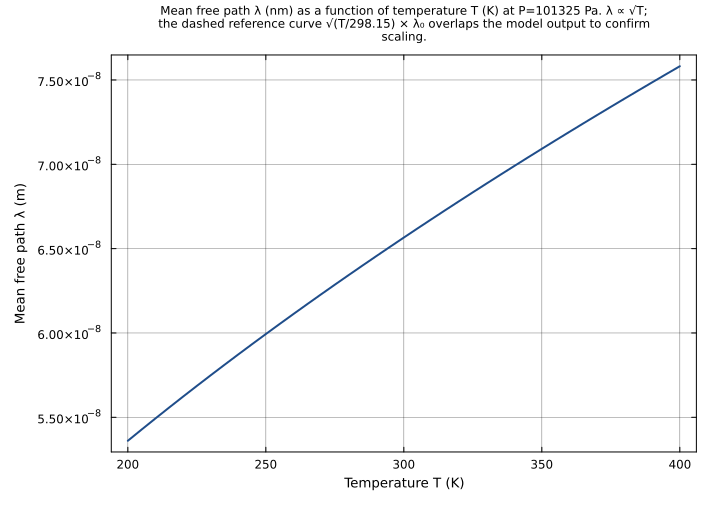
lambda_vs_temperature
Sweep temperature T from 200 K to 400 K log-spaced at standard pressure (P=101325 Pa). λ ∝ √T — the mean free path grows monotonically with temperature as the gas expands and molecules move faster. At 200 K λ ≈ 53.7 nm; at 400 K λ ≈ 75.8 nm.
Time span: 0.0 → 1.0
Swept over: T
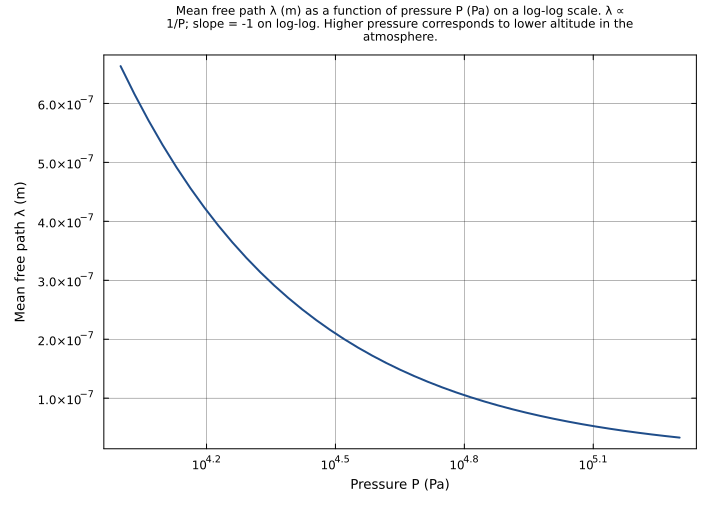
lambda_vs_pressure
Sweep pressure P from 10000 Pa (stratosphere) to 200000 Pa (deep troposphere/surface) log-spaced at T=298.15 K. λ ∝ 1/P exactly — doubling pressure halves the mean free path. At 10000 Pa λ ≈ 663 nm; at 101325 Pa λ ≈ 65.5 nm; at 200000 Pa λ ≈ 33.2 nm.
Time span: 0.0 → 1.0
Swept over: P
Raw .esm
Raw .esm JSON (this component)
{
  "reference": {
    "citation": "Seinfeld, J. H. and Pandis, S. N. (2006) Atmospheric Chemistry and Physics, 2nd Edition, Chapter 12, Section 12.1.3 — mean free path λ = 2μ/(ρ_air c̄_air) for aerosol mass transfer. Migrated from Aerosol.jl src/mass_transfer.jl `MeanFreePathMassTransfer` (esm-me7).",
    "notes": "source_ref: Aerosol.jl@FWrvp:src/mass_transfer.jl:45\n\nUpstream `MeanFreePathMassTransfer` is an MTK `@component` with 1 constant (R=8.314 J/(mol·K)), 5 parameters (T, P, M_A, M_air, μ), and 2 algebraic variables ρ_air(t) and λ(t). Both variables are determined by explicit algebraic equations with no time derivative — purely observed.\n\nEquations (S&P 2006, Chapter 12, Section 12.1.3):\n  ρ_air = P × M_air / (R × T)                        [ideal gas law for air density, kg/m³]\n  λ     = 2μ / (ρ_air × √(8RT/(πM_air)))             [mean free path, m]\n\nThe constant R = 8.314 J/(mol·K) is folded as a floating-point literal throughout; π is inlined as 3.141592653589793.\n\nNote on M_A: the upstream component declares M_A (molecular weight of species A) as a parameter with the same default as M_air (0.029 kg/mol), but M_A does not appear in either equation. It is preserved here to maintain API parity with the upstream component, which likely reserves M_A for future coupling with downstream components that parametrize a specific species. Changing M_A has no effect on the computed λ.\n\nPhysics derivation: The mean free path of a gas relates to its transport properties via λ = 2μ/(ρ c̄). This follows from the Chapman-Enskog result that the dynamic viscosity of a hard-sphere gas is μ ≈ (1/2) ρ c̄ λ, solved for λ. Combining the ideal gas law ρ = PM/(RT) with the Maxwell mean speed c̄ = √(8RT/(πM)) gives the fully explicit formula:\n  λ = 2μ R T / (P M_air √(8RT/(πM_air)))\n    = 2μ / P × √(πRT/(8M_air))\n\nScaling laws:\n  λ ∝ √T  (at fixed P, μ, M_air): faster molecules at higher T diffuse farther, so λ grows with T.\n  λ ∝ 1/P (at fixed T, μ, M_air): higher pressure → higher density → shorter mean free path.\n  λ ∝ μ   (at fixed T, P, M_air): more viscous gas means longer mean free path.\n\nAt standard conditions (T=298.15 K, P=101325 Pa, M_air=0.029 kg/mol, μ=1.81×10⁻⁵ Pa·s):\n  ρ_air ≈ 1.185 kg/m³ and λ ≈ 65.5 nm, consistent with the well-known ~65 nm atmospheric mean free path.\n\nThe intermediate variable rho_air is exposed as an observed quantity (matching the upstream model structure) so that downstream components can read air density directly if needed without recomputing it.\n\nASCII renaming: upstream Julia `ρ_air` → ESM `rho_air` (compound subscript name; consistent with MassTransferCoefficient pattern of tau_g/tau_i for τ_g/τ_i). Julia `λ` and `μ` retain their Unicode forms, consistent with the convention across the aerosol/mass_transfer migration family.\n\nTolerance rationale (model-level rel=1e-9): purely algebraic system. Both equations are finite compositions of ×, /, sqrt in float64; round-off is ~1e-15 relative. rel=1e-9 leaves six orders of magnitude of headroom, consistent with MeanMolecularSpeed (same complexity class)."
  },
  "tolerance": {
    "rel": 1e-09
  },
  "variables": {
    "T": {
      "type": "parameter",
      "units": "K",
      "default": 298.15,
      "description": "Temperature of the gas. Standard atmosphere 298.15 K. λ scales as √T at fixed pressure — higher temperature means faster molecules and a longer mean free path."
    },
    "P": {
      "type": "parameter",
      "units": "Pa",
      "default": 101325.0,
      "description": "Pressure of the gas. Standard atmosphere 101325 Pa. λ scales as 1/P at fixed temperature — higher pressure means higher density and a shorter mean free path."
    },
    "M_A": {
      "type": "parameter",
      "units": "kg/mol",
      "default": 0.029,
      "description": "Molar mass of diffusing species A. Default 0.029 kg/mol (dry air). Declared for API parity with the upstream Aerosol.jl component but does not appear in the mean-free-path equations — only M_air is used. May be relevant for future coupled systems that parametrize the species."
    },
    "M_air": {
      "type": "parameter",
      "units": "kg/mol",
      "default": 0.029,
      "description": "Molar mass of air. Default 0.029 kg/mol (dry air). Appears in both the density equation (ρ_air = PM_air/(RT)) and the mean-speed denominator (c̄ = √(8RT/(πM_air))). Increasing M_air reduces the mean molecular speed, which increases λ slightly (the density and speed effects partially cancel)."
    },
    "μ": {
      "type": "parameter",
      "units": "Pa*s",
      "default": 1.81e-05,
      "description": "Dynamic viscosity of air. Default 1.81×10⁻⁵ Pa·s at 298 K. λ is proportional to μ — more viscous gas implies a longer mean free path. Varies weakly with temperature (roughly as T^0.7 for air)."
    },
    "rho_air": {
      "type": "unknown",
      "units": "kg/m^3",
      "description": "Air density from the ideal gas law: ρ_air = P M_air / (R T), where R = 8.314 J/(mol·K). Intermediate quantity used in the mean-free-path calculation; exposed as an observed variable to match the upstream model structure and allow downstream components to read air density directly."
    },
    "λ": {
      "type": "unknown",
      "units": "m",
      "description": "Mean free path of gas molecules in air: λ = 2μ / (ρ_air × √(8RT/(πM_air))). At standard conditions (T=298.15 K, P=101325 Pa, μ=1.81×10⁻⁵ Pa·s, M_air=0.029 kg/mol), λ ≈ 65.5 nm. Used to compute the Knudsen number Kn = λ/R_p (knudsen.esm), which determines the aerosol mass-transfer regime."
    }
  },
  "equations": [
    {
      "lhs": "rho_air",
      "rhs": {
        "op": "/",
        "args": [
          {
            "op": "*",
            "args": [
              "P",
              "M_air"
            ]
          },
          {
            "op": "*",
            "args": [
              8.314,
              "T"
            ]
          }
        ]
      }
    },
    {
      "lhs": "λ",
      "rhs": {
        "op": "/",
        "args": [
          {
            "op": "*",
            "args": [
              2.0,
              "μ"
            ]
          },
          {
            "op": "*",
            "args": [
              "rho_air",
              {
                "op": "sqrt",
                "args": [
                  {
                    "op": "/",
                    "args": [
                      {
                        "op": "*",
                        "args": [
                          8.0,
                          8.314,
                          "T"
                        ]
                      },
                      {
                        "op": "*",
                        "args": [
                          3.141592653589793,
                          "M_air"
                        ]
                      }
                    ]
                  }
                ]
              }
            ]
          }
        ]
      }
    }
  ],
  "tests": [
    {
      "id": "default_conditions",
      "description": "Default parameters: T=298.15 K, P=101325 Pa, M_air=0.029 kg/mol, μ=1.81×10⁻⁵ Pa·s. ρ_air = 101325×0.029/(8.314×298.15) ≈ 1.1854 kg/m³. λ ≈ 65.5 nm, consistent with the well-known atmospheric mean free path at standard conditions. Anchors the model at its declared defaults.",
      "time_span": {
        "start": 0.0,
        "end": 1.0
      },
      "assertions": [
        {
          "variable": "rho_air",
          "time": 0.0,
          "expected": 1.185413247783995,
          "tolerance": {
            "rel": 1e-09
          }
        },
        {
          "variable": "λ",
          "time": 0.0,
          "expected": 6.545537554702463e-08,
          "tolerance": {
            "rel": 1e-09
          }
        }
      ]
    },
    {
      "id": "high_temperature",
      "description": "Elevated temperature: T=350 K, all other parameters at default. λ scales as √T: λ(350)/λ(298.15) = √(350/298.15) ≈ 1.0835. λ ≈ 70.9 nm. ρ_air decreases as 1/T (gas expands). Exercises the T dependence in both equations.",
      "time_span": {
        "start": 0.0,
        "end": 1.0
      },
      "parameter_overrides": {
        "T": 350.0
      },
      "assertions": [
        {
          "variable": "rho_air",
          "time": 0.0,
          "expected": 1.009802742362281,
          "tolerance": {
            "rel": 1e-09
          }
        },
        {
          "variable": "λ",
          "time": 0.0,
          "expected": 7.091889077384121e-08,
          "tolerance": {
            "rel": 1e-09
          }
        }
      ]
    },
    {
      "id": "low_pressure",
      "description": "Half-atmosphere pressure: P=50662.5 Pa, all other parameters at default. λ scales as 1/P exactly (density halves, mean speed unchanged). ρ_air ≈ 0.5927 kg/m³; λ ≈ 130.9 nm — exactly double the standard-condition value. Confirms the 1/P scaling.",
      "time_span": {
        "start": 0.0,
        "end": 1.0
      },
      "parameter_overrides": {
        "P": 50662.5
      },
      "assertions": [
        {
          "variable": "rho_air",
          "time": 0.0,
          "expected": 0.5927066238919977,
          "tolerance": {
            "rel": 1e-09
          }
        },
        {
          "variable": "λ",
          "time": 0.0,
          "expected": 1.309107510940493e-07,
          "tolerance": {
            "rel": 1e-09
          }
        }
      ]
    },
    {
      "id": "higher_viscosity",
      "description": "Increased dynamic viscosity: μ=2.0×10⁻⁵ Pa·s (representative of air at ~380 K), all other parameters at default. λ scales linearly with μ: λ(2e-5)/λ(1.81e-5) = 2e-5/1.81e-5 ≈ 1.1050. λ ≈ 72.3 nm. ρ_air unchanged. Confirms the linear μ dependence.",
      "time_span": {
        "start": 0.0,
        "end": 1.0
      },
      "parameter_overrides": {
        "μ": 2e-05
      },
      "assertions": [
        {
          "variable": "rho_air",
          "time": 0.0,
          "expected": 1.185413247783995,
          "tolerance": {
            "rel": 1e-09
          }
        },
        {
          "variable": "λ",
          "time": 0.0,
          "expected": 7.232638181991674e-08,
          "tolerance": {
            "rel": 1e-09
          }
        }
      ]
    },
    {
      "id": "nitrogen_molar_mass",
      "description": "Pure nitrogen carrier gas: M_air=0.028 kg/mol (N₂, slightly lighter than dry air at 0.029 kg/mol). ρ_air decreases ∝ M_air; c̄_air increases ∝ M_air^{-1/2}. Net effect: λ ∝ M_air^{-1/2}, so λ(0.028)/λ(0.029) = √(0.029/0.028) ≈ 1.0175. λ ≈ 66.6 nm. Exercises the M_air wiring in both equations.",
      "time_span": {
        "start": 0.0,
        "end": 1.0
      },
      "parameter_overrides": {
        "M_air": 0.028
      },
      "assertions": [
        {
          "variable": "rho_air",
          "time": 0.0,
          "expected": 1.144536928894892,
          "tolerance": {
            "rel": 1e-09
          }
        },
        {
          "variable": "λ",
          "time": 0.0,
          "expected": 6.661396771485982e-08,
          "tolerance": {
            "rel": 1e-09
          }
        }
      ]
    }
  ],
  "analyses": [
    {
      "id": "lambda_vs_temperature",
      "description": "Sweep temperature T from 200 K to 400 K log-spaced at standard pressure (P=101325 Pa). λ ∝ √T — the mean free path grows monotonically with temperature as the gas expands and molecules move faster. At 200 K λ ≈ 53.7 nm; at 400 K λ ≈ 75.8 nm.",
      "initial_state": {},
      "parameters": {},
      "time_span": {
        "start": 0.0,
        "end": 1.0
      },
      "parameter_sweep": {
        "type": "cartesian",
        "dimensions": [
          {
            "parameter": "T",
            "range": {
              "start": 200.0,
              "stop": 400.0,
              "count": 41,
              "scale": "linear"
            }
          }
        ]
      },
      "plots": [
        {
          "id": "lambda_vs_T",
          "type": "line",
          "description": "Mean free path λ (nm) as a function of temperature T (K) at P=101325 Pa. λ ∝ √T; the dashed reference curve √(T/298.15) × λ₀ overlaps the model output to confirm scaling.",
          "x": {
            "variable": "T",
            "label": "Temperature T (K)"
          },
          "y": {
            "variable": "λ",
            "label": "Mean free path λ (m)"
          }
        }
      ]
    },
    {
      "id": "lambda_vs_pressure",
      "description": "Sweep pressure P from 10000 Pa (stratosphere) to 200000 Pa (deep troposphere/surface) log-spaced at T=298.15 K. λ ∝ 1/P exactly — doubling pressure halves the mean free path. At 10000 Pa λ ≈ 663 nm; at 101325 Pa λ ≈ 65.5 nm; at 200000 Pa λ ≈ 33.2 nm.",
      "initial_state": {},
      "parameters": {},
      "time_span": {
        "start": 0.0,
        "end": 1.0
      },
      "parameter_sweep": {
        "type": "cartesian",
        "dimensions": [
          {
            "parameter": "P",
            "range": {
              "start": 10000.0,
              "stop": 200000.0,
              "count": 41,
              "scale": "log"
            }
          }
        ]
      },
      "plots": [
        {
          "id": "lambda_vs_P",
          "type": "line",
          "description": "Mean free path λ (m) as a function of pressure P (Pa) on a log-log scale. λ ∝ 1/P; slope = -1 on log-log. Higher pressure corresponds to lower altitude in the atmosphere.",
          "x": {
            "variable": "P",
            "label": "Pressure P (Pa)"
          },
          "y": {
            "variable": "λ",
            "label": "Mean free path λ (m)"
          }
        }
      ]
    }
  ]
}