FuchsSutugin
Fuchs-Sutugin transition-regime correction factor for aerosol mass transfer. f_FS = J/J_c is the ratio of the actual flux to the continuum-regime flux J_c; it interpolates between f_FS → 1 in the continuum limit (Kn ≪ 1) and f_FS → 0 in the free-molecular limit (Kn ≫ 1). The formula f_FS = 0.75α(1+Kn)/(Kn²+Kn+0.283Kn·α+0.75α) (Seinfeld & Pandis 2006, Chapter 12, Eq. 12.43) is the most widely used semi-empirical interpolation across the full Knudsen number range, and extends the original Fuchs (1934) result with an explicit accommodation-coefficient correction due to Sutugin. Migrated from Aerosol.jl src/mass_transfer.jl `FuchsSutugin`.
Description
Fuchs-Sutugin transition-regime correction factor for aerosol mass transfer. f_FS = J/J_c is the ratio of the actual flux to the continuum-regime flux J_c; it interpolates between f_FS → 1 in the continuum limit (Kn ≪ 1) and f_FS → 0 in the free-molecular limit (Kn ≫ 1). The formula f_FS = 0.75α(1+Kn)/(Kn²+Kn+0.283Kn·α+0.75α) (Seinfeld & Pandis 2006, Chapter 12, Eq. 12.43) is the most widely used semi-empirical interpolation across the full Knudsen number range, and extends the original Fuchs (1934) result with an explicit accommodation-coefficient correction due to Sutugin. Migrated from Aerosol.jl src/mass_transfer.jl FuchsSutugin.
Reference
Seinfeld, J. H. and Pandis, S. N. (2006) Atmospheric Chemistry and Physics, 2nd Edition, Chapter 12, Eq. 12.43 — Fuchs-Sutugin semi-empirical interpolation for transition-regime mass transfer. Migrated from Aerosol.jl src/mass_transfer.jl FuchsSutugin (esm-wrq).
_source_ref: Aerosol.jl@FWrvp:src/mass_transfer.jl:117
Upstream FuchsSutugin is an MTK @component with 2 parameters (Kn, α) and 1 variable f_FS(t) determined by one explicit algebraic equation with no time derivative — purely observed.
Equation (S&P 2006, Eq. 12.43): f_FS = 0.75α(1 + Kn) / (Kn² + Kn + 0.283Kn·α + 0.75α) [dimensionless]
Physics: The formula interpolates between the continuum limit and the free-molecular limit: Kn → 0 (continuum): f_FS → 0.75α / (0.75α) = 1.0 (no correction) Kn → ∞ (free-molecular): f_FS → 0.75α·Kn / Kn² = 0.75α/Kn → 0
The constant 0.283 is an empirical fitting coefficient from Fuchs and Sutugin (1971) that achieves continuity with the free-molecular regime kinetic theory result. The accommodation coefficient α (range 0 to 1] modulates both numerator and denominator; when α = 1, the formula reduces to the original Fuchs-Sutugin form without explicit accommodation.
Knudsen number Kn = λ/R_p where λ is the gas mean free path and R_p the particle radius. In the atmosphere at standard conditions, λ ≈ 65 nm, so Kn ≈ 0.65 for R_p = 0.1 µm (sub-micron aerosol) and Kn ≈ 0.0065 for R_p = 10 µm (large droplet). The transition regime (Kn ~ 0.1–10) is where f_FS deviates significantly from both limits.
f_FS is multiplied by the continuum-regime flux J_c (from MaxwellianFlux) to give the actual transition-regime flux J = f_FS × J_c. See MassTransfer for the complete coupled system.
Tolerance rationale (model-level rel=1e-12): purely algebraic expression; a ratio of two polynomials in float64. The only nonlinearity is Kn²; round-off is ~1e-15 relative, and rel=1e-12 leaves three orders of headroom, consistent with the maxwellian_flux.esm convention._
Parameters
| Name | Units | Default | Description |
|---|---|---|---|
Kn | 1 | 1.0 | Knudsen number Kn = λ/R_p, the ratio of the gas mean free path λ to the particle radius R_p. Kn ≪ 1 is the continuum regime; Kn ≫ 1 is the free-molecular regime; Kn ~ 1 is the transition regime where this correction is most important. Default 1.0 places the system in the middle of the transition regime. |
α | 1 | 1.0 | Mass accommodation coefficient: dimensionless probability (0, 1] that a gas molecule striking the particle surface is irreversibly taken up. α = 1.0 (perfect accommodation) gives the original Fuchs (1934) formula; smaller α reduces f_FS and the effective mass-transfer rate. Default 1.0. |
Observed
| Name | Units | Default | Description |
|---|---|---|---|
f_FS | 1 | Fuchs-Sutugin correction factor f_FS = J/J_c (Eq. 12.43): ratio of the actual molar flux to the continuum-regime flux. Dimensionless; range (0, 1]. Approaches 1 in the continuum limit (Kn ≪ 1), approaches 0 in the free-molecular limit (Kn ≫ 1). Multiply by J_c from MaxwellianFlux to obtain the transition-regime flux J. |
Observed expressions
$$ f_{FS} = \frac{0.75 \cdot α \cdot \left(1.0 + Kn\right)}{Kn^{2} + Kn + 0.283 \cdot Kn \cdot α + 0.75 \cdot α} $$Fuchs-Sutugin correction factor f_FS = J/J_c (Eq. 12.43): ratio of the actual molar flux to the continuum-regime flux. Dimensionless; range (0, 1]. Approaches 1 in the continuum limit (Kn ≪ 1), approaches 0 in the free-molecular limit (Kn ≫ 1). Multiply by J_c from MaxwellianFlux to obtain the transition-regime flux J.
Analyses
fFS_vs_Kn
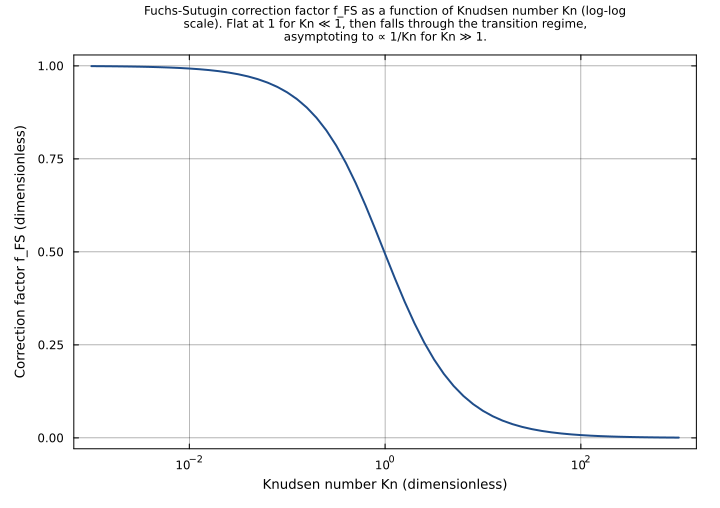
Sweep Knudsen number Kn from 0.001 to 1000 log-spaced at α=1.0 (perfect accommodation). f_FS transitions from ≈1 in the continuum limit (Kn ≪ 1) to ≈0 in the free-molecular limit (Kn ≫ 1). The transition region Kn ~ 0.1–10 corresponds to sub-micron aerosol particles in the lower atmosphere (λ ≈ 65 nm, R_p ≈ 7 nm–650 nm).
Time span: 0.0 → 1.0
Swept over: Kn
fFS_vs_alpha
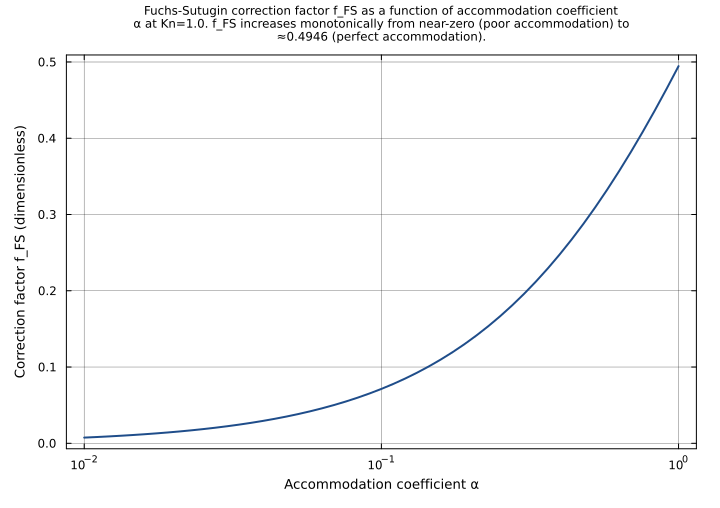
Sweep accommodation coefficient α from 0.01 to 1.0 log-spaced at Kn=1.0 (middle of transition regime). f_FS increases with α: at α=1 f_FS ≈ 0.4946; as α → 0, both the numerator and denominator shrink but the denominator is less sensitive, so f_FS → 0. Illustrates how poor accommodation (low α) suppresses mass transfer in addition to the geometric Knudsen-number effect.
Time span: 0.0 → 1.0
Swept over: α
Raw .esm
Raw .esm JSON (this component)
{
  "reference": {
    "citation": "Seinfeld, J. H. and Pandis, S. N. (2006) Atmospheric Chemistry and Physics, 2nd Edition, Chapter 12, Eq. 12.43 — Fuchs-Sutugin semi-empirical interpolation for transition-regime mass transfer. Migrated from Aerosol.jl src/mass_transfer.jl `FuchsSutugin` (esm-wrq).",
    "notes": "source_ref: Aerosol.jl@FWrvp:src/mass_transfer.jl:117\n\nUpstream `FuchsSutugin` is an MTK `@component` with 2 parameters (Kn, α) and 1 variable f_FS(t) determined by one explicit algebraic equation with no time derivative — purely observed.\n\nEquation (S&P 2006, Eq. 12.43):\n  f_FS = 0.75α(1 + Kn) / (Kn² + Kn + 0.283Kn·α + 0.75α)   [dimensionless]\n\nPhysics: The formula interpolates between the continuum limit and the free-molecular limit:\n  Kn → 0 (continuum):      f_FS → 0.75α / (0.75α) = 1.0   (no correction)\n  Kn → ∞ (free-molecular): f_FS → 0.75α·Kn / Kn² = 0.75α/Kn → 0\n\nThe constant 0.283 is an empirical fitting coefficient from Fuchs and Sutugin (1971) that achieves continuity with the free-molecular regime kinetic theory result. The accommodation coefficient α (range 0 to 1] modulates both numerator and denominator; when α = 1, the formula reduces to the original Fuchs-Sutugin form without explicit accommodation.\n\nKnudsen number Kn = λ/R_p where λ is the gas mean free path and R_p the particle radius. In the atmosphere at standard conditions, λ ≈ 65 nm, so Kn ≈ 0.65 for R_p = 0.1 µm (sub-micron aerosol) and Kn ≈ 0.0065 for R_p = 10 µm (large droplet). The transition regime (Kn ~ 0.1–10) is where f_FS deviates significantly from both limits.\n\nf_FS is multiplied by the continuum-regime flux J_c (from MaxwellianFlux) to give the actual transition-regime flux J = f_FS × J_c. See MassTransfer for the complete coupled system.\n\nTolerance rationale (model-level rel=1e-12): purely algebraic expression; a ratio of two polynomials in float64. The only nonlinearity is Kn²; round-off is ~1e-15 relative, and rel=1e-12 leaves three orders of headroom, consistent with the maxwellian_flux.esm convention."
  },
  "tolerance": {
    "rel": 1e-12
  },
  "variables": {
    "Kn": {
      "type": "parameter",
      "units": "1",
      "default": 1.0,
      "description": "Knudsen number Kn = λ/R_p, the ratio of the gas mean free path λ to the particle radius R_p. Kn ≪ 1 is the continuum regime; Kn ≫ 1 is the free-molecular regime; Kn ~ 1 is the transition regime where this correction is most important. Default 1.0 places the system in the middle of the transition regime."
    },
    "α": {
      "type": "parameter",
      "units": "1",
      "default": 1.0,
      "description": "Mass accommodation coefficient: dimensionless probability (0, 1] that a gas molecule striking the particle surface is irreversibly taken up. α = 1.0 (perfect accommodation) gives the original Fuchs (1934) formula; smaller α reduces f_FS and the effective mass-transfer rate. Default 1.0."
    },
    "f_FS": {
      "type": "unknown",
      "units": "1",
      "description": "Fuchs-Sutugin correction factor f_FS = J/J_c (Eq. 12.43): ratio of the actual molar flux to the continuum-regime flux. Dimensionless; range (0, 1]. Approaches 1 in the continuum limit (Kn ≪ 1), approaches 0 in the free-molecular limit (Kn ≫ 1). Multiply by J_c from MaxwellianFlux to obtain the transition-regime flux J."
    }
  },
  "equations": [
    {
      "lhs": "f_FS",
      "rhs": {
        "op": "/",
        "args": [
          {
            "op": "*",
            "args": [
              0.75,
              "α",
              {
                "op": "+",
                "args": [
                  1.0,
                  "Kn"
                ]
              }
            ]
          },
          {
            "op": "+",
            "args": [
              {
                "op": "^",
                "args": [
                  "Kn",
                  2
                ]
              },
              "Kn",
              {
                "op": "*",
                "args": [
                  0.283,
                  "Kn",
                  "α"
                ]
              },
              {
                "op": "*",
                "args": [
                  0.75,
                  "α"
                ]
              }
            ]
          }
        ]
      }
    }
  ],
  "tests": [
    {
      "id": "default_conditions",
      "description": "Default parameters: Kn=1.0, α=1.0. f_FS = 0.75×1×2 / (1+1+0.283+0.75) = 1.5/3.033 ≈ 0.4946. Anchors the model at its declared defaults in the middle of the transition regime.",
      "time_span": {
        "start": 0.0,
        "end": 1.0
      },
      "assertions": [
        {
          "variable": "f_FS",
          "time": 0.0,
          "expected": 0.49455984174085066,
          "tolerance": {
            "rel": 1e-12
          }
        }
      ]
    },
    {
      "id": "continuum_limit",
      "description": "Near-continuum regime: Kn=0.01, α=1.0. f_FS → 1 as Kn → 0; numerically ≈ 0.9929. Verifies that the correction factor is close to unity when the particle is much larger than the mean free path.",
      "time_span": {
        "start": 0.0,
        "end": 1.0
      },
      "parameter_overrides": {
        "Kn": 0.01
      },
      "assertions": [
        {
          "variable": "f_FS",
          "time": 0.0,
          "expected": 0.9928827022138336,
          "tolerance": {
            "rel": 1e-12
          }
        }
      ]
    },
    {
      "id": "free_molecular_limit",
      "description": "Deep free-molecular regime: Kn=100.0, α=1.0. f_FS ≈ 0.75α/Kn → 0; numerically ≈ 0.00748. Verifies the strong suppression of the continuum-regime flux in the free-molecular regime.",
      "time_span": {
        "start": 0.0,
        "end": 1.0
      },
      "parameter_overrides": {
        "Kn": 100.0
      },
      "assertions": [
        {
          "variable": "f_FS",
          "time": 0.0,
          "expected": 0.007478490085447303,
          "tolerance": {
            "rel": 1e-12
          }
        }
      ]
    },
    {
      "id": "reduced_accommodation",
      "description": "Reduced accommodation coefficient: Kn=1.0, α=0.5. f_FS = 0.75×0.5×2 / (1+1+0.1415+0.375) = 0.75/2.5165 ≈ 0.2980. Verifies that lower α reduces f_FS — less accommodation means less efficient mass transfer even after the Knudsen-regime correction.",
      "time_span": {
        "start": 0.0,
        "end": 1.0
      },
      "parameter_overrides": {
        "α": 0.5
      },
      "assertions": [
        {
          "variable": "f_FS",
          "time": 0.0,
          "expected": 0.2980329823167097,
          "tolerance": {
            "rel": 1e-12
          }
        }
      ]
    },
    {
      "id": "transition_regime",
      "description": "Upper transition / lower free-molecular regime: Kn=10.0, α=1.0. f_FS ≈ 0.0726. Exercises the Kn² term in the denominator, which dominates at intermediate-to-large Kn.",
      "time_span": {
        "start": 0.0,
        "end": 1.0
      },
      "parameter_overrides": {
        "Kn": 10.0
      },
      "assertions": [
        {
          "variable": "f_FS",
          "time": 0.0,
          "expected": 0.07263602746962494,
          "tolerance": {
            "rel": 1e-12
          }
        }
      ]
    }
  ],
  "analyses": [
    {
      "id": "fFS_vs_Kn",
      "description": "Sweep Knudsen number Kn from 0.001 to 1000 log-spaced at α=1.0 (perfect accommodation). f_FS transitions from ≈1 in the continuum limit (Kn ≪ 1) to ≈0 in the free-molecular limit (Kn ≫ 1). The transition region Kn ~ 0.1–10 corresponds to sub-micron aerosol particles in the lower atmosphere (λ ≈ 65 nm, R_p ≈ 7 nm–650 nm).",
      "initial_state": {},
      "parameters": {},
      "time_span": {
        "start": 0.0,
        "end": 1.0
      },
      "parameter_sweep": {
        "type": "cartesian",
        "dimensions": [
          {
            "parameter": "Kn",
            "range": {
              "start": 0.001,
              "stop": 1000.0,
              "count": 61,
              "scale": "log"
            }
          }
        ]
      },
      "plots": [
        {
          "id": "fFS_vs_Kn_plot",
          "type": "line",
          "description": "Fuchs-Sutugin correction factor f_FS as a function of Knudsen number Kn (log-log scale). Flat at 1 for Kn ≪ 1, then falls through the transition regime, asymptoting to ∝ 1/Kn for Kn ≫ 1.",
          "x": {
            "variable": "Kn",
            "label": "Knudsen number Kn (dimensionless)"
          },
          "y": {
            "variable": "f_FS",
            "label": "Correction factor f_FS (dimensionless)"
          }
        }
      ]
    },
    {
      "id": "fFS_vs_alpha",
      "description": "Sweep accommodation coefficient α from 0.01 to 1.0 log-spaced at Kn=1.0 (middle of transition regime). f_FS increases with α: at α=1 f_FS ≈ 0.4946; as α → 0, both the numerator and denominator shrink but the denominator is less sensitive, so f_FS → 0. Illustrates how poor accommodation (low α) suppresses mass transfer in addition to the geometric Knudsen-number effect.",
      "initial_state": {},
      "parameters": {},
      "time_span": {
        "start": 0.0,
        "end": 1.0
      },
      "parameter_sweep": {
        "type": "cartesian",
        "dimensions": [
          {
            "parameter": "α",
            "range": {
              "start": 0.01,
              "stop": 1.0,
              "count": 51,
              "scale": "log"
            }
          }
        ]
      },
      "plots": [
        {
          "id": "fFS_vs_alpha_plot",
          "type": "line",
          "description": "Fuchs-Sutugin correction factor f_FS as a function of accommodation coefficient α at Kn=1.0. f_FS increases monotonically from near-zero (poor accommodation) to ≈0.4946 (perfect accommodation).",
          "x": {
            "variable": "α",
            "label": "Accommodation coefficient α"
          },
          "y": {
            "variable": "f_FS",
            "label": "Correction factor f_FS (dimensionless)"
          }
        }
      ]
    }
  ]
}