Solids
Aggregate container for the 19 solid-phase salt species in the ISORROPIA II inorganic thermodynamic equilibrium model. Composes 19 named Solid instances — one per solid salt that can form in the K⁺-Ca²⁺-Mg²⁺-NH₄⁺-Na⁺-SO₄²⁻-NO₃⁻-Cl⁻-H₂O system — into a single subsystem bundle. Each Solid carries a single state variable M(t) [mol/m³] representing the molarity of that salt in air; in isolation M is conserved (D(M)/dt = 0). Source/sink terms are injected through the coupling mechanism when Solids is composed into the parent Isorropia system. Reference: Fountoukis and Nenes (2007), ISORROPIA II.
Description
Aggregate container for the 19 solid-phase salt species in the ISORROPIA II inorganic thermodynamic equilibrium model. Composes 19 named Solid instances — one per solid salt that can form in the K⁺-Ca²⁺-Mg²⁺-NH₄⁺-Na⁺-SO₄²⁻-NO₃⁻-Cl⁻-H₂O system — into a single subsystem bundle. Each Solid carries a single state variable M(t) [mol/m³] representing the molarity of that salt in air; in isolation M is conserved (D(M)/dt = 0). Source/sink terms are injected through the coupling mechanism when Solids is composed into the parent Isorropia system. Reference: Fountoukis and Nenes (2007), ISORROPIA II.
Reference
Fountoukis, C. and Nenes, A. (2007) ISORROPIA II, Atmos. Chem. Phys. 7(17), 4639–4659 — solid-phase salt species. Migrated from Aerosol.jl src/isorropia/solid.jl Solids (esm-6w1).
_source_ref: Aerosol.jl@c8c640bb636b22f2425460e9ed5cba50793bfee1:src/isorropia/solid.jl:22
Upstream Solids is an MTK @component that composes 19 named Solid instances into a single aggregate and returns System(eqs=[], t; systems=[…], name). There are no top-level equations or variables — Solids is a pure aggregator that makes individual solid molarities accessible via dot notation (e.g., Solids.NH4NO3.M, Solids.CaNO32.M).
The 19 solid salt instances correspond to the full K⁺-Ca²⁺-Mg²⁺-NH₄⁺-Na⁺-SO₄²⁻-NO₃⁻-Cl⁻-H₂O thermodynamic case from ISORROPIA II Table 2: NH42SO4 — (NH4)2SO4, ammonium sulfate NH4HSO4 — NH4HSO4, ammonium bisulfate LC — (NH4)3H(SO4)2, letovicite (standard ISORROPIA abbreviation) NH4NO3 — NH4NO3, ammonium nitrate NH4Cl — NH4Cl, ammonium chloride Na2SO4 — Na2SO4, sodium sulfate NaHSO4 — NaHSO4, sodium bisulfate NaNO3 — NaNO3, sodium nitrate NaCl — NaCl, sodium chloride CaSO4 — CaSO4, calcium sulfate CaNO32 — Ca(NO3)2, calcium nitrate CaCl2 — CaCl2, calcium chloride K2SO4 — K2SO4, potassium sulfate KHSO4 — KHSO4, potassium bisulfate KNO3 — KNO3, potassium nitrate KCl — KCl, potassium chloride MgSO4 — MgSO4, magnesium sulfate MgNO32 — Mg(NO3)2, magnesium nitrate MgCl2 — MgCl2, magnesium chloride
Each subsystem’s M(t) [mol/m³] satisfies D(M)/dt = 0 in isolation (the conserved-tracer convention; same as the standalone Solid component and elemental_carbon.esm). The upstream Solid carries guess = 1e-20 mol/m³; this is preserved as the default initial condition for each M in this composite model.
In the full Isorropia system, the parent component supplies source/sink equations for each M through coupling, so the trivial D(M)/dt = 0 equations are overridden at coupling time. These equations exist here solely to make the standalone model self-contained and its tests mechanically runnable.
ESM representation: the 19 instances are encoded as inline subsystems (ESS spec §4.7). Each subsystem has one state variable M and one equation D(M)/dt = 0. Top-level variables and equations are empty.
Tolerance rationale (model-level rel=1e-9): each subsystem integrates D(M)/dt = 0, the same trivial ODE as the standalone Solid component. Solver round-off is ~1e-15 relative; rel=1e-9 leaves six orders of margin, matching solid.esm._
Analyses
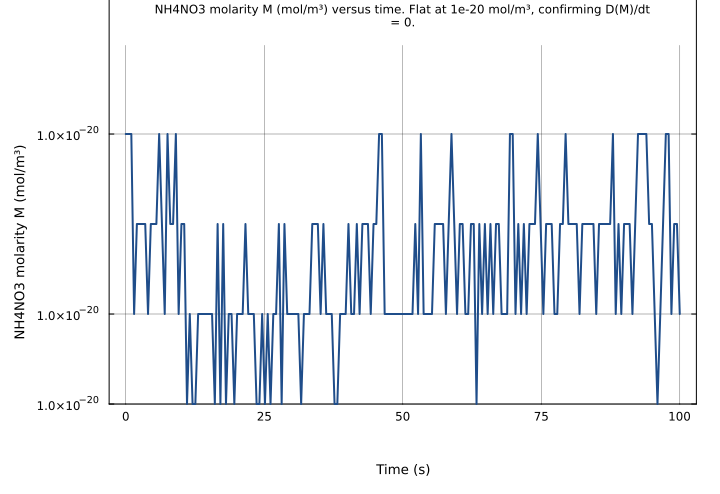
nh4no3_molarity_conserved_over_time
Time evolution of NH4NO3 (ammonium nitrate) molarity from t = 0 to 100 s, starting at the guess value 1e-20 mol/m³. Because D(M)/dt = 0, the trajectory is a flat line at 1e-20 mol/m³. Illustrates the conserved-tracer behaviour of a single solid in the standalone Solids container.
Time span: 0.0 → 100.0
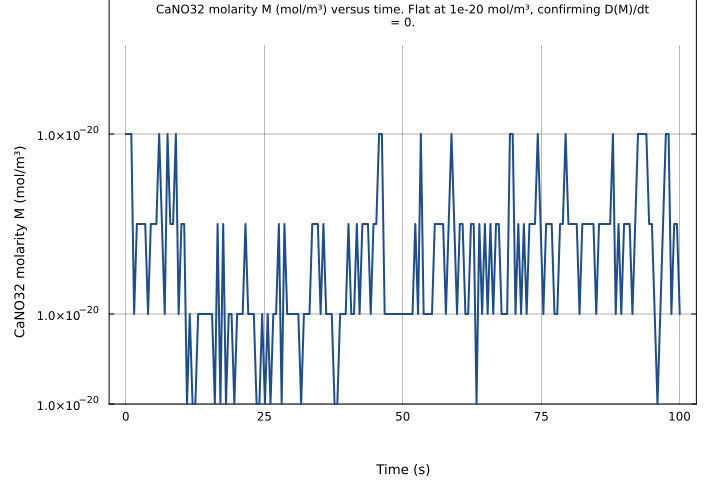
cano32_molarity_conserved_over_time
Time evolution of CaNO32 (calcium nitrate) molarity from t = 0 to 100 s, starting at 1e-20 mol/m³. Flat trajectory confirms D(M)/dt = 0 and that the Ca²⁺ salt subsystem is independent of the NH₄⁺ salts.
Time span: 0.0 → 100.0
Raw .esm
Raw .esm JSON (this component)
{
"reference": {
"citation": "Fountoukis, C. and Nenes, A. (2007) ISORROPIA II, Atmos. Chem. Phys. 7(17), 4639–4659 — solid-phase salt species. Migrated from Aerosol.jl src/isorropia/solid.jl `Solids` (esm-6w1).",
"notes": "source_ref: Aerosol.jl@c8c640bb636b22f2425460e9ed5cba50793bfee1:src/isorropia/solid.jl:22\n\nUpstream `Solids` is an MTK @component that composes 19 named `Solid` instances into a single aggregate and returns System(eqs=[], t; systems=[...], name). There are no top-level equations or variables — Solids is a pure aggregator that makes individual solid molarities accessible via dot notation (e.g., Solids.NH4NO3.M, Solids.CaNO32.M).\n\nThe 19 solid salt instances correspond to the full K⁺-Ca²⁺-Mg²⁺-NH₄⁺-Na⁺-SO₄²⁻-NO₃⁻-Cl⁻-H₂O thermodynamic case from ISORROPIA II Table 2:\n NH42SO4 — (NH4)2SO4, ammonium sulfate\n NH4HSO4 — NH4HSO4, ammonium bisulfate\n LC — (NH4)3H(SO4)2, letovicite (standard ISORROPIA abbreviation)\n NH4NO3 — NH4NO3, ammonium nitrate\n NH4Cl — NH4Cl, ammonium chloride\n Na2SO4 — Na2SO4, sodium sulfate\n NaHSO4 — NaHSO4, sodium bisulfate\n NaNO3 — NaNO3, sodium nitrate\n NaCl — NaCl, sodium chloride\n CaSO4 — CaSO4, calcium sulfate\n CaNO32 — Ca(NO3)2, calcium nitrate\n CaCl2 — CaCl2, calcium chloride\n K2SO4 — K2SO4, potassium sulfate\n KHSO4 — KHSO4, potassium bisulfate\n KNO3 — KNO3, potassium nitrate\n KCl — KCl, potassium chloride\n MgSO4 — MgSO4, magnesium sulfate\n MgNO32 — Mg(NO3)2, magnesium nitrate\n MgCl2 — MgCl2, magnesium chloride\n\nEach subsystem's M(t) [mol/m³] satisfies D(M)/dt = 0 in isolation (the conserved-tracer convention; same as the standalone Solid component and elemental_carbon.esm). The upstream `Solid` carries guess = 1e-20 mol/m³; this is preserved as the default initial condition for each M in this composite model.\n\nIn the full Isorropia system, the parent component supplies source/sink equations for each M through coupling, so the trivial D(M)/dt = 0 equations are overridden at coupling time. These equations exist here solely to make the standalone model self-contained and its tests mechanically runnable.\n\nESM representation: the 19 instances are encoded as inline subsystems (ESS spec §4.7). Each subsystem has one state variable M and one equation D(M)/dt = 0. Top-level variables and equations are empty.\n\nTolerance rationale (model-level rel=1e-9): each subsystem integrates D(M)/dt = 0, the same trivial ODE as the standalone Solid component. Solver round-off is ~1e-15 relative; rel=1e-9 leaves six orders of margin, matching solid.esm."
},
"tolerance": {
"rel": 1e-09
},
"variables": {},
"equations": [],
"subsystems": {
"NH42SO4": {
"variables": {
"M": {
"type": "unknown",
"units": "mol/m^3",
"default": 1e-20,
"description": "Molarity of (NH4)2SO4 (ammonium sulfate) solid in air. Conserved: D(M)/dt = 0 in standalone use; coupled Isorropia adds source/sink terms."
}
},
"equations": [
{
"lhs": {
"op": "D",
"args": [
"M"
],
"wrt": "t"
},
"rhs": 0
}
]
},
"NH4HSO4": {
"variables": {
"M": {
"type": "unknown",
"units": "mol/m^3",
"default": 1e-20,
"description": "Molarity of NH4HSO4 (ammonium bisulfate) solid in air. Conserved: D(M)/dt = 0 in standalone use."
}
},
"equations": [
{
"lhs": {
"op": "D",
"args": [
"M"
],
"wrt": "t"
},
"rhs": 0
}
]
},
"LC": {
"variables": {
"M": {
"type": "unknown",
"units": "mol/m^3",
"default": 1e-20,
"description": "Molarity of (NH4)3H(SO4)2 (letovicite, abbreviated LC) solid in air. Conserved: D(M)/dt = 0 in standalone use."
}
},
"equations": [
{
"lhs": {
"op": "D",
"args": [
"M"
],
"wrt": "t"
},
"rhs": 0
}
]
},
"NH4NO3": {
"variables": {
"M": {
"type": "unknown",
"units": "mol/m^3",
"default": 1e-20,
"description": "Molarity of NH4NO3 (ammonium nitrate) solid in air. Conserved: D(M)/dt = 0 in standalone use."
}
},
"equations": [
{
"lhs": {
"op": "D",
"args": [
"M"
],
"wrt": "t"
},
"rhs": 0
}
]
},
"NH4Cl": {
"variables": {
"M": {
"type": "unknown",
"units": "mol/m^3",
"default": 1e-20,
"description": "Molarity of NH4Cl (ammonium chloride) solid in air. Conserved: D(M)/dt = 0 in standalone use."
}
},
"equations": [
{
"lhs": {
"op": "D",
"args": [
"M"
],
"wrt": "t"
},
"rhs": 0
}
]
},
"Na2SO4": {
"variables": {
"M": {
"type": "unknown",
"units": "mol/m^3",
"default": 1e-20,
"description": "Molarity of Na2SO4 (sodium sulfate) solid in air. Conserved: D(M)/dt = 0 in standalone use."
}
},
"equations": [
{
"lhs": {
"op": "D",
"args": [
"M"
],
"wrt": "t"
},
"rhs": 0
}
]
},
"NaHSO4": {
"variables": {
"M": {
"type": "unknown",
"units": "mol/m^3",
"default": 1e-20,
"description": "Molarity of NaHSO4 (sodium bisulfate) solid in air. Conserved: D(M)/dt = 0 in standalone use."
}
},
"equations": [
{
"lhs": {
"op": "D",
"args": [
"M"
],
"wrt": "t"
},
"rhs": 0
}
]
},
"NaNO3": {
"variables": {
"M": {
"type": "unknown",
"units": "mol/m^3",
"default": 1e-20,
"description": "Molarity of NaNO3 (sodium nitrate) solid in air. Conserved: D(M)/dt = 0 in standalone use."
}
},
"equations": [
{
"lhs": {
"op": "D",
"args": [
"M"
],
"wrt": "t"
},
"rhs": 0
}
]
},
"NaCl": {
"variables": {
"M": {
"type": "unknown",
"units": "mol/m^3",
"default": 1e-20,
"description": "Molarity of NaCl (sodium chloride) solid in air. Conserved: D(M)/dt = 0 in standalone use."
}
},
"equations": [
{
"lhs": {
"op": "D",
"args": [
"M"
],
"wrt": "t"
},
"rhs": 0
}
]
},
"CaSO4": {
"variables": {
"M": {
"type": "unknown",
"units": "mol/m^3",
"default": 1e-20,
"description": "Molarity of CaSO4 (calcium sulfate) solid in air. Conserved: D(M)/dt = 0 in standalone use."
}
},
"equations": [
{
"lhs": {
"op": "D",
"args": [
"M"
],
"wrt": "t"
},
"rhs": 0
}
]
},
"CaNO32": {
"variables": {
"M": {
"type": "unknown",
"units": "mol/m^3",
"default": 1e-20,
"description": "Molarity of Ca(NO3)2 (calcium nitrate) solid in air. Conserved: D(M)/dt = 0 in standalone use."
}
},
"equations": [
{
"lhs": {
"op": "D",
"args": [
"M"
],
"wrt": "t"
},
"rhs": 0
}
]
},
"CaCl2": {
"variables": {
"M": {
"type": "unknown",
"units": "mol/m^3",
"default": 1e-20,
"description": "Molarity of CaCl2 (calcium chloride) solid in air. Conserved: D(M)/dt = 0 in standalone use."
}
},
"equations": [
{
"lhs": {
"op": "D",
"args": [
"M"
],
"wrt": "t"
},
"rhs": 0
}
]
},
"K2SO4": {
"variables": {
"M": {
"type": "unknown",
"units": "mol/m^3",
"default": 1e-20,
"description": "Molarity of K2SO4 (potassium sulfate) solid in air. Conserved: D(M)/dt = 0 in standalone use."
}
},
"equations": [
{
"lhs": {
"op": "D",
"args": [
"M"
],
"wrt": "t"
},
"rhs": 0
}
]
},
"KHSO4": {
"variables": {
"M": {
"type": "unknown",
"units": "mol/m^3",
"default": 1e-20,
"description": "Molarity of KHSO4 (potassium bisulfate) solid in air. Conserved: D(M)/dt = 0 in standalone use."
}
},
"equations": [
{
"lhs": {
"op": "D",
"args": [
"M"
],
"wrt": "t"
},
"rhs": 0
}
]
},
"KNO3": {
"variables": {
"M": {
"type": "unknown",
"units": "mol/m^3",
"default": 1e-20,
"description": "Molarity of KNO3 (potassium nitrate) solid in air. Conserved: D(M)/dt = 0 in standalone use."
}
},
"equations": [
{
"lhs": {
"op": "D",
"args": [
"M"
],
"wrt": "t"
},
"rhs": 0
}
]
},
"KCl": {
"variables": {
"M": {
"type": "unknown",
"units": "mol/m^3",
"default": 1e-20,
"description": "Molarity of KCl (potassium chloride) solid in air. Conserved: D(M)/dt = 0 in standalone use."
}
},
"equations": [
{
"lhs": {
"op": "D",
"args": [
"M"
],
"wrt": "t"
},
"rhs": 0
}
]
},
"MgSO4": {
"variables": {
"M": {
"type": "unknown",
"units": "mol/m^3",
"default": 1e-20,
"description": "Molarity of MgSO4 (magnesium sulfate) solid in air. Conserved: D(M)/dt = 0 in standalone use."
}
},
"equations": [
{
"lhs": {
"op": "D",
"args": [
"M"
],
"wrt": "t"
},
"rhs": 0
}
]
},
"MgNO32": {
"variables": {
"M": {
"type": "unknown",
"units": "mol/m^3",
"default": 1e-20,
"description": "Molarity of Mg(NO3)2 (magnesium nitrate) solid in air. Conserved: D(M)/dt = 0 in standalone use."
}
},
"equations": [
{
"lhs": {
"op": "D",
"args": [
"M"
],
"wrt": "t"
},
"rhs": 0
}
]
},
"MgCl2": {
"variables": {
"M": {
"type": "unknown",
"units": "mol/m^3",
"default": 1e-20,
"description": "Molarity of MgCl2 (magnesium chloride) solid in air. Conserved: D(M)/dt = 0 in standalone use."
}
},
"equations": [
{
"lhs": {
"op": "D",
"args": [
"M"
],
"wrt": "t"
},
"rhs": 0
}
]
}
},
"tests": [
{
"id": "all_solids_conserved_at_guess_ic",
"description": "All 19 solid molarities start at the upstream guess value 1e-20 mol/m³ (no initial_conditions override — defaults apply). D(M)/dt = 0 for every subsystem means each M is conserved at 1e-20 mol/m³ for all t. Checks a representative sample spanning NH4⁺ salts (NH42SO4, NH4NO3), Na⁺ (NaCl), Ca²⁺ (CaNO32), K⁺ (KNO3), and Mg²⁺ (MgCl2) at t = 0 and t = 1 s.",
"time_span": {
"start": 0.0,
"end": 1.0
},
"assertions": [
{
"variable": "NH42SO4.M",
"time": 0.0,
"expected": 1e-20
},
{
"variable": "NH42SO4.M",
"time": 1.0,
"expected": 1e-20
},
{
"variable": "NH4NO3.M",
"time": 0.0,
"expected": 1e-20
},
{
"variable": "NH4NO3.M",
"time": 1.0,
"expected": 1e-20
},
{
"variable": "NaCl.M",
"time": 0.0,
"expected": 1e-20
},
{
"variable": "NaCl.M",
"time": 1.0,
"expected": 1e-20
},
{
"variable": "CaNO32.M",
"time": 0.0,
"expected": 1e-20
},
{
"variable": "CaNO32.M",
"time": 1.0,
"expected": 1e-20
},
{
"variable": "KNO3.M",
"time": 0.0,
"expected": 1e-20
},
{
"variable": "KNO3.M",
"time": 1.0,
"expected": 1e-20
},
{
"variable": "MgCl2.M",
"time": 0.0,
"expected": 1e-20
},
{
"variable": "MgCl2.M",
"time": 1.0,
"expected": 1e-20
}
]
},
{
"id": "all_solids_at_representative_concentration",
"description": "All 19 molarities set to 1e-7 mol/m³ (representative aerosol concentration, similar to NH in Species). D(M)/dt = 0 conserves every M at 1e-7 mol/m³. Checks NH4HSO4, LC (letovicite), NaHSO4, CaSO4, KHSO4, and MgSO4 at t = 0 and t = 1 s.",
"time_span": {
"start": 0.0,
"end": 1.0
},
"initial_conditions": {
"Solids.NH42SO4.M": 1e-07,
"Solids.NH4HSO4.M": 1e-07,
"Solids.LC.M": 1e-07,
"Solids.NH4NO3.M": 1e-07,
"Solids.NH4Cl.M": 1e-07,
"Solids.Na2SO4.M": 1e-07,
"Solids.NaHSO4.M": 1e-07,
"Solids.NaNO3.M": 1e-07,
"Solids.NaCl.M": 1e-07,
"Solids.CaSO4.M": 1e-07,
"Solids.CaNO32.M": 1e-07,
"Solids.CaCl2.M": 1e-07,
"Solids.K2SO4.M": 1e-07,
"Solids.KHSO4.M": 1e-07,
"Solids.KNO3.M": 1e-07,
"Solids.KCl.M": 1e-07,
"Solids.MgSO4.M": 1e-07,
"Solids.MgNO32.M": 1e-07,
"Solids.MgCl2.M": 1e-07
},
"assertions": [
{
"variable": "NH4HSO4.M",
"time": 0.0,
"expected": 1e-07
},
{
"variable": "NH4HSO4.M",
"time": 1.0,
"expected": 1e-07
},
{
"variable": "LC.M",
"time": 0.0,
"expected": 1e-07
},
{
"variable": "LC.M",
"time": 1.0,
"expected": 1e-07
},
{
"variable": "NaHSO4.M",
"time": 0.0,
"expected": 1e-07
},
{
"variable": "NaHSO4.M",
"time": 1.0,
"expected": 1e-07
},
{
"variable": "CaSO4.M",
"time": 0.0,
"expected": 1e-07
},
{
"variable": "CaSO4.M",
"time": 1.0,
"expected": 1e-07
},
{
"variable": "KHSO4.M",
"time": 0.0,
"expected": 1e-07
},
{
"variable": "KHSO4.M",
"time": 1.0,
"expected": 1e-07
},
{
"variable": "MgSO4.M",
"time": 0.0,
"expected": 1e-07
},
{
"variable": "MgSO4.M",
"time": 1.0,
"expected": 1e-07
}
]
},
{
"id": "all_solids_at_zero_concentration",
"description": "All 19 molarities set to 0.0 mol/m³ (no solid present). D(M)/dt = 0 keeps every M at zero. Checks NH4Cl, Na2SO4, NaNO3, CaCl2, K2SO4, KCl, and MgNO32 at t = 0 and t = 1 s. Uses absolute tolerance because expected value is exactly zero.",
"time_span": {
"start": 0.0,
"end": 1.0
},
"initial_conditions": {
"Solids.NH42SO4.M": 0.0,
"Solids.NH4HSO4.M": 0.0,
"Solids.LC.M": 0.0,
"Solids.NH4NO3.M": 0.0,
"Solids.NH4Cl.M": 0.0,
"Solids.Na2SO4.M": 0.0,
"Solids.NaHSO4.M": 0.0,
"Solids.NaNO3.M": 0.0,
"Solids.NaCl.M": 0.0,
"Solids.CaSO4.M": 0.0,
"Solids.CaNO32.M": 0.0,
"Solids.CaCl2.M": 0.0,
"Solids.K2SO4.M": 0.0,
"Solids.KHSO4.M": 0.0,
"Solids.KNO3.M": 0.0,
"Solids.KCl.M": 0.0,
"Solids.MgSO4.M": 0.0,
"Solids.MgNO32.M": 0.0,
"Solids.MgCl2.M": 0.0
},
"assertions": [
{
"variable": "NH4Cl.M",
"time": 0.0,
"expected": 0.0,
"tolerance": {
"abs": 1e-20
}
},
{
"variable": "NH4Cl.M",
"time": 1.0,
"expected": 0.0,
"tolerance": {
"abs": 1e-20
}
},
{
"variable": "Na2SO4.M",
"time": 0.0,
"expected": 0.0,
"tolerance": {
"abs": 1e-20
}
},
{
"variable": "Na2SO4.M",
"time": 1.0,
"expected": 0.0,
"tolerance": {
"abs": 1e-20
}
},
{
"variable": "NaNO3.M",
"time": 0.0,
"expected": 0.0,
"tolerance": {
"abs": 1e-20
}
},
{
"variable": "NaNO3.M",
"time": 1.0,
"expected": 0.0,
"tolerance": {
"abs": 1e-20
}
},
{
"variable": "CaCl2.M",
"time": 0.0,
"expected": 0.0,
"tolerance": {
"abs": 1e-20
}
},
{
"variable": "CaCl2.M",
"time": 1.0,
"expected": 0.0,
"tolerance": {
"abs": 1e-20
}
},
{
"variable": "K2SO4.M",
"time": 0.0,
"expected": 0.0,
"tolerance": {
"abs": 1e-20
}
},
{
"variable": "K2SO4.M",
"time": 1.0,
"expected": 0.0,
"tolerance": {
"abs": 1e-20
}
},
{
"variable": "KCl.M",
"time": 0.0,
"expected": 0.0,
"tolerance": {
"abs": 1e-20
}
},
{
"variable": "KCl.M",
"time": 1.0,
"expected": 0.0,
"tolerance": {
"abs": 1e-20
}
},
{
"variable": "MgNO32.M",
"time": 0.0,
"expected": 0.0,
"tolerance": {
"abs": 1e-20
}
},
{
"variable": "MgNO32.M",
"time": 1.0,
"expected": 0.0,
"tolerance": {
"abs": 1e-20
}
}
]
},
{
"id": "independence_nh4no3_unit_rest_guess",
"description": "Verify subsystem independence: NH4NO3.M set to 1.0 mol/m³ while all other solids use the guess default (1e-20 mol/m³). D(M)/dt = 0 is uncoupled across subsystems, so NH4NO3.M must stay at 1.0 and CaNO32.M must stay at 1e-20. Demonstrates that the 19 ODEs evolve independently.",
"time_span": {
"start": 0.0,
"end": 1.0
},
"initial_conditions": {
"Solids.NH42SO4.M": 1e-20,
"Solids.NH4HSO4.M": 1e-20,
"Solids.LC.M": 1e-20,
"Solids.NH4NO3.M": 1.0,
"Solids.NH4Cl.M": 1e-20,
"Solids.Na2SO4.M": 1e-20,
"Solids.NaHSO4.M": 1e-20,
"Solids.NaNO3.M": 1e-20,
"Solids.NaCl.M": 1e-20,
"Solids.CaSO4.M": 1e-20,
"Solids.CaNO32.M": 1e-20,
"Solids.CaCl2.M": 1e-20,
"Solids.K2SO4.M": 1e-20,
"Solids.KHSO4.M": 1e-20,
"Solids.KNO3.M": 1e-20,
"Solids.KCl.M": 1e-20,
"Solids.MgSO4.M": 1e-20,
"Solids.MgNO32.M": 1e-20,
"Solids.MgCl2.M": 1e-20
},
"assertions": [
{
"variable": "NH4NO3.M",
"time": 0.0,
"expected": 1.0
},
{
"variable": "NH4NO3.M",
"time": 1.0,
"expected": 1.0
},
{
"variable": "CaNO32.M",
"time": 0.0,
"expected": 1e-20
},
{
"variable": "CaNO32.M",
"time": 1.0,
"expected": 1e-20
},
{
"variable": "MgCl2.M",
"time": 1.0,
"expected": 1e-20
}
]
}
],
"analyses": [
{
"id": "nh4no3_molarity_conserved_over_time",
"description": "Time evolution of NH4NO3 (ammonium nitrate) molarity from t = 0 to 100 s, starting at the guess value 1e-20 mol/m³. Because D(M)/dt = 0, the trajectory is a flat line at 1e-20 mol/m³. Illustrates the conserved-tracer behaviour of a single solid in the standalone Solids container.",
"initial_state": {},
"time_span": {
"start": 0.0,
"end": 100.0
},
"plots": [
{
"id": "nh4no3_vs_time",
"type": "line",
"description": "NH4NO3 molarity M (mol/m³) versus time. Flat at 1e-20 mol/m³, confirming D(M)/dt = 0.",
"x": {
"variable": "t",
"label": "Time (s)"
},
"y": {
"variable": "NH4NO3.M",
"label": "NH4NO3 molarity M (mol/m³)"
}
}
]
},
{
"id": "cano32_molarity_conserved_over_time",
"description": "Time evolution of CaNO32 (calcium nitrate) molarity from t = 0 to 100 s, starting at 1e-20 mol/m³. Flat trajectory confirms D(M)/dt = 0 and that the Ca²⁺ salt subsystem is independent of the NH₄⁺ salts.",
"initial_state": {},
"time_span": {
"start": 0.0,
"end": 100.0
},
"plots": [
{
"id": "cano32_vs_time",
"type": "line",
"description": "CaNO32 molarity M (mol/m³) versus time. Flat at 1e-20 mol/m³, confirming D(M)/dt = 0.",
"x": {
"variable": "t",
"label": "Time (s)"
},
"y": {
"variable": "CaNO32.M",
"label": "CaNO32 molarity M (mol/m³)"
}
}
]
}
]
}