Solid
A solid-phase aerosol species placeholder in the ISORROPIA II inorganic thermodynamic equilibrium model. Holds the molarity of a single solid salt in air. In isolation the concentration is conserved (D(M)/dt = 0); source and sink terms are added through the coupling mechanism when Solid instances are composed into the full Isorropia system. Reference: Fountoukis and Nenes (2007), ISORROPIA II.
Description
A solid-phase aerosol species placeholder in the ISORROPIA II inorganic thermodynamic equilibrium model. Holds the molarity of a single solid salt in air. In isolation the concentration is conserved (D(M)/dt = 0); source and sink terms are added through the coupling mechanism when Solid instances are composed into the full Isorropia system. Reference: Fountoukis and Nenes (2007), ISORROPIA II.
Reference
Fountoukis, C. and Nenes, A. (2007). ISORROPIA II: a computationally efficient thermodynamic equilibrium model for K+-Ca2+-Mg2+-NH4+-Na+-SO42–NO3–Cl–H2O aerosols. Atmospheric Chemistry and Physics, 7(17), 4639-4659. https://doi.org/10.5194/acp-7-4639-2007
_source_ref: Aerosol.jl@c8c640bb636b22f2425460e9ed5cba50793bfee1:src/isorropia/solid.jl:6
Upstream Solid is a minimal MTK @component — System(eqs, t; name) with eqs = [] — that declares a single scalar @variables entry: M(t) with description = "Molarity of the solid in air", unit = u"mol/m^3", and guess = 1.0e-20. There are no @parameters and no @constants blocks.
Role in ISORROPIA II: Solid is a building-block fragment. In the full Isorropia system, multiple named Solid instances (CaNO32, CaCl2, NH4NO3, etc.) are composed into a Solids aggregate and coupled to the parent system, which supplies the source/sink equations for each M. In isolation M has no equation, so the standalone ESM adds D(M)/dt = 0 — the conserved-tracer convention used across EarthSciModels (cf. elemental_carbon.esm) — so that the component is self-contained and its inline tests are mechanically runnable.
Equation choice: D(M)/dt = 0 is the only equation consistent with the empty eqs = [] upstream body and the requirement that a standalone .esm model be testable. It is not asserted as a physical law of the coupled Isorropia system; it represents the behaviour of this fragment when driven by no external coupling.
guess = 1.0e-20: the upstream @variables metadata carries an initial-guess seed of 1.0e-20 mol/m^3 for the ISORROPIA II nonlinear solver. This hint is preserved in the guesses block at the model level for fidelity; it is not used by the ODE runner for the standalone D(M)/dt = 0 tests but is available to runners that use nonlinear initialization.
Test strategy: D(M)/dt = 0 means M equals its initial condition at all times. Tests pin M at the upstream guess value (1e-20 mol/m^3), a representative physically meaningful concentration (1.0 mol/m^3), and zero (no solid present). The zero case uses an absolute tolerance because a relative tolerance is ill-conditioned when the expected value is exactly zero.
Not migrated: the companion Solids component at src/isorropia/solid.jl:22, which couples multiple named Solid instances, is tracked separately (target: components/aerosol/isorropia/solids.esm)._
Variables
| Name | Units | Default | Description |
|---|---|---|---|
M | mol/m^3 | Molarity of the solid in air. Conserved tracer in this standalone component (D(M)/dt = 0); source and sink terms are added through coupling in the full Isorropia system. |
Equations
$$ \mathrm{D}\left(M\right) = 0 $$Analyses
solid_concentration_vs_time
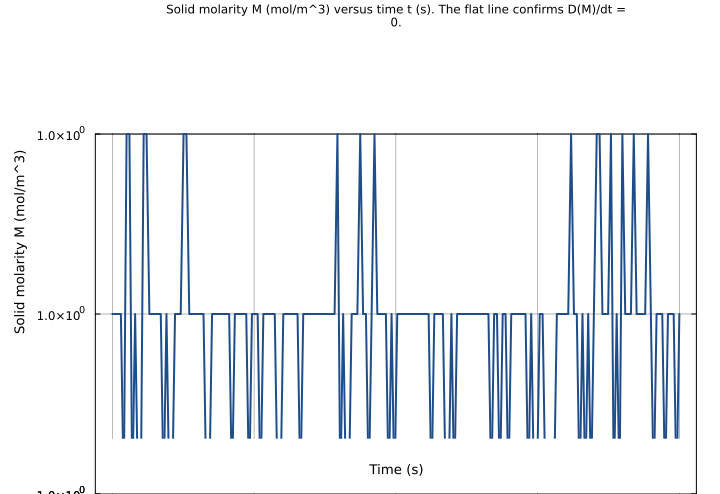
Solid aerosol molarity M versus time. Starting from M0 = 1.0 mol/m^3 and integrating D(M)/dt = 0, M is conserved at M0 for all t. Illustrates the conserved-tracer behaviour of the standalone Solid component.
Time span: 0.0 → 1.0
Raw .esm
Raw .esm JSON (this component)
{
  "reference": {
    "citation": "Fountoukis, C. and Nenes, A. (2007). ISORROPIA II: a computationally efficient thermodynamic equilibrium model for K+-Ca2+-Mg2+-NH4+-Na+-SO42--NO3--Cl--H2O aerosols. Atmospheric Chemistry and Physics, 7(17), 4639-4659. https://doi.org/10.5194/acp-7-4639-2007",
    "notes": "source_ref: Aerosol.jl@c8c640bb636b22f2425460e9ed5cba50793bfee1:src/isorropia/solid.jl:6\n\nUpstream `Solid` is a minimal MTK `@component` — `System(eqs, t; name)` with `eqs = []` — that declares a single scalar `@variables` entry: `M(t)` with `description = \"Molarity of the solid in air\"`, `unit = u\"mol/m^3\"`, and `guess = 1.0e-20`. There are no `@parameters` and no `@constants` blocks.\n\nRole in ISORROPIA II: `Solid` is a building-block fragment. In the full `Isorropia` system, multiple named `Solid` instances (CaNO32, CaCl2, NH4NO3, etc.) are composed into a `Solids` aggregate and coupled to the parent system, which supplies the source/sink equations for each `M`. In isolation `M` has no equation, so the standalone ESM adds `D(M)/dt = 0` — the conserved-tracer convention used across EarthSciModels (cf. elemental_carbon.esm) — so that the component is self-contained and its inline tests are mechanically runnable.\n\nEquation choice: `D(M)/dt = 0` is the only equation consistent with the empty `eqs = []` upstream body and the requirement that a standalone `.esm` model be testable. It is not asserted as a physical law of the coupled Isorropia system; it represents the behaviour of this fragment when driven by no external coupling.\n\nguess = 1.0e-20: the upstream `@variables` metadata carries an initial-guess seed of 1.0e-20 mol/m^3 for the ISORROPIA II nonlinear solver. This hint is preserved in the `guesses` block at the model level for fidelity; it is not used by the ODE runner for the standalone D(M)/dt = 0 tests but is available to runners that use nonlinear initialization.\n\nTest strategy: D(M)/dt = 0 means M equals its initial condition at all times. Tests pin M at the upstream guess value (1e-20 mol/m^3), a representative physically meaningful concentration (1.0 mol/m^3), and zero (no solid present). The zero case uses an absolute tolerance because a relative tolerance is ill-conditioned when the expected value is exactly zero.\n\nNot migrated: the companion `Solids` component at src/isorropia/solid.jl:22, which couples multiple named `Solid` instances, is tracked separately (target: components/aerosol/isorropia/solids.esm)."
  },
  "tolerance": {
    "rel": 1e-09
  },
  "guesses": {
    "M": 1e-20
  },
  "variables": {
    "M": {
      "type": "unknown",
      "units": "mol/m^3",
      "description": "Molarity of the solid in air. Conserved tracer in this standalone component (D(M)/dt = 0); source and sink terms are added through coupling in the full Isorropia system."
    }
  },
  "equations": [
    {
      "lhs": {
        "op": "D",
        "args": [
          "M"
        ],
        "wrt": "t"
      },
      "rhs": 0
    }
  ],
  "tests": [
    {
      "id": "guess_ic_conserved",
      "description": "Initial condition M = 1e-20 mol/m^3, the upstream guess value. D(M)/dt = 0 means M is conserved at its initial value at all times. Checks at t = 0, 0.5, and 1 s.",
      "time_span": {
        "start": 0.0,
        "end": 1.0
      },
      "initial_conditions": {
        "M": 1e-20
      },
      "assertions": [
        {
          "variable": "M",
          "time": 0.0,
          "expected": 1e-20
        },
        {
          "variable": "M",
          "time": 0.5,
          "expected": 1e-20
        },
        {
          "variable": "M",
          "time": 1.0,
          "expected": 1e-20
        }
      ]
    },
    {
      "id": "unit_concentration_conserved",
      "description": "Initial condition M = 1.0 mol/m^3, a representative aerosol solid concentration. D(M)/dt = 0 means M remains 1.0 mol/m^3 at all times.",
      "time_span": {
        "start": 0.0,
        "end": 1.0
      },
      "initial_conditions": {
        "M": 1.0
      },
      "assertions": [
        {
          "variable": "M",
          "time": 0.0,
          "expected": 1.0
        },
        {
          "variable": "M",
          "time": 0.5,
          "expected": 1.0
        },
        {
          "variable": "M",
          "time": 1.0,
          "expected": 1.0
        }
      ]
    },
    {
      "id": "zero_concentration_conserved",
      "description": "Initial condition M = 0.0 mol/m^3 (no solid present). D(M)/dt = 0 means M stays zero at all times. Uses an absolute tolerance because the expected value is exactly zero.",
      "time_span": {
        "start": 0.0,
        "end": 1.0
      },
      "initial_conditions": {
        "M": 0.0
      },
      "assertions": [
        {
          "variable": "M",
          "time": 0.0,
          "expected": 0.0,
          "tolerance": {
            "abs": 1e-20
          }
        },
        {
          "variable": "M",
          "time": 1.0,
          "expected": 0.0,
          "tolerance": {
            "abs": 1e-20
          }
        }
      ]
    }
  ],
  "analyses": [
    {
      "id": "solid_concentration_vs_time",
      "description": "Solid aerosol molarity M versus time. Starting from M0 = 1.0 mol/m^3 and integrating D(M)/dt = 0, M is conserved at M0 for all t. Illustrates the conserved-tracer behaviour of the standalone Solid component.",
      "time_span": {
        "start": 0.0,
        "end": 1.0
      },
      "initial_state": {
        "M": 1.0
      },
      "plots": [
        {
          "id": "M_vs_t",
          "type": "line",
          "description": "Solid molarity M (mol/m^3) versus time t (s). The flat line confirms D(M)/dt = 0.",
          "x": {
            "variable": "t",
            "label": "Time (s)"
          },
          "y": {
            "variable": "M",
            "label": "Solid molarity M (mol/m^3)"
          }
        }
      ]
    }
  ]
}