HenrysLaw
Basic Henry's law equilibrium at fixed temperature (Seinfeld & Pandis 2006, Chapter 7, Eq. 7.3). Computes the aqueous-phase concentration C_aq = H_A × p_A, where H_A is the Henry's law constant at the reference temperature and p_A is the gas-phase partial pressure of species A. Migrated from Aerosol.jl src/henrys_law.jl `HenrysLaw` (esm-3ro).
Description
Basic Henry’s law equilibrium at fixed temperature (Seinfeld & Pandis 2006, Chapter 7, Eq. 7.3). Computes the aqueous-phase concentration C_aq = H_A × p_A, where H_A is the Henry’s law constant at the reference temperature and p_A is the gas-phase partial pressure of species A. Migrated from Aerosol.jl src/henrys_law.jl HenrysLaw (esm-3ro).
Reference
Seinfeld, J. H. and Pandis, S. N. (2006) Atmospheric Chemistry and Physics, 2nd Edition, Chapter 7, Eq. 7.3 — basic Henry’s law equilibrium: C_aq = H_A × p_A. Migrated from Aerosol.jl src/henrys_law.jl HenrysLaw (esm-3ro).
_source_ref: Aerosol.jl@main:src/henrys_law.jl:101
Upstream HenrysLaw is an MTK @component with 1 parameter (H_A, mol/m³/Pa) and 2 variables (p_A(t) Pa, C_aq(t) mol/m³). The single equation is:
C_aq ~ H_A * p_A
Topological note: C_aq depends only on parameter H_A and driving variable p_A with no ODE integration. The system is purely algebraic (observed variable only). p_A is an @variable in the upstream MTK component supplied externally as the input; in this .esm it is represented as a parameter so the system is well-posed under the schema’s equation-count rule (one equation per state) and to match the observed-only pattern used elsewhere in this rig (see components/aerosol/mass_transfer/mean_molecular_speed.esm, components/aerosol/henrys_law/effective_henrys_law.esm). Tests vary p_A via parameter_overrides.
Physics: Eq. 7.3 is the fundamental Henry’s law: the equilibrium aqueous-phase concentration of a dissolved gas equals the product of its Henry’s law constant and its gas-phase partial pressure. H_A has units mol/m³/Pa (SI), obtained by converting the tabulated M/atm values (Table 7.2) via ×1000/101325. For fixed-temperature applications only; see HenrysLawTemperature for the van’t Hoff temperature correction.
Tolerance rationale (model-level rel=1e-9): purely algebraic system with a single multiplication. Float64 round-off is ~1e-15 relative; rel=1e-9 leaves six orders of magnitude headroom._
Parameters
| Name | Units | Default | Description |
|---|---|---|---|
H_A | mol/m^3/Pa | 1.0 | Henry’s law constant for species A at the reference temperature. Determines the solubility of the gas: higher H_A means the species partitions more strongly into the aqueous phase. SI value obtained by converting the tabulated M/atm constant (Table 7.2) via ×1000/101325. |
p_A | Pa | 1.0 | Gas-phase partial pressure of species A. Input parameter — the observed-only model has one algebraic equation for C_aq given p_A. Higher p_A drives more species into the aqueous phase proportionally. Tests vary p_A via parameter_overrides. |
Observed
| Name | Units | Default | Description |
|---|---|---|---|
C_aq | mol/m^3 | Aqueous-phase concentration of species A at equilibrium: C_aq = H_A × p_A (Eq. 7.3). Positive-definite for positive H_A and p_A. Scales linearly with both inputs. |
Observed expressions
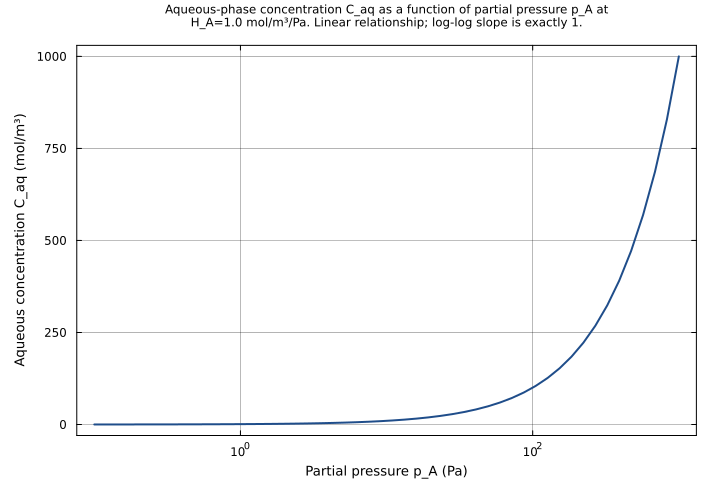
$$ C_{aq} = H_{A} \cdot p_{A} $$Aqueous-phase concentration of species A at equilibrium: C_aq = H_A × p_A (Eq. 7.3). Positive-definite for positive H_A and p_A. Scales linearly with both inputs.
Analyses
concentration_vs_pressure
Sweep partial pressure p_A from 0.1 Pa to 1000 Pa at H_A=1.0 mol/m³/Pa. C_aq scales linearly with p_A; the slope in a log-log plot is exactly 1.0. Illustrates the direct proportionality of aqueous-phase loading to gas-phase partial pressure.
Time span: 0.0 → 1.0
Swept over: p_A
solubility_comparison
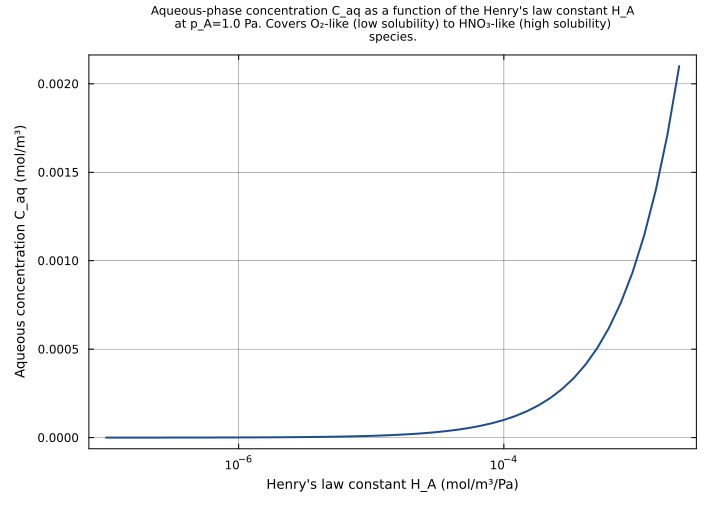
Sweep H_A from 1e-7 mol/m³/Pa (low-solubility gas like O₂: ~1.3e-7) to 2.1e-3 mol/m³/Pa (high-solubility gas like HNO₃: ~2.07e-3) at fixed p_A=1.0 Pa. Illustrates how Henry’s law constant controls equilibrium partitioning across three decades of solubility.
Time span: 0.0 → 1.0
Swept over: H_A
Raw .esm
Raw .esm JSON (this component)
{
  "reference": {
    "citation": "Seinfeld, J. H. and Pandis, S. N. (2006) Atmospheric Chemistry and Physics, 2nd Edition, Chapter 7, Eq. 7.3 — basic Henry's law equilibrium: C_aq = H_A × p_A. Migrated from Aerosol.jl src/henrys_law.jl `HenrysLaw` (esm-3ro).",
    "notes": "source_ref: Aerosol.jl@main:src/henrys_law.jl:101\n\nUpstream `HenrysLaw` is an MTK `@component` with 1 parameter (H_A, mol/m³/Pa) and 2 variables (p_A(t) Pa, C_aq(t) mol/m³). The single equation is:\n  C_aq ~ H_A * p_A\n\nTopological note: C_aq depends only on parameter H_A and driving variable p_A with no ODE integration. The system is purely algebraic (observed variable only). p_A is an `@variable` in the upstream MTK component supplied externally as the input; in this .esm it is represented as a `parameter` so the system is well-posed under the schema's equation-count rule (one equation per state) and to match the observed-only pattern used elsewhere in this rig (see components/aerosol/mass_transfer/mean_molecular_speed.esm, components/aerosol/henrys_law/effective_henrys_law.esm). Tests vary p_A via `parameter_overrides`.\n\nPhysics: Eq. 7.3 is the fundamental Henry's law: the equilibrium aqueous-phase concentration of a dissolved gas equals the product of its Henry's law constant and its gas-phase partial pressure. H_A has units mol/m³/Pa (SI), obtained by converting the tabulated M/atm values (Table 7.2) via ×1000/101325. For fixed-temperature applications only; see HenrysLawTemperature for the van't Hoff temperature correction.\n\nTolerance rationale (model-level rel=1e-9): purely algebraic system with a single multiplication. Float64 round-off is ~1e-15 relative; rel=1e-9 leaves six orders of magnitude headroom."
  },
  "tolerance": {
    "rel": 1e-09
  },
  "variables": {
    "H_A": {
      "type": "parameter",
      "units": "mol/m^3/Pa",
      "default": 1.0,
      "description": "Henry's law constant for species A at the reference temperature. Determines the solubility of the gas: higher H_A means the species partitions more strongly into the aqueous phase. SI value obtained by converting the tabulated M/atm constant (Table 7.2) via ×1000/101325."
    },
    "p_A": {
      "type": "parameter",
      "units": "Pa",
      "default": 1.0,
      "description": "Gas-phase partial pressure of species A. Input parameter — the observed-only model has one algebraic equation for C_aq given p_A. Higher p_A drives more species into the aqueous phase proportionally. Tests vary p_A via parameter_overrides."
    },
    "C_aq": {
      "type": "unknown",
      "units": "mol/m^3",
      "description": "Aqueous-phase concentration of species A at equilibrium: C_aq = H_A × p_A (Eq. 7.3). Positive-definite for positive H_A and p_A. Scales linearly with both inputs."
    }
  },
  "equations": [
    {
      "lhs": "C_aq",
      "rhs": {
        "op": "*",
        "args": [
          "H_A",
          "p_A"
        ]
      }
    }
  ],
  "tests": [
    {
      "id": "unit_params",
      "description": "Both H_A=1.0 mol/m³/Pa and p_A=1.0 Pa. C_aq = 1.0 × 1.0 = 1.0 mol/m³. Verifies the equation at unit values.",
      "time_span": {
        "start": 0.0,
        "end": 1.0
      },
      "assertions": [
        {
          "variable": "C_aq",
          "time": 0.0,
          "expected": 1.0,
          "tolerance": {
            "rel": 1e-09
          }
        }
      ]
    },
    {
      "id": "pressure_proportionality",
      "description": "H_A=1.0, p_A=500.0 Pa. C_aq = 500.0 mol/m³. Verifies linear scaling with partial pressure.",
      "time_span": {
        "start": 0.0,
        "end": 1.0
      },
      "parameter_overrides": {
        "p_A": 500.0
      },
      "assertions": [
        {
          "variable": "C_aq",
          "time": 0.0,
          "expected": 500.0,
          "tolerance": {
            "rel": 1e-09
          }
        }
      ]
    },
    {
      "id": "constant_proportionality",
      "description": "H_A=4.0 mol/m³/Pa, p_A=1.0 Pa. C_aq = 4.0 × 1.0 = 4.0 mol/m³. Verifies linear scaling with the Henry's law constant.",
      "time_span": {
        "start": 0.0,
        "end": 1.0
      },
      "parameter_overrides": {
        "H_A": 4.0
      },
      "assertions": [
        {
          "variable": "C_aq",
          "time": 0.0,
          "expected": 4.0,
          "tolerance": {
            "rel": 1e-09
          }
        }
      ]
    },
    {
      "id": "product_check",
      "description": "H_A=2.0 mol/m³/Pa, p_A=50.0 Pa. C_aq = 2.0 × 50.0 = 100.0 mol/m³. Verifies both parameters simultaneously.",
      "time_span": {
        "start": 0.0,
        "end": 1.0
      },
      "parameter_overrides": {
        "H_A": 2.0,
        "p_A": 50.0
      },
      "assertions": [
        {
          "variable": "C_aq",
          "time": 0.0,
          "expected": 100.0,
          "tolerance": {
            "rel": 1e-09
          }
        }
      ]
    }
  ],
  "analyses": [
    {
      "id": "concentration_vs_pressure",
      "description": "Sweep partial pressure p_A from 0.1 Pa to 1000 Pa at H_A=1.0 mol/m³/Pa. C_aq scales linearly with p_A; the slope in a log-log plot is exactly 1.0. Illustrates the direct proportionality of aqueous-phase loading to gas-phase partial pressure.",
      "initial_state": {},
      "parameters": {
        "H_A": 1.0
      },
      "time_span": {
        "start": 0.0,
        "end": 1.0
      },
      "parameter_sweep": {
        "type": "cartesian",
        "dimensions": [
          {
            "parameter": "p_A",
            "range": {
              "start": 0.1,
              "stop": 1000.0,
              "count": 50,
              "scale": "log"
            }
          }
        ]
      },
      "plots": [
        {
          "id": "C_aq_vs_p_A",
          "type": "line",
          "description": "Aqueous-phase concentration C_aq as a function of partial pressure p_A at H_A=1.0 mol/m³/Pa. Linear relationship; log-log slope is exactly 1.",
          "x": {
            "variable": "p_A",
            "label": "Partial pressure p_A (Pa)"
          },
          "y": {
            "variable": "C_aq",
            "label": "Aqueous concentration C_aq (mol/m³)"
          }
        }
      ]
    },
    {
      "id": "solubility_comparison",
      "description": "Sweep H_A from 1e-7 mol/m³/Pa (low-solubility gas like O₂: ~1.3e-7) to 2.1e-3 mol/m³/Pa (high-solubility gas like HNO₃: ~2.07e-3) at fixed p_A=1.0 Pa. Illustrates how Henry's law constant controls equilibrium partitioning across three decades of solubility.",
      "initial_state": {},
      "parameters": {
        "p_A": 1.0
      },
      "time_span": {
        "start": 0.0,
        "end": 1.0
      },
      "parameter_sweep": {
        "type": "cartesian",
        "dimensions": [
          {
            "parameter": "H_A",
            "range": {
              "start": 1e-07,
              "stop": 0.0021,
              "count": 50,
              "scale": "log"
            }
          }
        ]
      },
      "plots": [
        {
          "id": "C_aq_vs_H_A",
          "type": "line",
          "description": "Aqueous-phase concentration C_aq as a function of the Henry's law constant H_A at p_A=1.0 Pa. Covers O₂-like (low solubility) to HNO₃-like (high solubility) species.",
          "x": {
            "variable": "H_A",
            "label": "Henry's law constant H_A (mol/m³/Pa)"
          },
          "y": {
            "variable": "C_aq",
            "label": "Aqueous concentration C_aq (mol/m³)"
          }
        }
      ]
    }
  ]
}