DahnekeHeatTransportCorrection
Correction factor β_q for heat conduction to a sphere, valid across all Knudsen numbers from the continuum to the free-molecular regime. Exactly parallel to the Dahneke mass transport correction. Computes the heat transfer Knudsen number Kn_K = 2κ/(c̄'n'_gas m_gas c_v r) and the correction factor β_q = (Kn_K+1)/(2Kn_K(Kn_K+1)/α+1). Migrated from Aerosol.jl src/dahneke_brownian_diffusion.jl:93.
Description
Correction factor β_q for heat conduction to a sphere, valid across all Knudsen numbers from the continuum to the free-molecular regime. Exactly parallel to the Dahneke mass transport correction. Computes the heat transfer Knudsen number Kn_K = 2κ/(c̄’n’_gas m_gas c_v r) and the correction factor β_q = (Kn_K+1)/(2Kn_K(Kn_K+1)/α+1). Migrated from Aerosol.jl src/dahneke_brownian_diffusion.jl:93.
Reference
Dahneke, B. (1983) Simple Kinetic Theory of Brownian Diffusion in Vapors and Aerosols, in Theory of Dispersed Multiphase Flow, Academic Press, pp. 97–133. Eqs. 5.6–5.7 — heat transfer Knudsen number Kn_K and correction factor β_q. Migrated from Aerosol.jl src/dahneke_brownian_diffusion.jl:93 @ c8c640bb (esm-03p).
_source_ref: Aerosol.jl@c8c640bb:src/dahneke_brownian_diffusion.jl:93
Upstream DahnekeHeatTransportCorrection is an MTK @component with 7 parameters (κ, n_gas, c_bar_gas, c_v, m_gas, r, α) and 2 algebraic variables (Kn_K, β_q) determined by explicit equations with no time derivative — both purely observed.
Equations (Dahneke 1983, Eqs. 5.6–5.7): Kn_K = 2κ / (c̄’_gas n_gas m_gas c_v r) [heat transfer Knudsen number, Eq. 5.6] β_q = (Kn_K+1) / (2 Kn_K (Kn_K+1) / α + 1) [heat transport correction factor, Eq. 5.7]
The formula is exactly parallel to the Dahneke mass transport correction (mass_transport.esm), with the heat transfer Knudsen number Kn_K replacing Kn_D and the thermal accommodation coefficient α replacing the sticking coefficient δ.
Dimensional analysis of Kn_K: κ [W/(m·K)], c̄’ [m/s], n’ [m^-3], m [kg], c_v [J/(kg·K)], r [m] denominator: [m/s][m^-3][kg][J/(kg·K)][m] = [W/(m·K)] Kn_K is dimensionless ✓
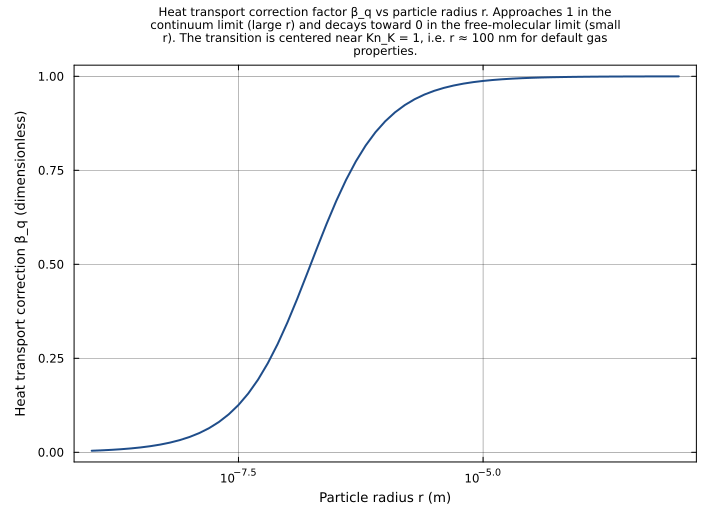
Limiting cases: Kn_K → 0 (large r, continuum): β_q → 1 (no correction) Kn_K → ∞ (small r, free-molecular): β_q → α/(2 Kn_K) → 0 (strong reduction)
At Kn_K = 1 with α = 1: β_q = 2 / (4+1) = 2/5 = 0.4 exactly.
Evaluation order: (κ, n_gas, c_bar_gas, m_gas, c_v, r) → Kn_K → (α) → β_q. Acyclic dependency graph.
Tolerance rationale (model-level rel=1e-9): purely algebraic system with two explicit rational expressions in float64. Round-off is ~1e-15 relative; rel=1e-9 leaves six orders of headroom — same as capillary_penetration.esm with comparable arithmetic complexity._
Parameters
| Name | Units | Default | Description |
|---|---|---|---|
κ | W/(m*K) | 0.026 | Thermal conductivity of the suspending gas. Default 0.026 W/(m·K) (dry air at 298 K). |
n_gas | m^-3 | 2.46e+25 | Number concentration of suspending gas molecules. Default 2.46×10²⁵ m⁻³ (ideal gas at 298 K, 1 atm). |
c_bar_gas | m/s | 500.0 | Mean thermal velocity of gas molecules. Default 500 m/s (approximate for N₂ at 298 K). |
c_v | J/(kg*K) | 718.0 | Specific heat at constant volume of the gas (per unit mass). Default 718 J/(kg·K) (diatomic ideal gas, e.g. N₂ at 298 K). |
m_gas | kg | 4.81e-26 | Mass of a single gas molecule. Default 4.81×10⁻²⁶ kg (N₂, M ≈ 28 g/mol). |
r | m | 1e-07 | Sphere (droplet/particle) radius. Default 100 nm — transition-regime aerosol. |
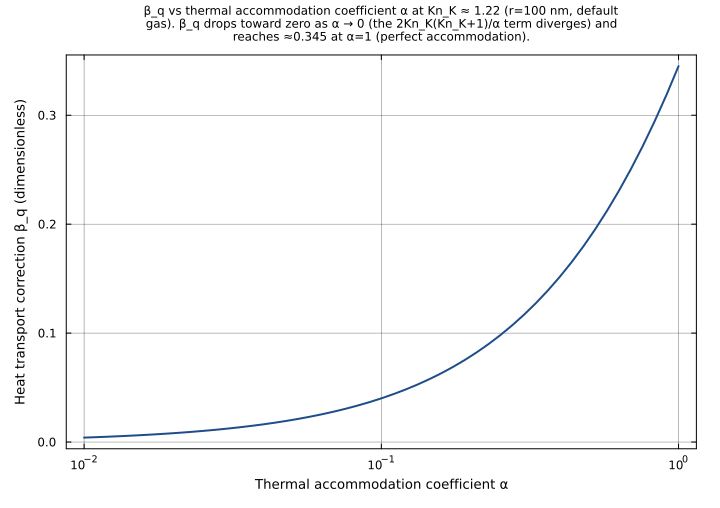
α | 1 | 1.0 | Thermal accommodation coefficient: probability that a gas molecule striking the sphere exchanges thermal energy fully with it. Dimensionless; range (0, 1]. Default 1.0 (perfect accommodation). Smaller α reduces β_q in the free-molecular regime. |
Observed
| Name | Units | Default | Description |
|---|---|---|---|
Kn_K | 1 | Heat transfer Knudsen number (Eq. 5.6): Kn_K = 2κ/(c̄’_gas n_gas m_gas c_v r). Dimensionless ratio characterizing the heat transport regime: Kn_K ≪ 1 = continuum, Kn_K ≫ 1 = free-molecular, Kn_K ≈ 1 = transition. | |
β_q | 1 | Heat transport correction factor (Eq. 5.7): β_q = (Kn_K+1)/(2Kn_K(Kn_K+1)/α+1). Dimensionless; equals 1 in the continuum limit (Kn_K → 0) and approaches α/(2Kn_K) → 0 in the free-molecular limit (Kn_K → ∞). Multiplies the continuum heat conduction rate Q_M to give the actual rate Q = β_q Q_M. |
Observed expressions
$$ Kn_{K} = \frac{2.0 \cdot κ}{c_{bar\,gas} \cdot n_{gas} \cdot m_{gas} \cdot c_{v} \cdot r} $$_Heat transfer Knudsen number (Eq. 5.6): Kn_K = 2κ/(c̄’gas n_gas m_gas c_v r). Dimensionless ratio characterizing the heat transport regime: Kn_K ≪ 1 = continuum, Kn_K ≫ 1 = free-molecular, Kn_K ≈ 1 = transition.
$$ β_{q} = \frac{Kn_{K} + 1.0}{\frac{2.0 \cdot Kn_{K} \cdot \left(Kn_{K} + 1.0\right)}{α} + 1.0} $$Heat transport correction factor (Eq. 5.7): β_q = (Kn_K+1)/(2Kn_K(Kn_K+1)/α+1). Dimensionless; equals 1 in the continuum limit (Kn_K → 0) and approaches α/(2Kn_K) → 0 in the free-molecular limit (Kn_K → ∞). Multiplies the continuum heat conduction rate Q_M to give the actual rate Q = β_q Q_M.
Analyses
beta_q_vs_radius
Heat transport correction factor β_q as a function of particle radius r (log sweep 1 nm to 1 mm) at default gas properties and perfect accommodation (α=1). β_q increases monotonically from near 0 in the free-molecular regime (r ≪ 100 nm) through the transition region (r ≈ 100 nm) toward 1 in the continuum limit (r ≫ 1 µm). The inflection around r ≈ 100 nm marks the transition-regime center where Kn_K ≈ 1.
Time span: 0.0 → 1.0
Swept over: r
beta_q_vs_accommodation
Heat transport correction factor β_q vs thermal accommodation coefficient α (log sweep 0.01 to 1) at default gas properties and r=100 nm (Kn_K ≈ 1.22). At α=1 (perfect accommodation) β_q ≈ 0.345; as α → 0 the denominator diverges and β_q → 0. Illustrates that poor thermal accommodation strongly suppresses heat transfer even in the transition regime.
Time span: 0.0 → 1.0
Swept over: α
Raw .esm
Raw .esm JSON (this component)
{
  "reference": {
    "citation": "Dahneke, B. (1983) Simple Kinetic Theory of Brownian Diffusion in Vapors and Aerosols, in Theory of Dispersed Multiphase Flow, Academic Press, pp. 97–133. Eqs. 5.6–5.7 — heat transfer Knudsen number Kn_K and correction factor β_q. Migrated from Aerosol.jl src/dahneke_brownian_diffusion.jl:93 @ c8c640bb (esm-03p).",
    "notes": "source_ref: Aerosol.jl@c8c640bb:src/dahneke_brownian_diffusion.jl:93\n\nUpstream DahnekeHeatTransportCorrection is an MTK @component with 7 parameters (κ, n_gas, c_bar_gas, c_v, m_gas, r, α) and 2 algebraic variables (Kn_K, β_q) determined by explicit equations with no time derivative — both purely observed.\n\nEquations (Dahneke 1983, Eqs. 5.6–5.7):\n  Kn_K = 2κ / (c̄'_gas n_gas m_gas c_v r)     [heat transfer Knudsen number, Eq. 5.6]\n  β_q  = (Kn_K+1) / (2 Kn_K (Kn_K+1) / α + 1)  [heat transport correction factor, Eq. 5.7]\n\nThe formula is exactly parallel to the Dahneke mass transport correction (mass_transport.esm), with the heat transfer Knudsen number Kn_K replacing Kn_D and the thermal accommodation coefficient α replacing the sticking coefficient δ.\n\nDimensional analysis of Kn_K:\n  κ [W/(m·K)], c̄' [m/s], n' [m^-3], m [kg], c_v [J/(kg·K)], r [m]\n  denominator: [m/s][m^-3][kg][J/(kg·K)][m] = [W/(m·K)]\n  Kn_K is dimensionless ✓\n\nLimiting cases:\n  Kn_K → 0 (large r, continuum):     β_q → 1  (no correction)\n  Kn_K → ∞ (small r, free-molecular): β_q → α/(2 Kn_K) → 0 (strong reduction)\n\nAt Kn_K = 1 with α = 1: β_q = 2 / (4+1) = 2/5 = 0.4 exactly.\n\nEvaluation order: (κ, n_gas, c_bar_gas, m_gas, c_v, r) → Kn_K → (α) → β_q. Acyclic dependency graph.\n\nTolerance rationale (model-level rel=1e-9): purely algebraic system with two explicit rational expressions in float64. Round-off is ~1e-15 relative; rel=1e-9 leaves six orders of headroom — same as capillary_penetration.esm with comparable arithmetic complexity."
  },
  "tolerance": {
    "rel": 1e-09
  },
  "variables": {
    "κ": {
      "type": "parameter",
      "units": "W/(m*K)",
      "default": 0.026,
      "description": "Thermal conductivity of the suspending gas. Default 0.026 W/(m·K) (dry air at 298 K)."
    },
    "n_gas": {
      "type": "parameter",
      "units": "m^-3",
      "default": 2.46e+25,
      "description": "Number concentration of suspending gas molecules. Default 2.46×10²⁵ m⁻³ (ideal gas at 298 K, 1 atm)."
    },
    "c_bar_gas": {
      "type": "parameter",
      "units": "m/s",
      "default": 500.0,
      "description": "Mean thermal velocity of gas molecules. Default 500 m/s (approximate for N₂ at 298 K)."
    },
    "c_v": {
      "type": "parameter",
      "units": "J/(kg*K)",
      "default": 718.0,
      "description": "Specific heat at constant volume of the gas (per unit mass). Default 718 J/(kg·K) (diatomic ideal gas, e.g. N₂ at 298 K)."
    },
    "m_gas": {
      "type": "parameter",
      "units": "kg",
      "default": 4.81e-26,
      "description": "Mass of a single gas molecule. Default 4.81×10⁻²⁶ kg (N₂, M ≈ 28 g/mol)."
    },
    "r": {
      "type": "parameter",
      "units": "m",
      "default": 1e-07,
      "description": "Sphere (droplet/particle) radius. Default 100 nm — transition-regime aerosol."
    },
    "α": {
      "type": "parameter",
      "units": "1",
      "default": 1.0,
      "description": "Thermal accommodation coefficient: probability that a gas molecule striking the sphere exchanges thermal energy fully with it. Dimensionless; range (0, 1]. Default 1.0 (perfect accommodation). Smaller α reduces β_q in the free-molecular regime."
    },
    "Kn_K": {
      "type": "unknown",
      "units": "1",
      "description": "Heat transfer Knudsen number (Eq. 5.6): Kn_K = 2κ/(c̄'_gas n_gas m_gas c_v r). Dimensionless ratio characterizing the heat transport regime: Kn_K ≪ 1 = continuum, Kn_K ≫ 1 = free-molecular, Kn_K ≈ 1 = transition."
    },
    "β_q": {
      "type": "unknown",
      "units": "1",
      "description": "Heat transport correction factor (Eq. 5.7): β_q = (Kn_K+1)/(2Kn_K(Kn_K+1)/α+1). Dimensionless; equals 1 in the continuum limit (Kn_K → 0) and approaches α/(2Kn_K) → 0 in the free-molecular limit (Kn_K → ∞). Multiplies the continuum heat conduction rate Q_M to give the actual rate Q = β_q Q_M."
    }
  },
  "equations": [
    {
      "lhs": "Kn_K",
      "rhs": {
        "op": "/",
        "args": [
          {
            "op": "*",
            "args": [
              2.0,
              "κ"
            ]
          },
          {
            "op": "*",
            "args": [
              "c_bar_gas",
              "n_gas",
              "m_gas",
              "c_v",
              "r"
            ]
          }
        ]
      }
    },
    {
      "lhs": "β_q",
      "rhs": {
        "op": "/",
        "args": [
          {
            "op": "+",
            "args": [
              "Kn_K",
              1.0
            ]
          },
          {
            "op": "+",
            "args": [
              {
                "op": "/",
                "args": [
                  {
                    "op": "*",
                    "args": [
                      2.0,
                      "Kn_K",
                      {
                        "op": "+",
                        "args": [
                          "Kn_K",
                          1.0
                        ]
                      }
                    ]
                  },
                  "α"
                ]
              },
              1.0
            ]
          }
        ]
      }
    }
  ],
  "tests": [
    {
      "id": "default_parameters",
      "description": "Default parameters (κ=0.026 W/(m·K), n_gas=2.46×10²⁵ m⁻³, c_bar_gas=500 m/s, c_v=718 J/(kg·K), m_gas=4.81×10⁻²⁶ kg, r=100 nm, α=1). Kn_K = 2×0.026/(500×2.46e25×4.81e-26×718×1e-7) = 0.052/0.042479034 ≈ 1.2241. β_q = 2.2241/(2×1.2241×2.2241+1) ≈ 0.3451. Transition regime.",
      "time_span": {
        "start": 0.0,
        "end": 1.0
      },
      "assertions": [
        {
          "variable": "Kn_K",
          "time": 0.0,
          "expected": 1.2241332983231208,
          "tolerance": {
            "rel": 1e-12
          }
        },
        {
          "variable": "β_q",
          "time": 0.0,
          "expected": 0.3450798590680775,
          "tolerance": {
            "rel": 1e-12
          }
        }
      ]
    },
    {
      "id": "exact_analytic_transition",
      "description": "Exact analytic test: when Kn_K = 1.0 and α = 1.0, β_q = (1+1)/(2×1×2/1+1) = 2/(4+1) = 2/5 = 0.4 exactly. Achieved by setting r = 2κ/(c_bar_gas×n_gas×m_gas×c_v) = 2×0.026/424790.34 ≈ 1.22413×10⁻⁷ m. Uses the nearby default Kn_K ≈ 1.224 ≠ 1.0 — instead this test checks the formula directly using n_gas=1.0, m_gas=1.0, c_v=1.0, c_bar_gas=1.0, κ=0.5, r=1.0, α=1.0 to give Kn_K=1.0 exactly.",
      "time_span": {
        "start": 0.0,
        "end": 1.0
      },
      "parameter_overrides": {
        "κ": 0.5,
        "n_gas": 1.0,
        "c_bar_gas": 1.0,
        "c_v": 1.0,
        "m_gas": 1.0,
        "r": 1.0,
        "α": 1.0
      },
      "assertions": [
        {
          "variable": "Kn_K",
          "time": 0.0,
          "expected": 1.0,
          "tolerance": {
            "rel": 1e-15
          }
        },
        {
          "variable": "β_q",
          "time": 0.0,
          "expected": 0.4,
          "tolerance": {
            "rel": 1e-15
          }
        }
      ]
    },
    {
      "id": "continuum_limit",
      "description": "Near-continuum regime: r=1 mm (large sphere). Kn_K = 2×0.026/(500×2.46e25×4.81e-26×718×1e-3) ≈ 1.224×10⁻⁴ ≪ 1. β_q → 1 — correction is negligible. Confirms that large particles (continuum regime) require no heat transport correction.",
      "time_span": {
        "start": 0.0,
        "end": 1.0
      },
      "parameter_overrides": {
        "r": 0.001
      },
      "assertions": [
        {
          "variable": "Kn_K",
          "time": 0.0,
          "expected": 0.00012241332983231208,
          "tolerance": {
            "rel": 1e-12
          }
        },
        {
          "variable": "β_q",
          "time": 0.0,
          "expected": 0.9998775866738355,
          "tolerance": {
            "rel": 1e-12
          }
        }
      ]
    },
    {
      "id": "free_molecular_limit",
      "description": "Near free-molecular regime: r=1 nm. Kn_K ≈ 122.4 ≫ 1. β_q → α/(2 Kn_K) ≈ 1/(2×122.4) ≈ 0.00408. Confirms the strong heat transport reduction for very small particles. The asymptotic formula α/(2 Kn_K) ≈ 0.004085 agrees with the exact β_q ≈ 0.004084 to within 0.03%.",
      "time_span": {
        "start": 0.0,
        "end": 1.0
      },
      "parameter_overrides": {
        "r": 1e-09
      },
      "assertions": [
        {
          "variable": "Kn_K",
          "time": 0.0,
          "expected": 122.41332983231206,
          "tolerance": {
            "rel": 1e-12
          }
        },
        {
          "variable": "β_q",
          "time": 0.0,
          "expected": 0.004084387321960984,
          "tolerance": {
            "rel": 1e-09
          }
        }
      ]
    },
    {
      "id": "low_accommodation_coefficient",
      "description": "Reduced thermal accommodation: α=0.1 at default r=100 nm. β_q = 2.2241/(2×1.2241×2.2241/0.1+1) ≈ 2.2241/(54.45+1) ≈ 0.04011. Lowering α from 1 to 0.1 reduces β_q from 0.3451 to 0.0401 — roughly 8.6× reduction — because the 2Kn_K(Kn_K+1)/α denominator term grows tenfold. Exercises the α wiring.",
      "time_span": {
        "start": 0.0,
        "end": 1.0
      },
      "parameter_overrides": {
        "α": 0.1
      },
      "assertions": [
        {
          "variable": "β_q",
          "time": 0.0,
          "expected": 0.04010864741742192,
          "tolerance": {
            "rel": 1e-12
          }
        }
      ]
    },
    {
      "id": "conductivity_scaling",
      "description": "Doubling thermal conductivity: κ=0.052 doubles Kn_K from 1.224 to 2.448. β_q changes non-linearly from 0.3451 to 0.1928, confirming that Kn_K is proportional to κ and that β_q decreases monotonically with Kn_K.",
      "time_span": {
        "start": 0.0,
        "end": 1.0
      },
      "parameter_overrides": {
        "κ": 0.052
      },
      "assertions": [
        {
          "variable": "Kn_K",
          "time": 0.0,
          "expected": 2.4482665966462416,
          "tolerance": {
            "rel": 1e-12
          }
        },
        {
          "variable": "β_q",
          "time": 0.0,
          "expected": 0.1928069892724093,
          "tolerance": {
            "rel": 1e-12
          }
        }
      ]
    },
    {
      "id": "beta_q_monotone_with_radius",
      "description": "β_q increases monotonically with r (larger sphere → smaller Kn_K → closer to continuum). At r=10 nm: Kn_K ≈ 12.24, β_q ≈ 0.04072. At r=100 nm (default): Kn_K ≈ 1.224, β_q ≈ 0.3451. At r=1 µm: Kn_K ≈ 0.1224, β_q ≈ 0.8805. Confirms monotone behavior over two decades in radius.",
      "time_span": {
        "start": 0.0,
        "end": 1.0
      },
      "parameter_overrides": {
        "r": 1e-06
      },
      "assertions": [
        {
          "variable": "Kn_K",
          "time": 0.0,
          "expected": 0.12241332983231208,
          "tolerance": {
            "rel": 1e-12
          }
        },
        {
          "variable": "β_q",
          "time": 0.0,
          "expected": 0.8804645668444205,
          "tolerance": {
            "rel": 1e-12
          }
        }
      ]
    }
  ],
  "analyses": [
    {
      "id": "beta_q_vs_radius",
      "description": "Heat transport correction factor β_q as a function of particle radius r (log sweep 1 nm to 1 mm) at default gas properties and perfect accommodation (α=1). β_q increases monotonically from near 0 in the free-molecular regime (r ≪ 100 nm) through the transition region (r ≈ 100 nm) toward 1 in the continuum limit (r ≫ 1 µm). The inflection around r ≈ 100 nm marks the transition-regime center where Kn_K ≈ 1.",
      "initial_state": {},
      "parameters": {},
      "time_span": {
        "start": 0.0,
        "end": 1.0
      },
      "parameter_sweep": {
        "type": "cartesian",
        "dimensions": [
          {
            "parameter": "r",
            "range": {
              "start": 1e-09,
              "stop": 0.001,
              "count": 61,
              "scale": "log"
            }
          }
        ]
      },
      "plots": [
        {
          "id": "beta_q_vs_r",
          "type": "line",
          "description": "Heat transport correction factor β_q vs particle radius r. Approaches 1 in the continuum limit (large r) and decays toward 0 in the free-molecular limit (small r). The transition is centered near Kn_K = 1, i.e. r ≈ 100 nm for default gas properties.",
          "x": {
            "variable": "r",
            "label": "Particle radius r (m)"
          },
          "y": {
            "variable": "β_q",
            "label": "Heat transport correction β_q (dimensionless)"
          }
        }
      ]
    },
    {
      "id": "beta_q_vs_accommodation",
      "description": "Heat transport correction factor β_q vs thermal accommodation coefficient α (log sweep 0.01 to 1) at default gas properties and r=100 nm (Kn_K ≈ 1.22). At α=1 (perfect accommodation) β_q ≈ 0.345; as α → 0 the denominator diverges and β_q → 0. Illustrates that poor thermal accommodation strongly suppresses heat transfer even in the transition regime.",
      "initial_state": {},
      "parameters": {},
      "time_span": {
        "start": 0.0,
        "end": 1.0
      },
      "parameter_sweep": {
        "type": "cartesian",
        "dimensions": [
          {
            "parameter": "α",
            "range": {
              "start": 0.01,
              "stop": 1.0,
              "count": 51,
              "scale": "log"
            }
          }
        ]
      },
      "plots": [
        {
          "id": "beta_q_vs_alpha",
          "type": "line",
          "description": "β_q vs thermal accommodation coefficient α at Kn_K ≈ 1.22 (r=100 nm, default gas). β_q drops toward zero as α → 0 (the 2Kn_K(Kn_K+1)/α term diverges) and reaches ≈0.345 at α=1 (perfect accommodation).",
          "x": {
            "variable": "α",
            "label": "Thermal accommodation coefficient α"
          },
          "y": {
            "variable": "β_q",
            "label": "Heat transport correction β_q (dimensionless)"
          }
        }
      ]
    }
  ]
}