DahnekeCapillaryPenetration
Parameters for aerosol penetration through a fine capillary tube via convective diffusion (Dahneke 1983, Section 9). Computes the velocity-profile normalization factor σ and the dimensionless tube length z' = DL/(σv̄R²) from which the penetration fraction ϕ(z') = Σ B_i exp(−ω_i² z') can be evaluated using the tabulated eigenvalues in Tables 3–5 of the reference. Migrated from Aerosol.jl src/dahneke_brownian_diffusion.jl:372.
Description
Parameters for aerosol penetration through a fine capillary tube via convective diffusion (Dahneke 1983, Section 9). Computes the velocity-profile normalization factor σ and the dimensionless tube length z’ = DL/(σv̄R²) from which the penetration fraction ϕ(z’) = Σ B_i exp(−ω_i² z’) can be evaluated using the tabulated eigenvalues in Tables 3–5 of the reference. Migrated from Aerosol.jl src/dahneke_brownian_diffusion.jl:372.
Reference
Dahneke, B. (1983) Simple Kinetic Theory of Brownian Diffusion in Vapors and Aerosols, Section 9, Eqs. 9.4–9.5 — velocity-profile normalization σ and dimensionless tube length z’. Migrated from Aerosol.jl src/dahneke_brownian_diffusion.jl:372 @ YeW6d (esm-1vo).
_source_ref: Aerosol.jl@YeW6d:src/dahneke_brownian_diffusion.jl:372
Upstream DahnekeCapillaryPenetration is an MTK @component with 5 parameters (Dcoeff, R_cap, v_mean, L_cap, γ_flow) and 2 algebraic variables (σ_flow, z_dim) with no time derivatives — both purely observed.
Equations (Dahneke 1983, Section 9): σ_flow = 2 / (2 − γ_flow) [Eq. 9.4–9.5: velocity-profile normalization factor] z_dim = Dcoeff * L_cap / (σ_flow * v_mean * R_cap²) [dimensionless tube length z']
The velocity profile is v(r) = σv̄[1 − γ(r/R)²] with: γ = 0 (plug flow, free-molecular): σ = 1 γ = 0.5 (transition / slip flow): σ = 4/3 γ = 1.0 (Poiseuille / continuum): σ = 2
Once z_dim is known, the penetration fraction ϕ is computed outside the component using the eigenfunction expansion Σ B_i exp(−ω_i² z) with eigenvalues and coefficients taken from Dahneke’s Tables 3–5 via the standalone dahneke_capillary_penetration function (not migrated as a model component since it requires discrete tabular lookup, not a continuous ODE/algebraic system).
Topological evaluation order: γ_flow → σ_flow → z_dim. The dependency graph is acyclic; both equations are purely explicit.
Tolerance rationale (model-level rel=1e-9): purely algebraic system with two divisions in float64. Round-off is ~1e-15 relative; rel=1e-9 leaves six orders of headroom above machine epsilon._
Parameters
| Name | Units | Default | Description |
|---|---|---|---|
Dcoeff | m^2/s | 1e-10 | Particle diffusion coefficient. |
R_cap | m | 0.0001 | Capillary radius. |
v_mean | m/s | 0.01 | Mean flow velocity. |
L_cap | m | 0.1 | Capillary length. |
γ_flow | 1 | 1.0 | Velocity profile parameter: 0 = plug flow (free-molecular), 0.5 = transition / slip flow, 1.0 = Poiseuille (continuum). |
Observed
| Name | Units | Default | Description |
|---|---|---|---|
σ_flow | 1 | Velocity-profile normalization factor σ = 2/(2−γ), Eq. 9.4–9.5 of Dahneke (1983). Equals 1 for plug flow (γ=0), 4/3 for transition (γ=0.5), and 2 for Poiseuille flow (γ=1.0). | |
z_dim | 1 | Dimensionless capillary length z’ = DL/(σv̄R²). The penetration fraction ϕ(z’) = Σ B_i exp(−ω_i² z’) is a monotonically decreasing function of z’; larger z’ means more deposition. |
Observed expressions
$$ σ_{flow} = \frac{2}{2 - γ_{flow}} $$Velocity-profile normalization factor σ = 2/(2−γ), Eq. 9.4–9.5 of Dahneke (1983). Equals 1 for plug flow (γ=0), 4/3 for transition (γ=0.5), and 2 for Poiseuille flow (γ=1.0).
$$ z_{dim} = \frac{Dcoeff \cdot L_{cap}}{σ_{flow} \cdot v_{mean} \cdot R_{cap}^{2}} $$Dimensionless capillary length z’ = DL/(σv̄R²). The penetration fraction ϕ(z’) = Σ B_i exp(−ω_i² z’) is a monotonically decreasing function of z’; larger z’ means more deposition.
Analyses
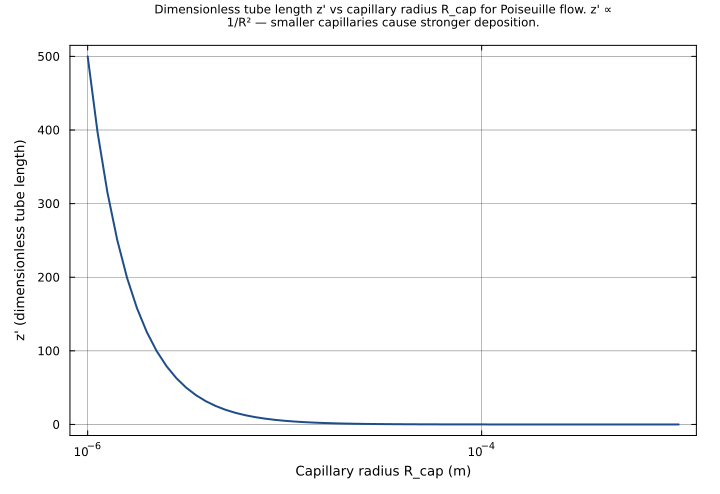
z_dim_vs_R_cap
Dimensionless tube length z’ as a function of capillary radius R_cap (log sweep 1 µm to 1 mm) for Poiseuille flow (γ=1.0, σ=2). Since z’ ∝ 1/R², z’ increases sharply for small radii, showing that thin capillaries cause much more particle deposition.
Time span: 0.0 → 1.0
Swept over: R_cap
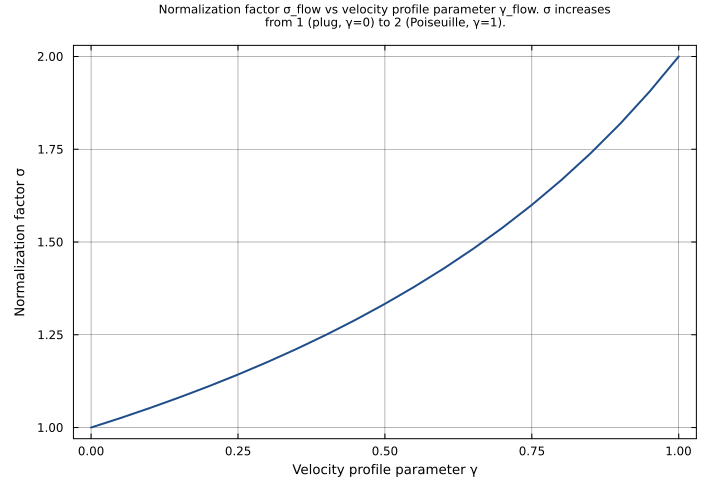
sigma_vs_gamma
Velocity-profile normalization factor σ = 2/(2−γ) as γ sweeps from 0 (plug flow) to 1 (Poiseuille). σ ranges from 1 to 2; higher σ reduces z’ and thus reduces particle deposition at fixed tube geometry.
Time span: 0.0 → 1.0
Swept over: γ_flow
Raw .esm
Raw .esm JSON (this component)
{
  "reference": {
    "citation": "Dahneke, B. (1983) Simple Kinetic Theory of Brownian Diffusion in Vapors and Aerosols, Section 9, Eqs. 9.4–9.5 — velocity-profile normalization σ and dimensionless tube length z'. Migrated from Aerosol.jl src/dahneke_brownian_diffusion.jl:372 @ YeW6d (esm-1vo).",
    "notes": "source_ref: Aerosol.jl@YeW6d:src/dahneke_brownian_diffusion.jl:372\n\nUpstream `DahnekeCapillaryPenetration` is an MTK `@component` with 5 parameters (Dcoeff, R_cap, v_mean, L_cap, γ_flow) and 2 algebraic variables (σ_flow, z_dim) with no time derivatives — both purely observed.\n\nEquations (Dahneke 1983, Section 9):\n  σ_flow = 2 / (2 − γ_flow)              [Eq. 9.4–9.5: velocity-profile normalization factor]\n  z_dim  = Dcoeff * L_cap / (σ_flow * v_mean * R_cap²)  [dimensionless tube length z']\n\nThe velocity profile is v(r) = σv̄[1 − γ(r/R)²] with:\n  γ = 0   (plug flow, free-molecular):  σ = 1\n  γ = 0.5 (transition / slip flow):     σ = 4/3\n  γ = 1.0 (Poiseuille / continuum):     σ = 2\n\nOnce z_dim is known, the penetration fraction ϕ is computed outside the component using the eigenfunction expansion Σ B_i exp(−ω_i² z) with eigenvalues and coefficients taken from Dahneke's Tables 3–5 via the standalone `dahneke_capillary_penetration` function (not migrated as a model component since it requires discrete tabular lookup, not a continuous ODE/algebraic system).\n\nTopological evaluation order: γ_flow → σ_flow → z_dim. The dependency graph is acyclic; both equations are purely explicit.\n\nTolerance rationale (model-level rel=1e-9): purely algebraic system with two divisions in float64. Round-off is ~1e-15 relative; rel=1e-9 leaves six orders of headroom above machine epsilon."
  },
  "tolerance": {
    "rel": 1e-09
  },
  "variables": {
    "Dcoeff": {
      "type": "parameter",
      "units": "m^2/s",
      "default": 1e-10,
      "description": "Particle diffusion coefficient."
    },
    "R_cap": {
      "type": "parameter",
      "units": "m",
      "default": 0.0001,
      "description": "Capillary radius."
    },
    "v_mean": {
      "type": "parameter",
      "units": "m/s",
      "default": 0.01,
      "description": "Mean flow velocity."
    },
    "L_cap": {
      "type": "parameter",
      "units": "m",
      "default": 0.1,
      "description": "Capillary length."
    },
    "γ_flow": {
      "type": "parameter",
      "units": "1",
      "default": 1.0,
      "description": "Velocity profile parameter: 0 = plug flow (free-molecular), 0.5 = transition / slip flow, 1.0 = Poiseuille (continuum)."
    },
    "σ_flow": {
      "type": "unknown",
      "units": "1",
      "description": "Velocity-profile normalization factor σ = 2/(2−γ), Eq. 9.4–9.5 of Dahneke (1983). Equals 1 for plug flow (γ=0), 4/3 for transition (γ=0.5), and 2 for Poiseuille flow (γ=1.0)."
    },
    "z_dim": {
      "type": "unknown",
      "units": "1",
      "description": "Dimensionless capillary length z' = DL/(σv̄R²). The penetration fraction ϕ(z') = Σ B_i exp(−ω_i² z') is a monotonically decreasing function of z'; larger z' means more deposition."
    }
  },
  "equations": [
    {
      "lhs": "σ_flow",
      "rhs": {
        "op": "/",
        "args": [
          2,
          {
            "op": "-",
            "args": [
              2,
              "γ_flow"
            ]
          }
        ]
      }
    },
    {
      "lhs": "z_dim",
      "rhs": {
        "op": "/",
        "args": [
          {
            "op": "*",
            "args": [
              "Dcoeff",
              "L_cap"
            ]
          },
          {
            "op": "*",
            "args": [
              "σ_flow",
              "v_mean",
              {
                "op": "^",
                "args": [
                  "R_cap",
                  2
                ]
              }
            ]
          }
        ]
      }
    }
  ],
  "tests": [
    {
      "id": "default_parameters",
      "description": "Default parameters: Dcoeff=1e-10 m²/s, R_cap=1e-4 m, v_mean=0.01 m/s, L_cap=0.1 m, γ_flow=1.0 (Poiseuille). σ_flow = 2/(2-1) = 2. z_dim = 1e-10 * 0.1 / (2 * 0.01 * (1e-4)²) = 1e-11 / (2e-9) = 0.05. Both equations verified.",
      "time_span": {
        "start": 0.0,
        "end": 1.0
      },
      "assertions": [
        {
          "variable": "σ_flow",
          "time": 0.0,
          "expected": 2.0,
          "tolerance": {
            "rel": 1e-12
          }
        },
        {
          "variable": "z_dim",
          "time": 0.0,
          "expected": 0.05,
          "tolerance": {
            "rel": 1e-12
          }
        }
      ]
    },
    {
      "id": "plug_flow",
      "description": "Plug-flow regime: γ_flow=0.0 → σ_flow = 2/(2-0) = 1.0. z_dim = 1e-10 * 0.1 / (1.0 * 0.01 * (1e-4)²) = 0.10. More deposition than Poiseuille because σ=1 < σ=2 gives larger z_dim at the same physical tube length.",
      "time_span": {
        "start": 0.0,
        "end": 1.0
      },
      "parameter_overrides": {
        "γ_flow": 0.0
      },
      "assertions": [
        {
          "variable": "σ_flow",
          "time": 0.0,
          "expected": 1.0,
          "tolerance": {
            "rel": 1e-12
          }
        },
        {
          "variable": "z_dim",
          "time": 0.0,
          "expected": 0.1,
          "tolerance": {
            "rel": 1e-12
          }
        }
      ]
    },
    {
      "id": "transition_flow",
      "description": "Transition / slip-flow regime: γ_flow=0.5 → σ_flow = 2/(2-0.5) = 4/3 ≈ 1.33333. z_dim = 1e-10 * 0.1 / (4/3 * 0.01 * (1e-4)²) = 0.075.",
      "time_span": {
        "start": 0.0,
        "end": 1.0
      },
      "parameter_overrides": {
        "γ_flow": 0.5
      },
      "assertions": [
        {
          "variable": "σ_flow",
          "time": 0.0,
          "expected": 1.3333333333333333,
          "tolerance": {
            "rel": 1e-12
          }
        },
        {
          "variable": "z_dim",
          "time": 0.0,
          "expected": 0.075,
          "tolerance": {
            "rel": 1e-12
          }
        }
      ]
    },
    {
      "id": "sigma_flow_monotonicity",
      "description": "σ_flow increases monotonically with γ_flow: plug flow (γ=0, σ=1) < transition (γ=0.5, σ=4/3) < Poiseuille (γ=1, σ=2). Conversely z_dim decreases — higher σ means less relative deposition at the same physical tube length.",
      "time_span": {
        "start": 0.0,
        "end": 1.0
      },
      "parameter_overrides": {
        "γ_flow": 0.0
      },
      "assertions": [
        {
          "variable": "σ_flow",
          "time": 0.0,
          "expected": 1.0,
          "tolerance": {
            "rel": 1e-12
          }
        }
      ]
    },
    {
      "id": "z_dim_diffusion_scaling",
      "description": "z_dim is proportional to Dcoeff: doubling the diffusion coefficient doubles z_dim. With Dcoeff=2e-10 and Poiseuille flow: z_dim = 2 * 0.05 = 0.10.",
      "time_span": {
        "start": 0.0,
        "end": 1.0
      },
      "parameter_overrides": {
        "Dcoeff": 2e-10
      },
      "assertions": [
        {
          "variable": "z_dim",
          "time": 0.0,
          "expected": 0.1,
          "tolerance": {
            "rel": 1e-12
          }
        }
      ]
    },
    {
      "id": "z_dim_radius_scaling",
      "description": "z_dim is inversely proportional to R_cap²: halving R_cap quadruples z_dim. With R_cap=5e-5 (half default) and Poiseuille flow: z_dim = 1e-10 * 0.1 / (2 * 0.01 * (5e-5)²) = 0.2.",
      "time_span": {
        "start": 0.0,
        "end": 1.0
      },
      "parameter_overrides": {
        "R_cap": 5e-05
      },
      "assertions": [
        {
          "variable": "z_dim",
          "time": 0.0,
          "expected": 0.2,
          "tolerance": {
            "rel": 1e-12
          }
        }
      ]
    }
  ],
  "analyses": [
    {
      "id": "z_dim_vs_R_cap",
      "description": "Dimensionless tube length z' as a function of capillary radius R_cap (log sweep 1 µm to 1 mm) for Poiseuille flow (γ=1.0, σ=2). Since z' ∝ 1/R², z' increases sharply for small radii, showing that thin capillaries cause much more particle deposition.",
      "initial_state": {},
      "parameters": {},
      "time_span": {
        "start": 0.0,
        "end": 1.0
      },
      "parameter_sweep": {
        "type": "cartesian",
        "dimensions": [
          {
            "parameter": "R_cap",
            "range": {
              "start": 1e-06,
              "stop": 0.001,
              "count": 61,
              "scale": "log"
            }
          }
        ]
      },
      "plots": [
        {
          "id": "z_dim_vs_R_cap",
          "type": "line",
          "description": "Dimensionless tube length z' vs capillary radius R_cap for Poiseuille flow. z' ∝ 1/R² — smaller capillaries cause stronger deposition.",
          "x": {
            "variable": "R_cap",
            "label": "Capillary radius R_cap (m)"
          },
          "y": {
            "variable": "z_dim",
            "label": "z' (dimensionless tube length)"
          }
        }
      ]
    },
    {
      "id": "sigma_vs_gamma",
      "description": "Velocity-profile normalization factor σ = 2/(2−γ) as γ sweeps from 0 (plug flow) to 1 (Poiseuille). σ ranges from 1 to 2; higher σ reduces z' and thus reduces particle deposition at fixed tube geometry.",
      "initial_state": {},
      "parameters": {},
      "time_span": {
        "start": 0.0,
        "end": 1.0
      },
      "parameter_sweep": {
        "type": "cartesian",
        "dimensions": [
          {
            "parameter": "γ_flow",
            "range": {
              "start": 0.0,
              "stop": 1.0,
              "count": 21,
              "scale": "linear"
            }
          }
        ]
      },
      "plots": [
        {
          "id": "sigma_vs_gamma",
          "type": "line",
          "description": "Normalization factor σ_flow vs velocity profile parameter γ_flow. σ increases from 1 (plug, γ=0) to 2 (Poiseuille, γ=1).",
          "x": {
            "variable": "γ_flow",
            "label": "Velocity profile parameter γ"
          },
          "y": {
            "variable": "σ_flow",
            "label": "Normalization factor σ"
          }
        }
      ]
    }
  ]
}