IcePhysics
Ice nucleation and ice-water equilibrium thermodynamics (Seinfeld & Pandis 2006, Eqs. 17.100-17.103). Computes freezing point depression for solutions, equilibrium freezing temperature from water activity, Kelvin curvature factor for ice particles, and empirical ice-nuclei concentration.
Description
Ice nucleation and ice-water equilibrium thermodynamics (Seinfeld & Pandis 2006, Eqs. 17.100-17.103). Computes freezing point depression for solutions, equilibrium freezing temperature from water activity, Kelvin curvature factor for ice particles, and empirical ice-nuclei concentration.
Reference
_source_ref: Aerosol.jl@9899a7e8:src/cloud_physics.jl:525 Seinfeld, J. H. and Pandis, S. N. (2006), Atmospheric Chemistry and Physics: From Air Pollution to Climate Change, 2nd Edition, Wiley, Ch. 17. Key equations: 17.100 (freezing point depression, K_f * molality); 17.101 (equilibrium freezing temperature from water activity, Raoult/Kelvin); 17.102 (ice Kelvin curvature factor, exp(4Mwsigma_ia/(RTrho_iD_p))); 17.103 (ice nuclei concentration, IN_ref * exp(coeff(T_ref - T))).
Tolerance rationale (model-level rel=1e-8 / abs=1e-12): time-independent algebraic system (zero ODE states after MTK structural_simplify; RHS depends only on parameters). rel=1e-8 captures float64 roundoff in exp, log, and arithmetic. abs=1e-12 floors the pure-water case (molality=0 → ΔT_f=0) where rel comparison is undefined. See defaults_all_variables and nacl_freezing_point_depression tests for per-assertion abs=1e-12 overrides on ΔT_f=0._
Parameters
| Name | Units | Default | Description |
|---|---|---|---|
M_w | kg/mol | 0.018015 | Molecular weight of water |
R | J/(mol*K) | 8.314 | Universal gas constant |
ρ_i | kg/m^3 | 917.0 | Density of ice |
T_freeze | K | 273.15 | Freezing point of pure water |
ΔH_m_mass | J/kg | 333500.0 | Latent heat of fusion of water |
K_f | K*kg/mol | 1.86 | Cryoscopic constant of water |
IN_ref | 1/m^3 | 1000.0 | Ice nuclei concentration reference at T_IN_ref |
IN_coeff | 1/K | 0.6 | Ice nuclei exponential temperature coefficient |
T_IN_ref | K | 253.0 | Reference temperature for ice nuclei parameterization |
dim_eps | 1 | 1e-30 | Small dimensionless value added to water activity to prevent log(0) |
T | K | 263.15 | Temperature |
σ_ia | N/m | 0.106 | Ice-air surface tension |
D_p | m | 1e-06 | Ice particle diameter |
a_w | 1 | 1.0 | Water activity (dimensionless) |
molality | mol/kg | 0.0 | Solute molality of the solution |
Observed
| Name | Units | Default | Description |
|---|---|---|---|
ΔT_f | K | Freezing point depression of the solution | |
T_e | K | Equilibrium freezing temperature from water activity (Kelvin equation) | |
kelvin_ice | 1 | Kelvin curvature factor for ice particle vapor pressure (dimensionless, always > 1) | |
IN | 1/m^3 | Ice nuclei concentration (empirical exponential parameterization) |
Observed expressions
$$ ΔT_{f} = K_{f} \cdot molality $$Freezing point depression of the solution
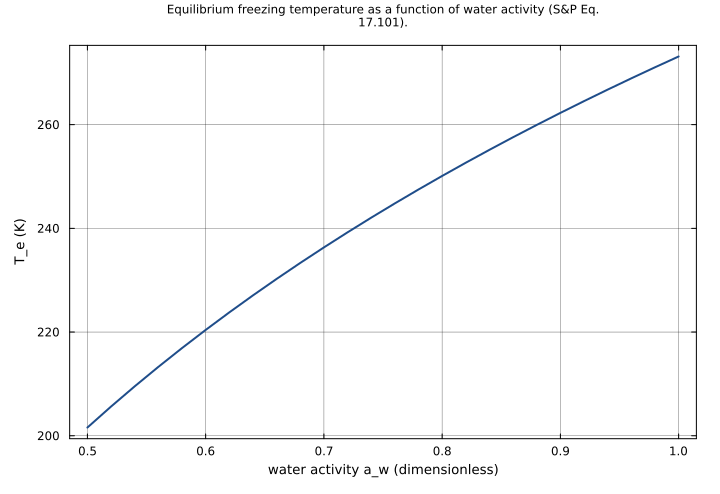
$$ T_{e} = T_{freeze} + \frac{R \cdot T_{freeze}^{2}}{ΔH_{m\,mass} \cdot M_{w}} \cdot \ln\left(a_{w} + dim_{eps}\right) $$Equilibrium freezing temperature from water activity (Kelvin equation)
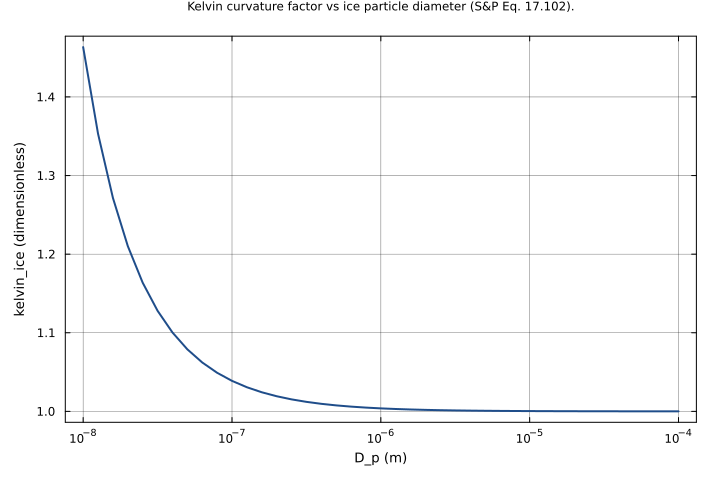
$$ kelvin_{ice} = e^{\frac{4 \cdot M_{w} \cdot σ_{ia}}{R \cdot T \cdot ρ_{i} \cdot D_{p}}} $$Kelvin curvature factor for ice particle vapor pressure (dimensionless, always > 1)
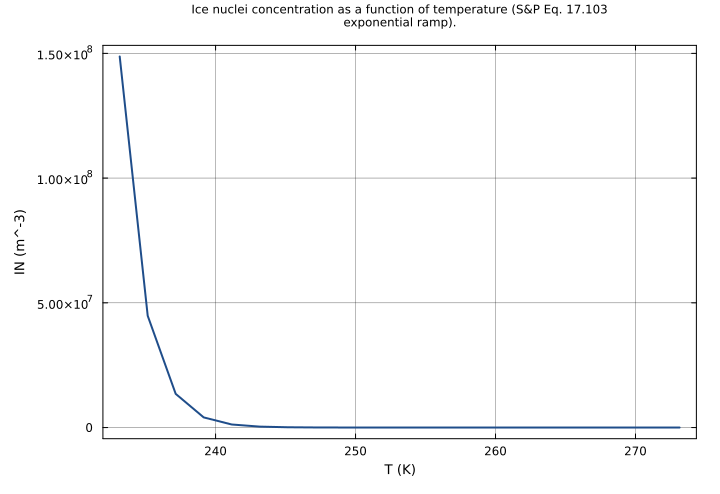
$$ IN = IN_{ref} \cdot e^{IN_{coeff} \cdot \left(T_{IN\,ref} + \left(-1\right) \cdot T\right)} $$Ice nuclei concentration (empirical exponential parameterization)
Analyses
defaults_trajectory
Reference-run trajectories of all four IcePhysics state variables at upstream Aerosol.jl defaults over a 1-hour window. All states are time-independent under S&P Eqs. 17.100-17.103 (algebraic system after MTK structural_simplify), so each plot is a horizontal line, making the parameter-driven algebraic structure of the model visually clear.
Time span: 0.0 → 3600.0
ice_nuclei_temperature_sweep
Sweep temperature from 233 K to 273 K at fixed IN_ref=1000 m^-3 and IN_coeff=0.6 K^-1. IN = IN_ref * exp(IN_coeff * (T_IN_ref - T)) spans ~7 orders of magnitude over this 40 K range, covering the exponential activation behavior of S&P Eq. 17.103. On a log-y axis the trajectory is a straight line — the slope equals IN_coeff = 0.6 K^-1.
Time span: 0.0 → 60.0
Swept over: T
kelvin_particle_size_sweep
Sweep ice particle diameter D_p from 10 nm to 100 μm at fixed T=263.15 K and σ_ia=0.106 N/m. kelvin_ice = exp(4Mwsigma/(RTrho_i*D_p)) scales as exp(1/D_p): small particles have a much larger Kelvin correction. On a log-x axis the exponent is linear in 1/D_p. At D_p=1 μm the correction is ~0.4%, at 10 nm it exceeds 40%.
Time span: 0.0 → 60.0
Swept over: D_p
equilibrium_temperature_activity_sweep
Sweep water activity a_w from 0.5 to 1.0. T_e = T_freeze + (RT_freeze^2/(ΔH_mM_w))*ln(a_w) decreases monotonically: solutions with lower activity (higher solute loading) freeze at lower temperatures. T_e = 273.15 K at a_w=1 (pure water) and drops by ~103 K for a unit decrease in ln(a_w). This is the thermodynamic route to freezing point depression (S&P Eq. 17.101), complementing the colligative route (K_f * molality) in ΔT_f.
Time span: 0.0 → 60.0
Swept over: a_w
Raw .esm
Raw .esm JSON (this component)
{
"variables": {
"M_w": {
"default": 0.018015,
"type": "parameter",
"units": "kg/mol",
"description": "Molecular weight of water"
},
"R": {
"default": 8.314,
"type": "parameter",
"units": "J/(mol*K)",
"description": "Universal gas constant"
},
"ρ_i": {
"default": 917.0,
"type": "parameter",
"units": "kg/m^3",
"description": "Density of ice"
},
"T_freeze": {
"default": 273.15,
"type": "parameter",
"units": "K",
"description": "Freezing point of pure water"
},
"ΔH_m_mass": {
"default": 333500.0,
"type": "parameter",
"units": "J/kg",
"description": "Latent heat of fusion of water"
},
"K_f": {
"default": 1.86,
"type": "parameter",
"units": "K*kg/mol",
"description": "Cryoscopic constant of water"
},
"IN_ref": {
"default": 1000.0,
"type": "parameter",
"units": "1/m^3",
"description": "Ice nuclei concentration reference at T_IN_ref"
},
"IN_coeff": {
"default": 0.6,
"type": "parameter",
"units": "1/K",
"description": "Ice nuclei exponential temperature coefficient"
},
"T_IN_ref": {
"default": 253.0,
"type": "parameter",
"units": "K",
"description": "Reference temperature for ice nuclei parameterization"
},
"dim_eps": {
"default": 1e-30,
"type": "parameter",
"units": "1",
"description": "Small dimensionless value added to water activity to prevent log(0)"
},
"T": {
"default": 263.15,
"type": "parameter",
"units": "K",
"description": "Temperature"
},
"σ_ia": {
"default": 0.106,
"type": "parameter",
"units": "N/m",
"description": "Ice-air surface tension"
},
"D_p": {
"default": 1e-06,
"type": "parameter",
"units": "m",
"description": "Ice particle diameter"
},
"a_w": {
"default": 1.0,
"type": "parameter",
"units": "1",
"description": "Water activity (dimensionless)"
},
"molality": {
"default": 0.0,
"type": "parameter",
"units": "mol/kg",
"description": "Solute molality of the solution"
},
"ΔT_f": {
"type": "unknown",
"units": "K",
"description": "Freezing point depression of the solution"
},
"T_e": {
"type": "unknown",
"units": "K",
"description": "Equilibrium freezing temperature from water activity (Kelvin equation)"
},
"kelvin_ice": {
"type": "unknown",
"units": "1",
"description": "Kelvin curvature factor for ice particle vapor pressure (dimensionless, always > 1)"
},
"IN": {
"type": "unknown",
"units": "1/m^3",
"description": "Ice nuclei concentration (empirical exponential parameterization)"
}
},
"equations": [
{
"lhs": "ΔT_f",
"rhs": {
"op": "*",
"args": [
"K_f",
"molality"
]
}
},
{
"lhs": "T_e",
"rhs": {
"op": "+",
"args": [
"T_freeze",
{
"op": "*",
"args": [
{
"op": "/",
"args": [
{
"op": "*",
"args": [
"R",
{
"op": "^",
"args": [
"T_freeze",
2
]
}
]
},
{
"op": "*",
"args": [
"ΔH_m_mass",
"M_w"
]
}
]
},
{
"op": "log",
"args": [
{
"op": "+",
"args": [
"a_w",
"dim_eps"
]
}
]
}
]
}
]
}
},
{
"lhs": "kelvin_ice",
"rhs": {
"op": "exp",
"args": [
{
"op": "/",
"args": [
{
"op": "*",
"args": [
4,
"M_w",
"σ_ia"
]
},
{
"op": "*",
"args": [
"R",
"T",
"ρ_i",
"D_p"
]
}
]
}
]
}
},
{
"lhs": "IN",
"rhs": {
"op": "*",
"args": [
"IN_ref",
{
"op": "exp",
"args": [
{
"op": "*",
"args": [
"IN_coeff",
{
"op": "+",
"args": [
"T_IN_ref",
{
"op": "*",
"args": [
-1,
"T"
]
}
]
}
]
}
]
}
]
}
}
],
"reference": {
"notes": "source_ref: Aerosol.jl@9899a7e8:src/cloud_physics.jl:525\nSeinfeld, J. H. and Pandis, S. N. (2006), Atmospheric Chemistry and Physics: From Air Pollution to Climate Change, 2nd Edition, Wiley, Ch. 17. Key equations: 17.100 (freezing point depression, K_f * molality); 17.101 (equilibrium freezing temperature from water activity, Raoult/Kelvin); 17.102 (ice Kelvin curvature factor, exp(4*Mw*sigma_ia/(R*T*rho_i*D_p))); 17.103 (ice nuclei concentration, IN_ref * exp(coeff*(T_ref - T))).\n\nTolerance rationale (model-level rel=1e-8 / abs=1e-12): time-independent algebraic system (zero ODE states after MTK structural_simplify; RHS depends only on parameters). rel=1e-8 captures float64 roundoff in exp, log, and arithmetic. abs=1e-12 floors the pure-water case (molality=0 → ΔT_f=0) where rel comparison is undefined. See `defaults_all_variables` and `nacl_freezing_point_depression` tests for per-assertion abs=1e-12 overrides on ΔT_f=0."
},
"tolerance": {
"rel": 1e-08,
"abs": 1e-12
},
"tests": [
{
"id": "defaults_all_variables",
"description": "Reference run at upstream Aerosol.jl defaults (T=263.15 K, molality=0, a_w=1.0, sigma_ia=0.106 N/m, D_p=1e-6 m). Reproduces upstream Aerosol test/cloud_physics_test.jl 'IcePhysics physical behavior' pure-water case: ΔT_f=0, T_e=273.15 K, kelvin_ice>1, and IN concentration at cold T. Sampled at t=0, 60, 600, 3600 s to confirm algebraic constraints hold across the full tspan (RHS is time-independent, so every sample must return the same constants).",
"time_span": {
"start": 0.0,
"end": 3600.0
},
"assertions": [
{
"variable": "ΔT_f",
"time": 0.0,
"expected": 0.0,
"tolerance": {
"abs": 1e-12
}
},
{
"variable": "ΔT_f",
"time": 60.0,
"expected": 0.0,
"tolerance": {
"abs": 1e-12
}
},
{
"variable": "ΔT_f",
"time": 600.0,
"expected": 0.0,
"tolerance": {
"abs": 1e-12
}
},
{
"variable": "ΔT_f",
"time": 3600.0,
"expected": 0.0,
"tolerance": {
"abs": 1e-12
}
},
{
"variable": "T_e",
"time": 0.0,
"expected": 273.15
},
{
"variable": "T_e",
"time": 60.0,
"expected": 273.15
},
{
"variable": "T_e",
"time": 600.0,
"expected": 273.15
},
{
"variable": "T_e",
"time": 3600.0,
"expected": 273.15
},
{
"variable": "kelvin_ice",
"time": 0.0,
"expected": 1.0038145595610195
},
{
"variable": "kelvin_ice",
"time": 60.0,
"expected": 1.0038145595610195
},
{
"variable": "kelvin_ice",
"time": 600.0,
"expected": 1.0038145595610195
},
{
"variable": "kelvin_ice",
"time": 3600.0,
"expected": 1.0038145595610195
},
{
"variable": "IN",
"time": 0.0,
"expected": 2.265408914814352
},
{
"variable": "IN",
"time": 60.0,
"expected": 2.265408914814352
},
{
"variable": "IN",
"time": 600.0,
"expected": 2.265408914814352
},
{
"variable": "IN",
"time": 3600.0,
"expected": 2.265408914814352
}
]
},
{
"id": "nacl_freezing_point_depression",
"description": "1 mol/kg NaCl solution: ΔT_f = K_f * molality = 1.86 * 1.0 = 1.86 K. Reproduces upstream Aerosol test/cloud_physics_test.jl 'IcePhysics physical behavior' salt-solution case. Validates cryoscopic constant K_f = 1.86 K·kg/mol against S&P Eq. 17.100.",
"parameter_overrides": {
"molality": 1.0
},
"time_span": {
"start": 0.0,
"end": 3600.0
},
"assertions": [
{
"variable": "ΔT_f",
"time": 60.0,
"expected": 1.86
},
{
"variable": "ΔT_f",
"time": 600.0,
"expected": 1.86
},
{
"variable": "ΔT_f",
"time": 3600.0,
"expected": 1.86
}
]
},
{
"id": "solution_equilibrium_freezing_temperature",
"description": "Water activity a_w=0.9 (representative dilute-solution value). T_e = T_freeze + (R*T_freeze^2/(ΔH_m*M_w))*ln(0.9) = 273.15 - 10.88 K ≈ 262.27 K. Tests the log(a_w) thermodynamic depression of freezing point from S&P Eq. 17.101. Complementary to the cryoscopic formula tested by nacl_freezing_point_depression: activity-based (thermodynamic) vs molality-based (colligative) routes to freezing point depression.",
"parameter_overrides": {
"a_w": 0.9
},
"time_span": {
"start": 0.0,
"end": 600.0
},
"assertions": [
{
"variable": "T_e",
"time": 60.0,
"expected": 262.2717205118178
},
{
"variable": "T_e",
"time": 600.0,
"expected": 262.2717205118178
}
]
},
{
"id": "kelvin_effect_small_particle",
"description": "D_p=1e-7 m (100 nm ice particle, 10x smaller than default 1 μm). Kelvin exponent scales as 1/D_p, so the exponent is 10x larger and kelvin_ice = exp(10 * default_exponent) ≈ 1.039, compared to 1.0038 at 1 μm. Exercises the S&P Eq. 17.102 size-scaling: smaller ice crystals have substantially enhanced saturation vapor pressure. Reproduces upstream Aerosol test/cloud_physics_test.jl Kelvin-effect assertion (kelvin_ice > 1).",
"parameter_overrides": {
"D_p": 1e-07
},
"time_span": {
"start": 0.0,
"end": 600.0
},
"assertions": [
{
"variable": "kelvin_ice",
"time": 60.0,
"expected": 1.0388070898029664
},
{
"variable": "kelvin_ice",
"time": 600.0,
"expected": 1.0388070898029664
}
]
},
{
"id": "ice_nuclei_cold_surge",
"description": "T=243.15 K (T_IN_ref - T = 9.85 K below reference). IN = IN_ref * exp(IN_coeff * 9.85) = 1000 * exp(5.91) ≈ 368706 m^-3. Reproduces upstream Aerosol test/cloud_physics_test.jl IN temperature-dependence assertion: IN(cold) >> IN(warm). Tests the upper end of the S&P Eq. 17.103 exponential ramp: 10 K of additional cooling increases IN by ~163x relative to defaults.",
"parameter_overrides": {
"T": 243.15
},
"time_span": {
"start": 0.0,
"end": 600.0
},
"assertions": [
{
"variable": "IN",
"time": 60.0,
"expected": 368706.1554093557
},
{
"variable": "IN",
"time": 600.0,
"expected": 368706.1554093557
}
]
},
{
"id": "ice_nuclei_warm_temperature",
"description": "T=273.15 K (melting point of pure water, 20 K above T_IN_ref=253 K). IN = 1000 * exp(0.6*(253 - 273.15)) = 1000 * exp(-12.09) ≈ 0.0056 m^-3. Tests the lower tail of S&P Eq. 17.103: near-melting temperatures yield negligibly few ice nuclei. Complementary to ice_nuclei_cold_surge.",
"parameter_overrides": {
"T": 273.15
},
"time_span": {
"start": 0.0,
"end": 600.0
},
"assertions": [
{
"variable": "IN",
"time": 60.0,
"expected": 0.005615387278635454
},
{
"variable": "IN",
"time": 600.0,
"expected": 0.005615387278635454
}
]
},
{
"id": "kelvin_effect_large_particle",
"description": "D_p=1e-5 m (10 μm ice particle, 10x larger than default). Kelvin exponent scales as 1/D_p, so the exponent is 10x smaller and kelvin_ice is much closer to 1. Confirms that macroscopic ice crystals have negligible curvature correction relative to sub-micron particles. Exercises the lower end of S&P Eq. 17.102.",
"parameter_overrides": {
"D_p": 1e-05
},
"time_span": {
"start": 0.0,
"end": 600.0
},
"assertions": [
{
"variable": "kelvin_ice",
"time": 60.0,
"expected": 1.0003808027447276
},
{
"variable": "kelvin_ice",
"time": 600.0,
"expected": 1.0003808027447276
}
]
}
],
"analyses": [
{
"id": "defaults_trajectory",
"description": "Reference-run trajectories of all four IcePhysics state variables at upstream Aerosol.jl defaults over a 1-hour window. All states are time-independent under S&P Eqs. 17.100-17.103 (algebraic system after MTK structural_simplify), so each plot is a horizontal line, making the parameter-driven algebraic structure of the model visually clear.",
"time_span": {
"start": 0.0,
"end": 3600.0
},
"plots": [
{
"id": "freezing_point_depression_vs_time",
"type": "line",
"description": "ΔT_f stays at 0 K for the full hour (pure water, molality=0).",
"x": {
"variable": "t",
"label": "time (s)"
},
"y": {
"variable": "ΔT_f",
"label": "ΔT_f (K)"
}
},
{
"id": "equilibrium_freeze_temp_vs_time",
"type": "line",
"description": "T_e stays at 273.15 K for the full hour (a_w=1.0, pure water).",
"x": {
"variable": "t",
"label": "time (s)"
},
"y": {
"variable": "T_e",
"label": "T_e (K)"
}
},
{
"id": "kelvin_factor_vs_time",
"type": "line",
"description": "kelvin_ice is constant at ~1.00381 (D_p=1 μm, T=263.15 K).",
"x": {
"variable": "t",
"label": "time (s)"
},
"y": {
"variable": "kelvin_ice",
"label": "kelvin_ice (dimensionless)"
}
},
{
"id": "ice_nuclei_vs_time",
"type": "line",
"description": "IN stays at ~2.27 m^-3 for the full hour (T=263.15 K, 10 K below T_IN_ref).",
"x": {
"variable": "t",
"label": "time (s)"
},
"y": {
"variable": "IN",
"label": "IN (m^-3)"
}
}
]
},
{
"id": "ice_nuclei_temperature_sweep",
"description": "Sweep temperature from 233 K to 273 K at fixed IN_ref=1000 m^-3 and IN_coeff=0.6 K^-1. IN = IN_ref * exp(IN_coeff * (T_IN_ref - T)) spans ~7 orders of magnitude over this 40 K range, covering the exponential activation behavior of S&P Eq. 17.103. On a log-y axis the trajectory is a straight line — the slope equals IN_coeff = 0.6 K^-1.",
"time_span": {
"start": 0.0,
"end": 60.0
},
"parameter_sweep": {
"type": "cartesian",
"dimensions": [
{
"parameter": "T",
"range": {
"start": 233.15,
"stop": 273.15,
"count": 21,
"scale": "linear"
}
}
]
},
"plots": [
{
"id": "IN_vs_temperature",
"type": "line",
"description": "Ice nuclei concentration as a function of temperature (S&P Eq. 17.103 exponential ramp).",
"x": {
"variable": "T",
"label": "T (K)"
},
"y": {
"variable": "IN",
"label": "IN (m^-3)"
}
}
]
},
{
"id": "kelvin_particle_size_sweep",
"description": "Sweep ice particle diameter D_p from 10 nm to 100 μm at fixed T=263.15 K and σ_ia=0.106 N/m. kelvin_ice = exp(4*Mw*sigma/(R*T*rho_i*D_p)) scales as exp(1/D_p): small particles have a much larger Kelvin correction. On a log-x axis the exponent is linear in 1/D_p. At D_p=1 μm the correction is ~0.4%, at 10 nm it exceeds 40%.",
"time_span": {
"start": 0.0,
"end": 60.0
},
"parameter_sweep": {
"type": "cartesian",
"dimensions": [
{
"parameter": "D_p",
"range": {
"start": 1e-08,
"stop": 0.0001,
"count": 41,
"scale": "log"
}
}
]
},
"plots": [
{
"id": "kelvin_vs_diameter",
"type": "line",
"description": "Kelvin curvature factor vs ice particle diameter (S&P Eq. 17.102).",
"x": {
"variable": "D_p",
"label": "D_p (m)"
},
"y": {
"variable": "kelvin_ice",
"label": "kelvin_ice (dimensionless)"
}
}
]
},
{
"id": "equilibrium_temperature_activity_sweep",
"description": "Sweep water activity a_w from 0.5 to 1.0. T_e = T_freeze + (R*T_freeze^2/(ΔH_m*M_w))*ln(a_w) decreases monotonically: solutions with lower activity (higher solute loading) freeze at lower temperatures. T_e = 273.15 K at a_w=1 (pure water) and drops by ~103 K for a unit decrease in ln(a_w). This is the thermodynamic route to freezing point depression (S&P Eq. 17.101), complementing the colligative route (K_f * molality) in ΔT_f.",
"time_span": {
"start": 0.0,
"end": 60.0
},
"parameter_sweep": {
"type": "cartesian",
"dimensions": [
{
"parameter": "a_w",
"range": {
"start": 0.5,
"stop": 1.0,
"count": 26,
"scale": "linear"
}
}
]
},
"plots": [
{
"id": "Te_vs_water_activity",
"type": "line",
"description": "Equilibrium freezing temperature as a function of water activity (S&P Eq. 17.101).",
"x": {
"variable": "a_w",
"label": "water activity a_w (dimensionless)"
},
"y": {
"variable": "T_e",
"label": "T_e (K)"
}
}
]
}
]
}