H2O2Equilibria
H2O2 gas-aqueous dissolution and (weak) dissociation equilibria with van't Hoff temperature dependence. Migrated from Aerosol.jl@c8c640bb src/aqueous_equilibria.jl:519 (`H2O2Equilibria` @component). Implements Seinfeld & Pandis Ch 7 §7.3.6: K_H(H2O2, 298 K) = 1.0×10⁵ M/atm, ΔH_sol = −14.5 kcal/mol; K_h1(H2O2, 298 K) = 2.2×10⁻¹² M (temperature-independent, very weak). Parameterized as observed-only: T, H_plus, and p_H2O2 are inputs; H_H2O2, K_h1, H2O2_aq, HO2_minus, H2O2_total, H_H2O2_eff are algebraic outputs.
Description
H2O2 gas-aqueous dissolution and (weak) dissociation equilibria with van’t Hoff temperature dependence. Migrated from Aerosol.jl@c8c640bb src/aqueous_equilibria.jl:519 (H2O2Equilibria @component). Implements Seinfeld & Pandis Ch 7 §7.3.6: K_H(H2O2, 298 K) = 1.0×10⁵ M/atm, ΔH_sol = −14.5 kcal/mol; K_h1(H2O2, 298 K) = 2.2×10⁻¹² M (temperature-independent, very weak). Parameterized as observed-only: T, H_plus, and p_H2O2 are inputs; H_H2O2, K_h1, H2O2_aq, HO2_minus, H2O2_total, H_H2O2_eff are algebraic outputs.
Reference
_source_ref: Aerosol.jl@c8c640bb:src/aqueous_equilibria.jl:519
Upstream H2O2Equilibria is an MTK @component where T, H_plus, and p_H2O2 are @variables driven by a parent AqueousEquilibria system. For standalone serialization (and to make the component well-posed in isolation), T, H_plus, and p_H2O2 are declared as parameters here — matching the bead’s (S, observed-only) classification. The six algebraic equations are unchanged from upstream.
Key difference from SO2/CO2/NH3: K_h1 is temperature-independent (upstream K_h1 ~ K_h1_298 with no van’t Hoff correction). H2O2 is a very weak acid (pKa ≈ 11.6 at 298 K), so dissociation is negligible at typical atmospheric pH 3–7 (K_h1/H_plus ≤ 2.2×10⁻⁵ at pH 7, rising to 2.2 at pH 11).
H_H2O2_298 = 1.0×10⁵ M/atm × 1000 mol·m⁻³/M ÷ 101325 Pa/atm = 986.9233 mol/(m³·Pa). K_h1_298 = 2.2×10⁻¹² M × 1000 = 2.2×10⁻⁹ mol/m³.
Tolerance rationale (model-level rel=1e-6): observed-only algebraic system (no ODE integration); 1e-6 covers float64 roundoff in the exp/multiply expression of the van’t Hoff H_H2O2(T) closed form. K_h1 is constant; the dissociation and totals are simple products/sums._
Parameters
| Name | Units | Default | Description |
|---|---|---|---|
T | K | 298.0 | Temperature |
H_plus | mol/m^3 | 0.0001 | Hydrogen ion concentration (1e-4 mol/m³ = pH 7 in pure water at 298 K) |
p_H2O2 | Pa | 1.0 | Partial pressure of H2O2 |
R_gas | J/mol/K | 8.314 | Gas constant |
T_ref | K | 298.0 | Reference temperature |
H_H2O2_298 | mol/m^3/Pa | 986.9232667160128 | Henry’s law constant for H2O2 at 298 K (1.0×10⁵ M/atm converted to mol/(m³·Pa): 1.0e5 / 101325.0 * 1000.0) |
dH_H_H2O2 | J/mol | -60668.0 | Heat of dissolution for H2O2 (-14.5 kcal/mol converted to J/mol; Seinfeld & Pandis Table 7.4) |
K_h1_298 | mol/m^3 | 2.2e-09 | Dissociation constant for H2O2 → H⁺ + HO2⁻ at 298 K (2.2×10⁻¹² M converted to mol/m³; very weak, temperature-independent in upstream source) |
Observed
| Name | Units | Default | Description |
|---|---|---|---|
H_H2O2 | mol/m^3/Pa | Temperature-dependent Henry’s law constant for H2O2 | |
K_h1 | mol/m^3 | Dissociation constant H2O2 → H⁺ + HO2⁻ (temperature-independent: K_h1 = K_h1_298) | |
H2O2_aq | mol/m^3 | Aqueous H2O2 concentration | |
HO2_minus | mol/m^3 | Hydroperoxide anion concentration [HO2-] | |
H2O2_total | mol/m^3 | Total dissolved hydrogen peroxide: [H2O2(aq)] + [HO2-] | |
H_H2O2_eff | mol/m^3/Pa | Effective Henry’s law constant for H2O2 accounting for dissociation: H_H2O2 × (1 + K_h1/[H+]) |
Observed expressions
$$ H_{H2O2} = H_{H2O2\,298} \cdot e^{\frac{dH_{H\,H2O2}}{R_{gas}} \cdot \left(\frac{1}{T_{ref}} + \frac{-1}{T}\right)} $$Temperature-dependent Henry’s law constant for H2O2
$$ K_{h1} = K_{h1\,298} $$Dissociation constant H2O2 → H⁺ + HO2⁻ (temperature-independent: K_h1 = K_h1_298)
$$ H2O2_{aq} = H_{H2O2} \cdot p_{H2O2} $$Aqueous H2O2 concentration
$$ HO2_{minus} = \frac{K_{h1} \cdot H2O2_{aq}}{H_{plus}} $$Hydroperoxide anion concentration [HO2-]
$$ H2O2_{total} = H2O2_{aq} + HO2_{minus} $$Total dissolved hydrogen peroxide: [H2O2(aq)] + [HO2-]
$$ H_{H2O2\,eff} = H_{H2O2} \cdot \left(1 + \frac{K_{h1}}{H_{plus}}\right) $$Effective Henry’s law constant for H2O2 accounting for dissociation: H_H2O2 × (1 + K_h1/[H+])
Analyses
H_H2O2_vs_temperature
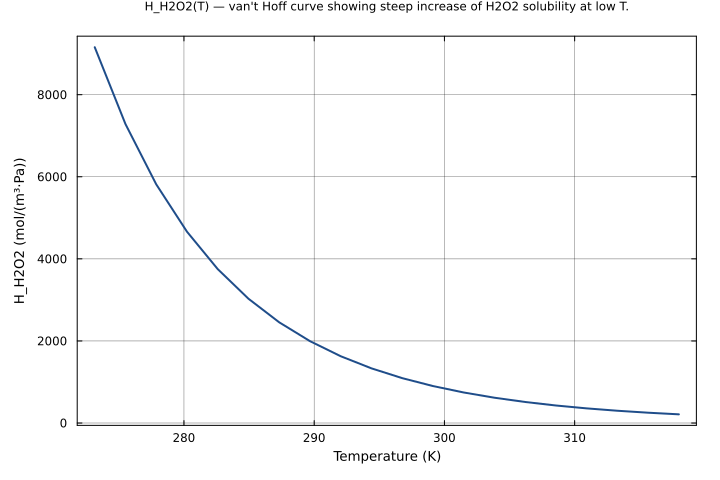
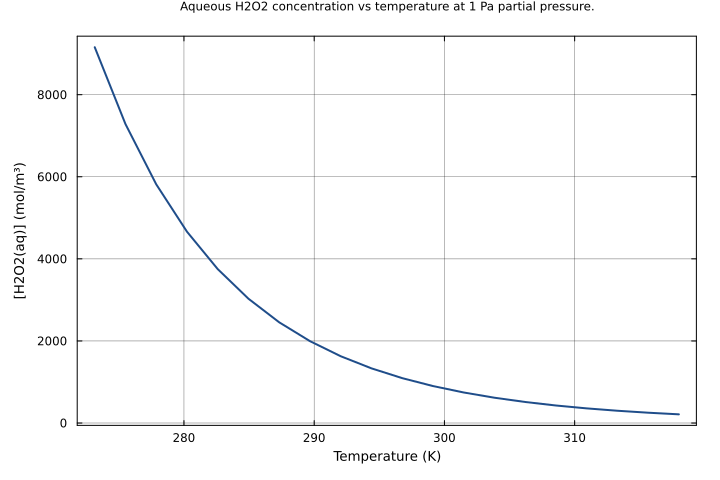
Van’t Hoff temperature dependence of the H2O2 Henry’s law constant (S&P Table 7.3). With ΔH_sol = −14.5 kcal/mol, H2O2 is one of the most strongly temperature-sensitive atmospheric gases — H_H2O2 increases ~43× from 45°C (318 K) to 0°C (273 K), much larger than SO2 (~2.6×) or CO2 (~2.1×). This strong temperature sensitivity controls H2O2 partitioning between gas and cloud-droplet phases.
Time span: 0.0 → 1.0
Swept over: T
H_H2O2_eff_vs_pH
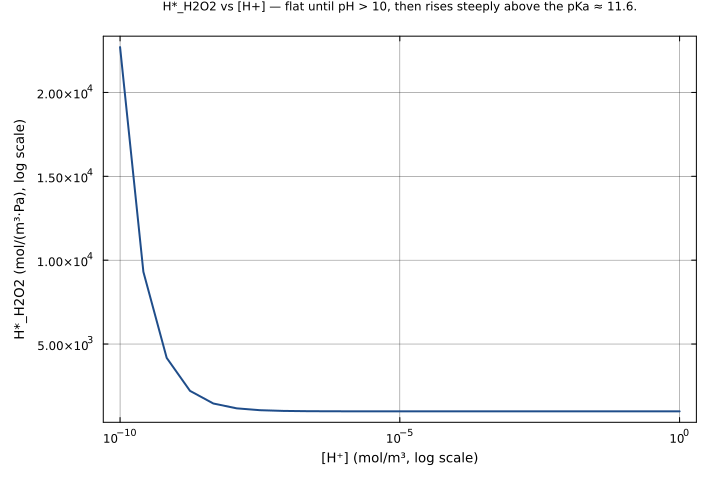
Effective Henry’s law constant H*_H2O2 = H_H2O2 × (1 + K_h1/[H+]) vs [H+] at 298 K. H2O2 pKa ≈ 11.6, so the dissociation enhancement is negligible below pH 10 and only becomes noticeable above pH 11. At pH 12, H*_H2O2 ≈ 3.2× H_H2O2. This is in stark contrast to SO2 (pKa1 ≈ 1.9) where dissociation enhances H*_SO2 by many orders of magnitude across the atmospheric pH range.
Time span: 0.0 → 1.0
Swept over: H_plus
coupled_T_p_sweep
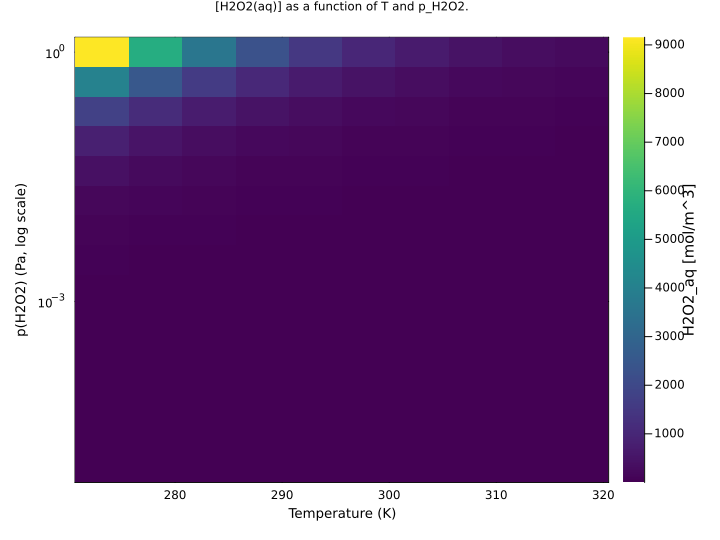
Henry’s law: aqueous H2O2 concentration as a function of both temperature (van’t Hoff) and partial pressure (linearity). Sweeping T from 273 K to 318 K and p_H2O2 from 1e-5 to 1.0 Pa shows the joint T-p surface that determines cloud-droplet H2O2 in atmospheric models.
Time span: 0.0 → 1.0
Swept over: T, p_H2O2
Raw .esm
Raw .esm JSON (this component)
{
"reference": {
"notes": "source_ref: Aerosol.jl@c8c640bb:src/aqueous_equilibria.jl:519\n\nUpstream `H2O2Equilibria` is an MTK `@component` where T, H_plus, and p_H2O2 are `@variables` driven by a parent `AqueousEquilibria` system. For standalone serialization (and to make the component well-posed in isolation), T, H_plus, and p_H2O2 are declared as parameters here — matching the bead's `(S, observed-only)` classification. The six algebraic equations are unchanged from upstream.\n\nKey difference from SO2/CO2/NH3: K_h1 is temperature-independent (upstream `K_h1 ~ K_h1_298` with no van't Hoff correction). H2O2 is a very weak acid (pKa ≈ 11.6 at 298 K), so dissociation is negligible at typical atmospheric pH 3–7 (K_h1/H_plus ≤ 2.2×10⁻⁵ at pH 7, rising to 2.2 at pH 11).\n\nH_H2O2_298 = 1.0×10⁵ M/atm × 1000 mol·m⁻³/M ÷ 101325 Pa/atm = 986.9233 mol/(m³·Pa). K_h1_298 = 2.2×10⁻¹² M × 1000 = 2.2×10⁻⁹ mol/m³.\n\nTolerance rationale (model-level rel=1e-6): observed-only algebraic system (no ODE integration); 1e-6 covers float64 roundoff in the exp/multiply expression of the van't Hoff H_H2O2(T) closed form. K_h1 is constant; the dissociation and totals are simple products/sums."
},
"tolerance": {
"rel": 1e-06
},
"variables": {
"T": {
"type": "parameter",
"units": "K",
"default": 298.0,
"description": "Temperature"
},
"H_plus": {
"type": "parameter",
"units": "mol/m^3",
"default": 0.0001,
"description": "Hydrogen ion concentration (1e-4 mol/m³ = pH 7 in pure water at 298 K)"
},
"p_H2O2": {
"type": "parameter",
"units": "Pa",
"default": 1.0,
"description": "Partial pressure of H2O2"
},
"R_gas": {
"type": "parameter",
"units": "J/mol/K",
"default": 8.314,
"description": "Gas constant"
},
"T_ref": {
"type": "parameter",
"units": "K",
"default": 298.0,
"description": "Reference temperature"
},
"H_H2O2_298": {
"type": "parameter",
"units": "mol/m^3/Pa",
"default": 986.9232667160128,
"description": "Henry's law constant for H2O2 at 298 K (1.0×10⁵ M/atm converted to mol/(m³·Pa): 1.0e5 / 101325.0 * 1000.0)"
},
"dH_H_H2O2": {
"type": "parameter",
"units": "J/mol",
"default": -60668.0,
"description": "Heat of dissolution for H2O2 (-14.5 kcal/mol converted to J/mol; Seinfeld & Pandis Table 7.4)"
},
"K_h1_298": {
"type": "parameter",
"units": "mol/m^3",
"default": 2.2e-09,
"description": "Dissociation constant for H2O2 → H⁺ + HO2⁻ at 298 K (2.2×10⁻¹² M converted to mol/m³; very weak, temperature-independent in upstream source)"
},
"H_H2O2": {
"type": "unknown",
"units": "mol/m^3/Pa",
"description": "Temperature-dependent Henry's law constant for H2O2"
},
"K_h1": {
"type": "unknown",
"units": "mol/m^3",
"description": "Dissociation constant H2O2 → H⁺ + HO2⁻ (temperature-independent: K_h1 = K_h1_298)"
},
"H2O2_aq": {
"type": "unknown",
"units": "mol/m^3",
"description": "Aqueous H2O2 concentration"
},
"HO2_minus": {
"type": "unknown",
"units": "mol/m^3",
"description": "Hydroperoxide anion concentration [HO2-]"
},
"H2O2_total": {
"type": "unknown",
"units": "mol/m^3",
"description": "Total dissolved hydrogen peroxide: [H2O2(aq)] + [HO2-]"
},
"H_H2O2_eff": {
"type": "unknown",
"units": "mol/m^3/Pa",
"description": "Effective Henry's law constant for H2O2 accounting for dissociation: H_H2O2 × (1 + K_h1/[H+])"
}
},
"equations": [
{
"lhs": "H_H2O2",
"rhs": {
"op": "*",
"args": [
"H_H2O2_298",
{
"op": "exp",
"args": [
{
"op": "*",
"args": [
{
"op": "/",
"args": [
"dH_H_H2O2",
"R_gas"
]
},
{
"op": "+",
"args": [
{
"op": "/",
"args": [
1,
"T_ref"
]
},
{
"op": "/",
"args": [
-1,
"T"
]
}
]
}
]
}
]
}
]
}
},
{
"lhs": "K_h1",
"rhs": "K_h1_298"
},
{
"lhs": "H2O2_aq",
"rhs": {
"op": "*",
"args": [
"H_H2O2",
"p_H2O2"
]
}
},
{
"lhs": "HO2_minus",
"rhs": {
"op": "/",
"args": [
{
"op": "*",
"args": [
"K_h1",
"H2O2_aq"
]
},
"H_plus"
]
}
},
{
"lhs": "H2O2_total",
"rhs": {
"op": "+",
"args": [
"H2O2_aq",
"HO2_minus"
]
}
},
{
"lhs": "H_H2O2_eff",
"rhs": {
"op": "*",
"args": [
"H_H2O2",
{
"op": "+",
"args": [
1,
{
"op": "/",
"args": [
"K_h1",
"H_plus"
]
}
]
}
]
}
}
],
"tests": [
{
"id": "reference_298K_pH7",
"description": "Reference state at 298 K (T_ref) with neutral water (pH 7) and 1 Pa H2O2. At T=T_ref the van't Hoff exponent is zero so H_H2O2 = H_H2O2_298. K_h1 is temperature-independent and equals K_h1_298. The dissociation correction K_h1/H_plus = 2.2e-9/1e-4 = 2.2e-5 is negligible — HO2_minus is ~0.002% of H2O2_aq.",
"parameter_overrides": {
"T": 298.0,
"H_plus": 0.0001,
"p_H2O2": 1.0
},
"time_span": {
"start": 0.0,
"end": 1.0
},
"assertions": [
{
"variable": "H_H2O2",
"time": 0.0,
"expected": 986.9232667160128
},
{
"variable": "K_h1",
"time": 0.0,
"expected": 2.2e-09
},
{
"variable": "H2O2_aq",
"time": 0.0,
"expected": 986.9232667160128
},
{
"variable": "HO2_minus",
"time": 0.0,
"expected": 0.02171231186775228
},
{
"variable": "H2O2_total",
"time": 0.0,
"expected": 986.9449790278805
},
{
"variable": "H_H2O2_eff",
"time": 0.0,
"expected": 986.9449790278805
}
]
},
{
"id": "cold_273K_pH7",
"description": "Cold cloud water at 273.15 K (0°C), pH 7. H2O2 has a very large negative ΔH_sol (−14.5 kcal/mol = −60668 J/mol), so solubility increases sharply with cooling — H_H2O2 grows ~9.3× relative to 298 K. K_h1 is unchanged (temperature-independent).",
"parameter_overrides": {
"T": 273.15,
"H_plus": 0.0001,
"p_H2O2": 1.0
},
"time_span": {
"start": 0.0,
"end": 1.0
},
"assertions": [
{
"variable": "H_H2O2",
"time": 0.0,
"expected": 9157.256660439376
},
{
"variable": "K_h1",
"time": 0.0,
"expected": 2.2e-09
},
{
"variable": "H2O2_aq",
"time": 0.0,
"expected": 9157.256660439376
},
{
"variable": "HO2_minus",
"time": 0.0,
"expected": 0.20145964652966625
},
{
"variable": "H2O2_total",
"time": 0.0,
"expected": 9157.458120085907
},
{
"variable": "H_H2O2_eff",
"time": 0.0,
"expected": 9157.458120085905
}
]
},
{
"id": "cold_280K_pH7",
"description": "Intermediate cold-water reference (280 K), pH 7. H_H2O2 ≈ 4763.6 mol/(m³·Pa), roughly 4.8× the 298 K value.",
"parameter_overrides": {
"T": 280.0,
"H_plus": 0.0001,
"p_H2O2": 1.0
},
"time_span": {
"start": 0.0,
"end": 1.0
},
"assertions": [
{
"variable": "H_H2O2",
"time": 0.0,
"expected": 4763.550867474284
},
{
"variable": "H2O2_aq",
"time": 0.0,
"expected": 4763.550867474284
}
]
},
{
"id": "warm_310K_pH7",
"description": "Warm-cloud reference (310 K), pH 7. H2O2 solubility falls with warming (large negative ΔH_sol): H_H2O2 ≈ 382.5 mol/(m³·Pa), about 0.39× the 298 K value.",
"parameter_overrides": {
"T": 310.0,
"H_plus": 0.0001,
"p_H2O2": 1.0
},
"time_span": {
"start": 0.0,
"end": 1.0
},
"assertions": [
{
"variable": "H_H2O2",
"time": 0.0,
"expected": 382.4940875002585
},
{
"variable": "H2O2_aq",
"time": 0.0,
"expected": 382.4940875002585
},
{
"variable": "HO2_minus",
"time": 0.0,
"expected": 0.008414869925005687
},
{
"variable": "H_H2O2_eff",
"time": 0.0,
"expected": 382.5025023701835
}
]
},
{
"id": "hot_318K_pH7",
"description": "Upper-range reference (318 K, 45°C) for warm aqueous-phase chemistry.",
"parameter_overrides": {
"T": 318.0,
"H_plus": 0.0001,
"p_H2O2": 1.0
},
"time_span": {
"start": 0.0,
"end": 1.0
},
"assertions": [
{
"variable": "H_H2O2",
"time": 0.0,
"expected": 211.56603164215167
},
{
"variable": "H2O2_aq",
"time": 0.0,
"expected": 211.56603164215167
}
]
},
{
"id": "van_t_hoff_ratio_check",
"description": "Explicit van't Hoff ratio: H_H2O2(273.15) / H_H2O2(298) = exp((-60668/8.314) × (1/298 - 1/273.15)) ≈ 9.27. Verified via the ratio of the cold_273K and reference_298K test values: 9157.26/986.92 ≈ 9.27. States H_H2O2_eff matches H_H2O2 × (1 + K_h1/H_plus) at a p=2 Pa case.",
"parameter_overrides": {
"T": 273.15,
"H_plus": 0.0001,
"p_H2O2": 2.0
},
"time_span": {
"start": 0.0,
"end": 1.0
},
"assertions": [
{
"variable": "H_H2O2",
"time": 0.0,
"expected": 9157.256660439376
},
{
"variable": "H2O2_aq",
"time": 0.0,
"expected": 18314.513320878752
},
{
"variable": "HO2_minus",
"time": 0.0,
"expected": 0.4029192930593325
}
]
},
{
"id": "acidic_pH4_298K",
"description": "Acidic cloud water (pH 4, [H+] = 0.1 mol/m³) at 298 K. K_h1/H_plus = 2.2e-9/0.1 = 2.2e-8 — even smaller fraction dissociated than at pH 7. H_H2O2_eff → H_H2O2 to excellent approximation.",
"parameter_overrides": {
"T": 298.0,
"H_plus": 0.1,
"p_H2O2": 1.0
},
"time_span": {
"start": 0.0,
"end": 1.0
},
"assertions": [
{
"variable": "H2O2_aq",
"time": 0.0,
"expected": 986.9232667160128
},
{
"variable": "HO2_minus",
"time": 0.0,
"expected": 2.171231186775228e-05
},
{
"variable": "H2O2_total",
"time": 0.0,
"expected": 986.9232884283247
},
{
"variable": "H_H2O2_eff",
"time": 0.0,
"expected": 986.9232884283247
}
]
},
{
"id": "acidic_pH2_298K",
"description": "Strongly acidic regime (pH 2, [H+] = 10 mol/m³) at 298 K. K_h1/H_plus = 2.2e-10 — dissociation completely negligible. Stress-tests the HO2_minus and H_H2O2_eff expressions at the far-acidic tail.",
"parameter_overrides": {
"T": 298.0,
"H_plus": 10.0,
"p_H2O2": 1.0
},
"time_span": {
"start": 0.0,
"end": 1.0
},
"assertions": [
{
"variable": "HO2_minus",
"time": 0.0,
"expected": 2.1712311867752282e-07
},
{
"variable": "H_H2O2_eff",
"time": 0.0,
"expected": 986.9232669331359
}
]
},
{
"id": "basic_pH11_298K",
"description": "Basic regime (pH 11, [H+] = 1e-8 mol/m³) at 298 K. K_h1/H_plus = 2.2e-9/1e-8 = 0.22 — dissociation is now ~22% of H2O2_aq, comparable. H_H2O2_eff is ~1.22× H_H2O2.",
"parameter_overrides": {
"T": 298.0,
"H_plus": 1e-08,
"p_H2O2": 1.0
},
"time_span": {
"start": 0.0,
"end": 1.0
},
"assertions": [
{
"variable": "H2O2_aq",
"time": 0.0,
"expected": 986.9232667160128
},
{
"variable": "HO2_minus",
"time": 0.0,
"expected": 217.12311867752283
},
{
"variable": "H2O2_total",
"time": 0.0,
"expected": 1204.0463853935357
},
{
"variable": "H_H2O2_eff",
"time": 0.0,
"expected": 1204.0463853935355
}
]
},
{
"id": "basic_pH12_298K",
"description": "Basic regime (pH 12, [H+] = 1e-9 mol/m³) at 298 K. K_h1/H_plus = 2.2 — dissociation is now substantial: HO2_minus ≈ 2.2× H2O2_aq. H_H2O2_eff ≈ 3.2× H_H2O2. Exercises the high-pH enhancement of the effective Henry's constant.",
"parameter_overrides": {
"T": 298.0,
"H_plus": 1e-09,
"p_H2O2": 1.0
},
"time_span": {
"start": 0.0,
"end": 1.0
},
"assertions": [
{
"variable": "HO2_minus",
"time": 0.0,
"expected": 2171.2311867752283
},
{
"variable": "H2O2_total",
"time": 0.0,
"expected": 3158.154453491241
},
{
"variable": "H_H2O2_eff",
"time": 0.0,
"expected": 3158.1544534912405
}
]
},
{
"id": "high_p_H2O2",
"description": "Henry's-law linearity check: 10× p_H2O2 at fixed T and H_plus scales H2O2_aq, HO2_minus, H2O2_total by 10× while leaving H_H2O2, K_h1, H_H2O2_eff unchanged.",
"parameter_overrides": {
"T": 298.0,
"H_plus": 0.0001,
"p_H2O2": 10.0
},
"time_span": {
"start": 0.0,
"end": 1.0
},
"assertions": [
{
"variable": "H2O2_aq",
"time": 0.0,
"expected": 9869.232667160128
},
{
"variable": "HO2_minus",
"time": 0.0,
"expected": 0.2171231186775228
},
{
"variable": "H2O2_total",
"time": 0.0,
"expected": 9869.449790278804
},
{
"variable": "H_H2O2_eff",
"time": 0.0,
"expected": 986.9449790278805
}
]
},
{
"id": "low_p_H2O2",
"description": "Henry's-law linearity check at low partial pressure: p_H2O2 = 0.01 Pa scales H2O2_aq by 0.01× from baseline. H_H2O2_eff is independent of p_H2O2.",
"parameter_overrides": {
"T": 298.0,
"H_plus": 0.0001,
"p_H2O2": 0.01
},
"time_span": {
"start": 0.0,
"end": 1.0
},
"assertions": [
{
"variable": "H2O2_aq",
"time": 0.0,
"expected": 9.869232667160128
},
{
"variable": "H2O2_total",
"time": 0.0,
"expected": 9.869449790278805
},
{
"variable": "H_H2O2_eff",
"time": 0.0,
"expected": 986.9449790278805
}
]
},
{
"id": "coupled_cold_acidic",
"description": "Cross-check: cold (273.15 K) AND acidic (pH 4). Combines the van't Hoff temperature shift (H_H2O2 grows ~9.3×) with the acidic suppression of HO2_minus. Dissociation is negligible at pH 4 regardless of T.",
"parameter_overrides": {
"T": 273.15,
"H_plus": 0.1,
"p_H2O2": 1.0
},
"time_span": {
"start": 0.0,
"end": 1.0
},
"assertions": [
{
"variable": "H_H2O2",
"time": 0.0,
"expected": 9157.256660439376
},
{
"variable": "H2O2_aq",
"time": 0.0,
"expected": 9157.256660439376
},
{
"variable": "H2O2_total",
"time": 0.0,
"expected": 9157.256861899023
},
{
"variable": "H_H2O2_eff",
"time": 0.0,
"expected": 9157.256861899023
}
]
},
{
"id": "coupled_warm_basic",
"description": "Cross-check: warm (310 K) AND basic (pH 11). Reduced H_H2O2 (lower T reduces solubility) combined with elevated dissociation at high pH. K_h1/H_plus = 2.2e-9/1e-8 = 0.22 → HO2_minus ≈ 84 mol/m³, H_H2O2_eff ≈ 1.22× H_H2O2.",
"parameter_overrides": {
"T": 310.0,
"H_plus": 1e-08,
"p_H2O2": 1.0
},
"time_span": {
"start": 0.0,
"end": 1.0
},
"assertions": [
{
"variable": "H_H2O2",
"time": 0.0,
"expected": 382.4940875002585
},
{
"variable": "H2O2_aq",
"time": 0.0,
"expected": 382.4940875002585
},
{
"variable": "HO2_minus",
"time": 0.0,
"expected": 84.14869925005686
},
{
"variable": "H_H2O2_eff",
"time": 0.0,
"expected": 466.64278675031534
}
]
}
],
"analyses": [
{
"id": "H_H2O2_vs_temperature",
"description": "Van't Hoff temperature dependence of the H2O2 Henry's law constant (S&P Table 7.3). With ΔH_sol = −14.5 kcal/mol, H2O2 is one of the most strongly temperature-sensitive atmospheric gases — H_H2O2 increases ~43× from 45°C (318 K) to 0°C (273 K), much larger than SO2 (~2.6×) or CO2 (~2.1×). This strong temperature sensitivity controls H2O2 partitioning between gas and cloud-droplet phases.",
"initial_state": {},
"parameters": {
"H_plus": 0.0001,
"p_H2O2": 1.0
},
"time_span": {
"start": 0.0,
"end": 1.0
},
"parameter_sweep": {
"type": "cartesian",
"dimensions": [
{
"parameter": "T",
"range": {
"start": 273.15,
"stop": 318.0,
"count": 20,
"scale": "linear"
}
}
]
},
"plots": [
{
"id": "H_H2O2_curve",
"type": "line",
"description": "H_H2O2(T) — van't Hoff curve showing steep increase of H2O2 solubility at low T.",
"x": {
"variable": "T",
"label": "Temperature (K)"
},
"y": {
"variable": "H_H2O2",
"label": "H_H2O2 (mol/(m³·Pa))"
}
},
{
"id": "H2O2_aq_curve",
"type": "line",
"description": "Aqueous H2O2 concentration vs temperature at 1 Pa partial pressure.",
"x": {
"variable": "T",
"label": "Temperature (K)"
},
"y": {
"variable": "H2O2_aq",
"label": "[H2O2(aq)] (mol/m³)"
}
}
]
},
{
"id": "H_H2O2_eff_vs_pH",
"description": "Effective Henry's law constant H*_H2O2 = H_H2O2 × (1 + K_h1/[H+]) vs [H+] at 298 K. H2O2 pKa ≈ 11.6, so the dissociation enhancement is negligible below pH 10 and only becomes noticeable above pH 11. At pH 12, H*_H2O2 ≈ 3.2× H_H2O2. This is in stark contrast to SO2 (pKa1 ≈ 1.9) where dissociation enhances H*_SO2 by many orders of magnitude across the atmospheric pH range.",
"initial_state": {},
"parameters": {
"T": 298.0,
"p_H2O2": 1.0
},
"time_span": {
"start": 0.0,
"end": 1.0
},
"parameter_sweep": {
"type": "cartesian",
"dimensions": [
{
"parameter": "H_plus",
"range": {
"start": 1e-10,
"stop": 1.0,
"count": 25,
"scale": "log"
}
}
]
},
"plots": [
{
"id": "Hstar_curve",
"type": "line",
"description": "H*_H2O2 vs [H+] — flat until pH > 10, then rises steeply above the pKa ≈ 11.6.",
"x": {
"variable": "H_plus",
"label": "[H⁺] (mol/m³, log scale)"
},
"y": {
"variable": "H_H2O2_eff",
"label": "H*_H2O2 (mol/(m³·Pa), log scale)"
}
}
]
},
{
"id": "coupled_T_p_sweep",
"description": "Henry's law: aqueous H2O2 concentration as a function of both temperature (van't Hoff) and partial pressure (linearity). Sweeping T from 273 K to 318 K and p_H2O2 from 1e-5 to 1.0 Pa shows the joint T-p surface that determines cloud-droplet H2O2 in atmospheric models.",
"initial_state": {},
"parameters": {
"H_plus": 0.0001
},
"time_span": {
"start": 0.0,
"end": 1.0
},
"parameter_sweep": {
"type": "cartesian",
"dimensions": [
{
"parameter": "T",
"range": {
"start": 273.15,
"stop": 318.0,
"count": 10,
"scale": "linear"
}
},
{
"parameter": "p_H2O2",
"range": {
"start": 1e-05,
"stop": 1.0,
"count": 15,
"scale": "log"
}
}
]
},
"plots": [
{
"id": "H2O2_aq_heatmap",
"type": "heatmap",
"description": "[H2O2(aq)] as a function of T and p_H2O2.",
"x": {
"variable": "T",
"label": "Temperature (K)"
},
"y": {
"variable": "p_H2O2",
"label": "p(H2O2) (Pa, log scale)"
},
"value": {
"variable": "H2O2_aq",
"reduce": "final"
}
}
]
}
]
}