mpas
MPAS unstructured spherical centroidal-Voronoi (icosahedral) C-grid on the unit sphere: NCELLS Voronoi cells, NEDGES edges, NVERTICES triangle vertices, with cell valence bounded by MAXEDGES (on a closed sphere the Euler relations give NEDGES = 3*(NCELLS - 2) and NVERTICES = 2*(NCELLS - 2), but the three counts stay independent metaparameters so planar or open meshes can reuse the file).
MPAS unstructured spherical centroidal-Voronoi (icosahedral) C-grid on the unit sphere: NCELLS Voronoi cells, NEDGES edges, NVERTICES triangle vertices, with cell valence bounded by MAXEDGES (on a closed sphere the Euler relations give NEDGES = 3*(NCELLS - 2) and NVERTICES = 2*(NCELLS - 2), but the three counts stay independent metaparameters so planar or open meshes can reuse the file). Unlike the rectangular grids there is no coordinate axis: the iteration domains are the three entity interval sets (cells, edges, vertices) plus the ragged connectivity set edges_of_cell (esm-schema IndexSet kind “ragged”; RFC semiring-faq-unified-ir 5.2), which binds by NAME to two keyed factors the consuming document must expose as cell-shaped arrays: nEdgesOnCell (offsets: the valence of each cell) and edgesOnCell (values: the edge ids around each cell, counterclockwise, zero-padded to maxEdges). Geometry is likewise DATA, not formula: mesh files under grids/mpas/mesh/ (section-4.7 subsystem files with literal const arrays) supply the factors nEdgesOnCell, edgesOnCell, edgeSignOnCell, cellsOnEdge, verticesOnEdge, dvEdge, dcEdge, areaCell, latCell, lonCell – and, since the 2026-07 regridding wave WIDENED the mesh contract, the VERTEX-GEOMETRY factors latVertex, lonVertex (vertex = Delaunay-triangle circumcenter, radians, lon in (-pi, pi], same convention as latCell/lonCell) and verticesOnCell (vertex ids around each cell, counterclockwise viewed from outside, zero-padded to maxEdges exactly like edgesOnCell; verticesOnCell[i][k] is the vertex SHARED by consecutive CCW edges edgesOnCell[i][k] and edgesOnCell[i][k+1 cyclic]; on a closed mesh every cell has exactly as many vertices as edges, so nEdgesOnCell doubles as the per-cell vertex count and there is no separate offsets factor) – under exactly those names; a consuming model mounts one as a subsystem and re-exposes the factors a rule needs as bare-name observed aliases (e.g. areaCell := mesh.areaCell), since keyed factors resolve by bare name in the model scope (see problems/divergence_mpas.esm for the pattern). The widened contract makes CELL POLYGON RINGS derivable in-document: the match-less template mpas_cell_rings_deg gathers each cell’s vertex ring into the [cells, maxEdges, ring_coord] lon-lat-DEGREE stack the conservative regridder consumes as src_poly/tgt_poly (regridding/conservative_overlap.esm; ring vertex = [lon, lat] in degrees, CCW), clamping the gather with min(k, nEdgesOnCell(i)) so PADDING SLOTS REPEAT THE CELL’S LAST REAL VERTEX – rectangular (padded) ring storage rather than a ragged ring, chosen because the polygon_intersection_area kernels accept trailing-duplicate padded rings value-identically (verified empirically against the Julia planar and spherical clip kernels: padded and unpadded rings agree at 0 ulp as subject and as clip operand; on a mesh whose MAXEDGES equals every cell’s valence, e.g. the level-0 pentagons, no padding ever occurs). The other closed-form geometry is the resolution scale: cell_area_mean = 4*pi/NCELLS, the mean cell area on the unit sphere (the h^2 measure for convergence sweeps, h ~ sqrt(cell_area_mean)). Orientation conventions are fixed by the mesh data (positive edge normal from cellsOnEdge[e][1] to cellsOnEdge[e][2]; positive tangent v1->v2 with t = k x n; edgeSignOnCell = +1 where the positive normal leaves the cell), per Ringler et al. (2010).
Metaparameters
| Name | Type | Default | Description |
|---|---|---|---|
NCELLS | integer | 12 | Number of Voronoi cells (generators). Default: the icosahedral level-0 mesh (grids/mpas/mesh/level0.esm). |
NEDGES | integer | 30 | Number of edges (cell-pair interfaces; 3*(NCELLS-2) on a closed sphere). |
NVERTICES | integer | 20 | Number of mesh vertices (Delaunay-triangle circumcenters; 2*(NCELLS-2) on a closed sphere). |
MAXEDGES | integer | 5 | Maximum cell valence: the padded row length of the per-cell connectivity arrays (5 for level0, 6 for level1 and all larger icosahedral meshes). |
All sizes are load-time metaparameters (esm-spec §9.7.6): rebind them at the import edge (or through the loader API) and the same files serve every resolution.
Consumer-supplied free names
The mesh geometry arrives as data, not formula: these are the keyed-factor arrays a consuming model must expose under exactly these bare names, normally as observed aliases of a mounted grids/mpas/mesh/ subsystem’s const data (see problems/divergence_mpas.esm). The 2026-07 regridding wave widened the contract with the vertex-geometry factors so cell polygon rings derive in-document via mpas_cell_rings_deg.
Index sets
| Name | Kind | Size |
|---|---|---|
cells | interval | NCELLS |
edges | interval | NEDGES |
vertices | interval | NVERTICES |
maxEdges | interval | MAXEDGES |
edge_ends | interval | 2 |
edges_of_cell | ragged | per cells (offsets: nEdgesOnCell, values: edgesOnCell) |
ring_coord | interval | 2 |
Geometry templates
| Template | Parameters | Definition | Description |
|---|---|---|---|
cell_area_mean | — | 12.566370614359172 / NCELLS | Mean Voronoi-cell area on the unit sphere, 4*pi/NCELLS: the grid’s resolution measure (nominal mesh spacing h ~ sqrt(cell_area_mean)), used by convergence sweeps exactly as dx = 1/N is on cartesian_uniform_1d. |
mpas_cell_rings_deg | latVertex, lonVertex, verticesOnCell, nEdgesOnCell | sum[i, k, c] (ifelse(c == 1, lonVertex[verticesOnCell[i, min(k, nEdgesOnCell[i])]] * 57.29577951308232, latVertex[verticesOnCell[i, min(k, nEdgesOnCell[i])]] * 57.29577951308232)) where {c in ring_coord, i in cells, k in maxEdges} | Cell polygon rings from the widened mesh contract, regridder-ready: ring[i,k,c] = [lonVertex, latVertex](verticesOnCell[i, min(k, nEdgesOnCell(i))]) * 180/pi – the [cells, maxEdges, ring_coord] closed CCW lon-lat-DEGREE vertex-ring stack that regridding/conservative_overlap.esm consumes as src_poly/tgt_poly (ring vertex = [lon, lat] degrees; CCW is inherited from verticesOnCell’s counterclockwise order). The gather is CLAMPED, min(k, nEdgesOnCell(i)), so a cell with fewer than MAXEDGES vertices pads its ring by REPEATING ITS LAST REAL VERTEX rather than dereferencing a zero pad slot – trailing-duplicate padded rings are accepted value-identically by the polygon_intersection_area kernels (empirically verified, 0 ulp, planar and spherical), which is why the ring ships rectangular instead of ragged. The four mesh factors are TEMPLATE PARAMETERS (this template is match-less and explicitly applied, so params are the natural mechanism – unlike the div rule, whose match-fired body must use the bare-name keyed-factor contract): bind them to the mounted mesh subsystem’s factors DIRECTLY under their subsystem-scoped names (e.g. latVertex: ‘mesh.latVertex’), which keeps the ring expression’s references const-backed – the build-time geometry-setup evaluator materializes aggregates over const data, and routing through bare-name VarExpr aliases would put a non-const reference inside the setup closure (the alias re-exposure pass and the geometry-setup pass do not compose in that order upstream). Radians-to-degrees (factor 57.29577951308232 = 180/pi) is part of the template because the mesh files publish radians (MPAS convention) while the geometry kernels take degrees. Build-time CONST: the rings fold into the regridder’s overlap-matrix setup. |
Rules
Complete auto-applied rewrite rules on spatial D: imported stencil + boundary conditions in one makearray (esm-spec §9.6.8). Import a rule and every matching derivative in your model lowers through it.
fv_divergence_cell
Source: grids/mpas/rules/fv_divergence_cell.esm
Rewrites div(F) — match pattern:
{"op": "div", "args": ["F"]}
where): fires only when F is a bare field shaped [edges]. Under import-edge renaming (§9.7.7) the wrt literal and this shape follow the renamed axis together, so the rule can be imported more than once (each instance scoped to its own grid) without a first-declared-wins collision. A consumer differentiating a compound inline expression must bind it to a declared shaped observed first.Definition:
Finite-volume cell divergence of an edge-normal flux on the MPAS Voronoi grid (the TRiSK discrete divergence, Ringler et al. 2010 eq. 21): div_i = (1/A_i) * sum_{k=1..nEdgesOnCell(i)} edgeSignOnCell(i,k) * F(e) * dvEdge(e) with e = edgesOnCell(i,k) — the exact Gauss/divergence theorem on cell i with the flux integral along each edge approximated by the midpoint rule, F being the flux component along the edge’s positive normal (which points from cellsOnEdge(e,1) to cellsOnEdge(e,2)) and edgeSignOnCell flipping it outward from cell i. Matches the open-namespace rewrite-target {op: div, args: [F]} (esm-spec 9.6.8: div is author sugar with no evaluable core, and a rule MAY match it directly and emit a one-shot scheme), match-scoped with where: {F: {shape: [edges]}} (esm-spec 9.6.1) so it fires ONLY on the divergence of a bare field declared over this grid’s edges index set — the axis-less div pattern would otherwise fire on every div in a consuming component. The shape constraint is the mechanism that lets two MPAS meshes coexist in one document: import this rule twice under distinct index-set renames (esm-spec 9.7.7), and each instance’s where shape follows its renamed edge set (e.g. [meshA.edges] vs [meshB.edges]), so each div lowers by its own mesh’s rule with no first-declared-wins tie-break. Because the constraint requires a bare variable of exactly that shape, a consumer that divergences a COMPOUND inline flux (e.g. div(u*h)) must first bind the flux to a declared edge-shaped observed (the divergence_mpas problem’s flux observed is exactly that pattern). The body is a single aggregate over the cells axis whose contracted index k runs over the RAGGED index set edges_of_cell (esm-spec 4.3.1 { from, of }; RFC semiring-faq-unified-ir 5.2): per-cell dynamic bound k <= nEdgesOnCell(i) plus a gather through the edgesOnCell values factor — this is the connectivity-based stencil form that replaces the makearray region form of the rectangular grids. The division by areaCell(i) sits inside the summand, which equals (1/A_i)sum since A_i is constant over k. There are no boundary regions and no makearray because a closed sphere has no boundary: every edge separates exactly two cells (bc:none; a rule for a limited-area MPAS mesh would instead overwrite the boundary-cell entries, and would be a different rule). The free names nEdgesOnCell, edgesOnCell, edgeSignOnCell, dvEdge, areaCell are the grid’s keyed-factor contract (see grids/mpas/grid.esm): the consuming model must expose them as bare-name arrays, normally as observed aliases of a grids/mpas/mesh/ subsystem’s const data. Accuracy: exactly conservative for any F (sum_i A_idiv_i = 0, each edge cancels between its two cells) and exactly annihilates discrete curls (div of F_e = (eta(v2)-eta(v1))/dvEdge(e) is zero to rounding — the TRiSK div-curl identity; problems/divergence_mpas.esm asserts it); order tag is the guaranteed first-order bound on arbitrarily distorted Voronoi meshes, though the midpoint flux is second-order on centroidal/symmetric meshes (Ringler et al. 2010, section 3.2).
References
- Ringler, T., Thuburn, J., Klemp, J. B., & Skamarock, W. C. (2010). A unified approach to energy conservation and potential vorticity dynamics for arbitrarily-structured C-grids. Journal of Computational Physics, 229(9), 3065-3090. Eq. (21) and the div-curl mimetic identities of section 3.
- Thuburn, J., Ringler, T. D., Skamarock, W. C., & Klemp, J. B. (2009). Numerical representation of geostrophic modes on arbitrarily structured C-grids. Journal of Computational Physics, 228(22), 8321-8335.
Conformance fixtures
- ast:
fv_divergence_cell— statusactive - convergence:
divergence_mpas— statusactive - simulation:
divergence_mpas— statusactive
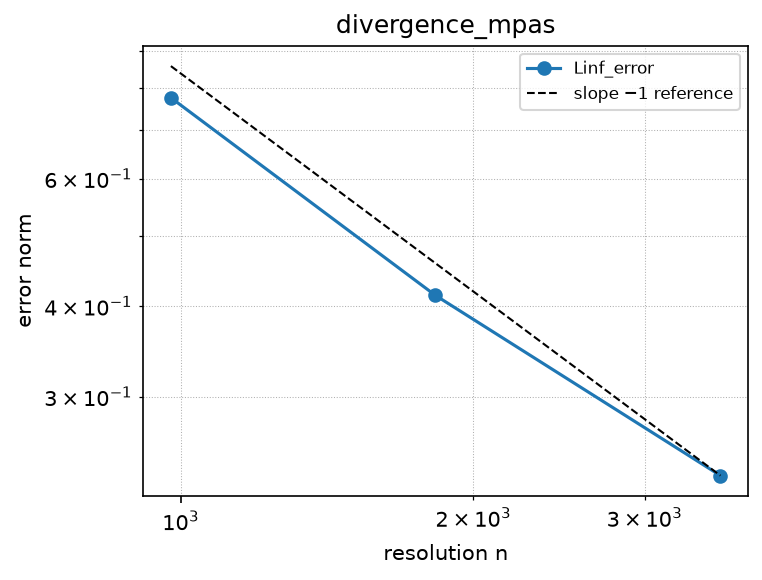
Convergence — case divergence_mpas
Error norms read from the committed golden tests/conformance/convergence/divergence_mpas/golden/errors.json
(binding: julia; nothing recomputed for display).
| n | Linf_error | observed order |
|---|---|---|
| 977 | 7.759e-01 | — |
| 1828 | 4.140e-01 | 1.00 |
| 3590 | 2.335e-01 | 0.85 |
Expected order: 1 (± 0.25).
fv_gradient_edge
Source: grids/mpas/rules/fv_gradient_edge.esm
Rewrites grad(phi) — match pattern:
{"op": "grad", "args": ["phi"]}
where): fires only when phi is a bare field shaped [cells]. Under import-edge renaming (§9.7.7) the wrt literal and this shape follow the renamed axis together, so the rule can be imported more than once (each instance scoped to its own grid) without a first-declared-wins collision. A consumer differentiating a compound inline expression must bind it to a declared shaped observed first.Definition:
Finite-volume edge-normal gradient of a cell scalar on the MPAS Voronoi grid (the TRiSK discrete gradient, Ringler et al. 2010 eq. 22): grad_e = (phi(cellsOnEdge(e,2)) - phi(cellsOnEdge(e,1))) / dcEdge(e) — the component, along each edge’s positive normal, of the gradient of the cell field phi, formed as the two-point difference of the flanking cell values divided by the center-to-center arc dcEdge(e). The positive normal points from cellsOnEdge(e,1) to cellsOnEdge(e,2) (the MPAS orientation shared with edgeSignOnCell and with the divergence rule’s flux convention), so the difference is taken head-minus-tail in that direction and dcEdge is the great-circle distance the difference spans. This is the exact MIMETIC DUAL of grids/mpas/rules/fv_divergence_cell: that rule maps an edge-normal flux to a cell divergence over cells; this rule maps a cell scalar to an edge-normal gradient over edges, and the two are negative adjoints of one another (see Accuracy). Matches the open-namespace rewrite-target {op: grad, args: [phi]} (esm-spec 9.6.8, 4.2: grad is author sugar with no evaluable core, and a rule MAY match it directly on the bare op and emit a one-shot scheme rather than routing through the D-sugar identity grad(f,dim:x)=D(f,wrt:x)), match-scoped with where: {phi: {shape: [cells]}} (esm-spec 9.6.1) so it fires ONLY on the gradient of a bare field declared over this grid’s cells index set — the axis-less grad pattern would otherwise fire on every grad in a consuming component. The shape constraint is the mechanism that lets two MPAS meshes coexist in one document: import this rule twice under distinct index-set renames (esm-spec 9.7.7), and each instance’s where shape follows its renamed cell set (e.g. [meshA.cells] vs [meshB.cells]), so each grad lowers by its own mesh’s rule with no first-declared-wins tie-break. Because the constraint requires a bare variable of exactly that shape, a consumer that takes the gradient of a COMPOUND inline cell expression (e.g. grad(a*b)) must first bind it to a declared cell-shaped observed. The body is a single aggregate over the edges axis with output index e and NO contracted index — a pure connectivity map, one two-point stencil per edge — because on the MPAS C-grid the gradient is intrinsically edge-local: every edge separates exactly two cells and the edge-normal derivative reads only those two, unlike the divergence whose body contracts the ragged edges_of_cell set. There is no makearray and no boundary region because a closed sphere has no boundary: every edge has both a cellsOnEdge(e,1) and a cellsOnEdge(e,2) (bc:none; a rule for a limited-area MPAS mesh would instead special-case the boundary edges that have only one interior cell, and would be a different rule). The free names cellsOnEdge, dcEdge are the grid’s keyed-factor contract (see grids/mpas/grid.esm): the consuming model must expose them as bare-name arrays, normally as observed aliases of a grids/mpas/mesh/ subsystem’s const data (problems/gradient_mpas.esm is the pattern). Accuracy: exactly annihilates spatially-constant fields (phi(c2)-phi(c1) = 0 for phi = const, hence grad_e = 0 at every edge to rounding — problems/gradient_mpas.esm asserts this), which is the gradient’s null-space mimetic property and the discrete statement that grad(const) = 0. The rule is the negative discrete adjoint of fv_divergence_cell under the TRiSK inner products <a,b>_cells = sum_i areaCell(i)a_ib_i and <u,v>_edges = sum_e dvEdge(e)*dcEdge(e)u_ev_e: summation by parts on the closed sphere carries no boundary term, so sum_i areaCell(i)phi_idiv(F)_i = -sum_e dvEdge(e)*dcEdge(e)grad(phi)_eF_e for any cell field phi and edge field F, the discrete Gauss/Green identity the two operators share (Ringler et al. 2010, section 3). The order tag is the guaranteed first-order bound on arbitrarily distorted Voronoi meshes, though the two-point difference is second-order on centroidal/symmetric meshes where the edge midpoint bisects the cell-center arc (Ringler et al. 2010, section 3.2). A convergence-order sweep on refined MPAS meshes is a possible follow-up, out of scope for the exactness gate that ships with this rule.
References
- Ringler, T., Thuburn, J., Klemp, J. B., & Skamarock, W. C. (2010). A unified approach to energy conservation and potential vorticity dynamics for arbitrarily-structured C-grids. Journal of Computational Physics, 229(9), 3065-3090. Eq. (22) and the discrete Green/adjoint (grad = -div^T) identities of section 3.
- Thuburn, J., Ringler, T. D., Skamarock, W. C., & Klemp, J. B. (2009). Numerical representation of geostrophic modes on arbitrarily structured C-grids. Journal of Computational Physics, 228(22), 8321-8335.
Conformance fixtures
- ast:
fv_gradient_edge— statusactive - simulation:
gradient_mpas— statusactive
fv_laplacian_cell
Source: grids/mpas/rules/fv_laplacian_cell.esm
Rewrites laplacian(phi) — match pattern:
{"op": "laplacian", "args": ["phi"]}
where): fires only when phi is a bare field shaped [cells]. Under import-edge renaming (§9.7.7) the wrt literal and this shape follow the renamed axis together, so the rule can be imported more than once (each instance scoped to its own grid) without a first-declared-wins collision. A consumer differentiating a compound inline expression must bind it to a declared shaped observed first.Definition:
Finite-volume cell Laplacian of a cell scalar on the MPAS Voronoi grid (the TRiSK discrete Laplacian, Ringler et al. 2010, the div-of-grad composition of eqs. 21-22): lap_i = (1/A_i) * sum_{k=1..nEdgesOnCell(i)} edgeSignOnCell(i,k) * dvEdge(e) * (phi(cellsOnEdge(e,2)) - phi(cellsOnEdge(e,1))) / dcEdge(e) with e = edgesOnCell(i,k) – the exact Gauss/divergence theorem on cell i applied to the edge-normal gradient of phi, i.e. div(grad phi) with the flux integral along each edge approximated by the midpoint rule. This rule is the mimetic COMPOSITION of grids/mpas/rules/fv_divergence_cell with grids/mpas/rules/fv_gradient_edge: the divergence’s per-edge flux F(e) is replaced INLINE by the two-point edge-normal gradient grad_e = (phi(c2) - phi(c1)) / dcEdge(e) that fv_gradient_edge would emit (c1 = cellsOnEdge(e,1), c2 = cellsOnEdge(e,2); the positive edge normal points c1 -> c2, the MPAS orientation shared by edgeSignOnCell and by both parent rules), so the summand is the outward-signed edge-normal gradient flux edgeSignOnCell(i,k)dvEdge(e)grad_e and the sum is the net flux through cell i’s boundary, per unit area A_i. Emitting the composed one-shot stencil (rather than lowering div and grad on separate fixpoint passes) is the open-namespace option esm-spec 9.6.8 explicitly grants: ‘A rule author MAY instead match laplacian directly and emit a one-shot stencil.’ Matches the open-namespace rewrite-target {op: laplacian, args: [phi]} (esm-spec 9.6.8, 4.2: laplacian is author sugar with no evaluable core – laplacian(u) = sum_i D(D(u,x_i),x_i) – and a rule MAY match it directly on the bare op and emit a scheme rather than routing through the nested-D identity), match-scoped with where: {phi: {shape: [cells]}} (esm-spec 9.6.1) so it fires ONLY on the Laplacian of a bare field declared over this grid’s cells index set – the axis-less laplacian pattern would otherwise fire on every laplacian in a consuming component. The shape constraint is the mechanism that lets two MPAS meshes coexist in one document: import this rule twice under distinct index-set renames (esm-spec 9.7.7), and each instance’s where shape follows its renamed cell set (e.g. [meshA.cells] vs [meshB.cells]), so each laplacian lowers by its own mesh’s rule with no first-declared-wins tie-break. Because the constraint requires a bare variable of exactly that shape, a consumer that takes the Laplacian of a COMPOUND inline cell expression (e.g. laplacian(ab)) must first bind it to a declared cell-shaped observed. The body is a single aggregate over the cells axis whose contracted index k runs over the RAGGED index set edges_of_cell (esm-spec 4.3.1 { from, of }; RFC semiring-faq-unified-ir 5.2): per-cell dynamic bound k <= nEdgesOnCell(i) plus a gather through the edgesOnCell values factor – the same connectivity-based stencil form as fv_divergence_cell, since the Laplacian IS a divergence (its output is a cell aggregate contracting the cell’s ragged edge ring), only with the edge flux built in-place from phi and dcEdge instead of read from a declared edge field. The division by areaCell(i) sits inside the summand, which equals (1/A_i)sum since A_i is constant over k, exactly as in fv_divergence_cell. There are no boundary regions and no makearray because a closed sphere has no boundary: every edge separates exactly two cells, so every cellsOnEdge(e,1)/cellsOnEdge(e,2) gather and every edgeSignOnCell entry the ragged bound reaches is well defined (bc:none; a rule for a limited-area MPAS mesh would instead overwrite the boundary-cell entries – one-sided/Neumann/Dirichlet closure of the edges with only one interior cell – and would be a different rule). The free names edgeSignOnCell, edgesOnCell, dvEdge, cellsOnEdge, dcEdge, areaCell are the grid’s keyed-factor contract (see grids/mpas/grid.esm): the consuming model must expose them as bare-name arrays, normally as observed aliases of a grids/mpas/mesh/ subsystem’s const data (problems/laplacian_mpas.esm is the pattern) – the union of fv_divergence_cell’s factors (edgeSignOnCell, edgesOnCell, dvEdge, areaCell) and fv_gradient_edge’s factors (cellsOnEdge, dcEdge), since the composed stencil needs both the divergence’s cell-boundary connectivity and the gradient’s flanking-cell gather. Accuracy: exactly ANNIHILATES spatially-constant fields (phi(c2)-phi(c1) = 0 for phi = const at every edge, hence every summand edgeSignOnCelldvEdge0/dcEdge = 0 and lap_i = 0 at every cell to rounding – the Laplacian’s null-space mimetic property, the discrete statement that laplacian(const) = 0; problems/laplacian_mpas.esm asserts it). Exactly CONSERVATIVE for any cell field phi (sum_i A_ilap_i = 0: each interior edge e appears in exactly its two cells cellsOnEdge(e,1) and cellsOnEdge(e,2) with opposite edgeSignOnCell and the same dvEdgegrad_e, so the two cells’ contributions cancel and the global integral of the discrete Laplacian is zero – the discrete divergence-theorem closure inherited from fv_divergence_cell; problems/laplacian_mpas.esm asserts it for a non-constant field). And SYMMETRIC NEGATIVE-SEMIDEFINITE under the TRiSK inner products <a,b>_cells = sum_i areaCell(i)a_ib_i and <u,v>_edges = sum_e dvEdge(e)*dcEdge(e)u_ev_e: because lap = div(grad) and fv_gradient_edge is the negative discrete adjoint of fv_divergence_cell (grad = -div^T under those inner products, the closed-sphere summation-by-parts identity of section 3), the Laplacian satisfies <phi, lap psi>_cells = -sum_e dvEdge(e)*dcEdge(e)grad(phi)_egrad(psi)_e, which is symmetric in phi<->psi and equals -||grad phi||^2 <= 0 at psi = phi – the discrete Dirichlet energy, the property that makes the TRiSK Laplacian a stable diffusion operator. The order tag is the guaranteed first-order bound on arbitrarily distorted Voronoi meshes, though the composed midpoint flux is second-order on centroidal/symmetric meshes where the edge midpoint bisects the cell-center arc (Ringler et al. 2010, section 3.2). A convergence-order sweep on refined MPAS meshes is a possible follow-up, out of scope for the exactness gate that ships with this rule.
References
- Ringler, T., Thuburn, J., Klemp, J. B., & Skamarock, W. C. (2010). A unified approach to energy conservation and potential vorticity dynamics for arbitrarily-structured C-grids. Journal of Computational Physics, 229(9), 3065-3090. Eqs. (21)-(22) and the discrete div-grad adjoint (grad = -div^T) / Dirichlet-energy identities of section 3.
- Thuburn, J., Ringler, T. D., Skamarock, W. C., & Klemp, J. B. (2009). Numerical representation of geostrophic modes on arbitrarily structured C-grids. Journal of Computational Physics, 228(22), 8321-8335.
Conformance fixtures
- ast:
fv_laplacian_cell— statusactive - simulation:
laplacian_mpas— statusactive