latlon
Uniform longitude-latitude grid with consumer-supplied extent (global or regional).
Uniform longitude-latitude grid with consumer-supplied extent (global or regional). The lon and lat index sets are the iteration axes; NLON and NLAT (the point counts) are the esm-spec 9.7 metaparameters, bound at an import edge or the loader API. The real-valued geometry is NOT baked into this file: lon0_deg, dlon_deg, lat0_deg, dlat_deg (all in degrees) are free names in the coordinate/metric template bodies and in this grid’s stencils/rules, resolving in the consuming component’s scope at evaluation — the same keyed-factor contract grids/mpas uses for areaCell/dvEdge and grids/cartesian_uniform_1d uses for x0/dx. COORDINATE CONVENTIONS (pinned; every rule in this directory assumes them): longitude is CELL-BASED — NLON cells with centers lon_i = lon0_deg + (i - 1/2) dlon_deg, i = 1..NLON, so the axis covers [lon0_deg, lon0_deg + NLON dlon_deg) and closes into a periodic zonal circle exactly when NLON dlon_deg = 360; latitude is POINT-BASED and endpoint-inclusive — NLAT points lat_j = lat0_deg + (j - 1) dlat_deg, j = 1..NLAT, covering [lat0_deg, lat0_deg + (NLAT - 1) dlat_deg]. GLOBAL RECIPE (the default 144 x 91 sizes match the esm-spec 9.6.8 worked example): the consuming model defines lon0_deg = 0 (parameter), dlon_deg = 360/NLON, lat0_deg = -90 (parameter), dlat_deg = 180/(NLAT - 1) — the lat points then run pole to pole with lat_1 = -90 and lat_NLAT = +90. Spell the spacings as observed variables whose expressions divide by the METAPARAMETER NAME (e.g. dlon_deg = {op: /, args: [360, NLON]}), which esm-spec 9.7.6 substitutes as an integer literal at load, so a loader-API rebinding of NLON/NLAT — a convergence sweep — keeps the geometry consistent automatically. A model that binds NLON/NLAT at the import edge closes them before they reach the model’s own scope and must spell the matching literals instead. REGIONAL RECIPE: any other origin/spacing (e.g. lon0_deg = -130, dlon_deg = 0.25 over CONUS); the zonal circle then does NOT close, so use the zero-gradient (or a future one-sided) lon rule, never the periodic one. PHYSICAL-UNITS RECIPE: every rule here differentiates PER DEGREE of arc; on a sphere of radius R_sphere (a further free name, meters, consumer-supplied) the eastward and northward physical derivatives are df/dx_east = (180/pi) D(f, lon) / (R_sphere * coslat) and df/dy_north = (180/pi) D(f, lat) / R_sphere — compose these metric factors in the consuming equation (the coslat template below supplies cos(lat) over the lat axis; 180/pi = 57.29577951308232). Keeping the metric composition in the consumer keeps the rule count low and the rules exact on the index space.
FACE (NODE) AXES, FOR THE CONSERVATIVE FLUX-FORM OPERATORS. Alongside the two CELL/POINT axes this grid declares two N+1 EDGE axes — lon_nodes (size NLON+1) and lat_nodes (size NLAT+1), esm-spec 9.7.6 metaparameter-expression sizes folded at load. They carry the face-staggered horizontal winds and the face-length metrics of the flux-form transport operators, exactly as lev_nodes does in the vertical on grids/latlon3d. FACE INDEXING (pinned, and identical to the vertical convention): FACE j IS THE LOWER (southern) EDGE OF CELL j, so cell j is bounded by face j to the south and face j+1 to the north; faces 1 and NLAT+1 are the two domain-end walls. lon_nodes follows the same rule (face i is the western edge of cell i) and is declared here so the contract is frozen before the zonal flux-form work lands; nothing in this grid reads it yet. Declaring lat_nodes as a distinct index-set NAME is also what makes the flux-form rules DISCRIMINABLE: an esm-spec 9.6.1 where shape constraint matches on the index-set NAME list, so a face wind of shape [lon, lat_nodes, lev] can never be mistaken for a cell tracer of shape [lon, lat, lev].
HALF-POLAR FINITE VOLUMES FROM POINT LATITUDES (the lat_edge derivation). Latitude is POINT-based and carries no edges of its own, so a finite-volume operator has to manufacture them. The rule pinned here: put each interior edge HALFWAY BETWEEN the two neighbouring points and CLAMP at the domain ends, phie[j] = max(lat0_deg, min(latN_deg, lat0_deg + (j - 1.5) dlat_deg)) for j = 1..NLAT+1, with latN_deg = lat0_deg + (NLAT - 1) dlat_deg. The min/max make it branch-free. On the GLOBAL recipe (lat0_deg = -90, dlat_deg = 180/(NLAT-1)) the j = 1 edge clamps to -90 and the j = NLAT+1 edge clamps to +90, so the two end cells span only HALF a nominal grid interval: this reproduces GEOS-Chem’s HALF-POLAR CAPS as a consequence of the clamp rather than as a special case, and it does so on the regional recipe too (there the clamp simply halves the two end rows). Interior cells span a full dlat_deg.
DERIVED LATITUDE GEOMETRY (the keyed-factor contract, mirroring grids/latlon3d’s pe -> lev_thickness/lev_center). The CONSUMER declares one observed phie of shape [lat_nodes] by applying lat_edge (which takes no arguments — it folds from the free names lat0_deg/dlat_deg and the NLAT metaparameter), then feeds that SAME phie to the three derived templates: coslat_edge (shape [lat_nodes]) = cos(rad(phie[j])), the FACE-LENGTH weight; latcell_area (shape [lat]) = sin(rad(phie[j+1])) - sin(rad(phie[j])), the EXACT spherical cell-area weight (an exact integral of cos(phi) dphi, not a midpoint approximation — this is what makes the flux-form divergence conservative to machine precision); and latcell_dphi (shape [lat]) = rad(phie[j+1]) - rad(phie[j]), the cell angular width, a HALF-width at the two caps. rad(x) = x pi/180. Angles go in as DEGREES and come out as RADIANS (widths) or dimensionless (areas, cosines); on a sphere of radius R the physical cell area is R^2 dlon_rad latcell_area[j] and the physical face length is R dlon_rad coslat_edge[j].
AGGREGATE-INDEX HYGIENE, AND WHY THE FOUR TEMPLATES USE FOUR DIFFERENT INDEX NAMES (gje / gjc / gja / gjd). Template application is inlined NON-HYGIENICALLY: an aggregate index in an applied template body is NOT renamed apart from an identically-named index in the surrounding (or the supplied) expression. Two consequences, both load-bearing. (1) None of these names may be j (nor i/k), or a derived observed inlined into a consuming stencil would capture that stencil’s own aggregate index — the footgun documented in grids/cartesian_nonuniform_1d and in grids/latlon3d’s gk. (2) More subtly, the PRODUCER (lat_edge, index gje) and each CONSUMER (coslat_edge gjc, latcell_area gja, latcell_dphi gjd) must not share an index name EITHER: when the consumer’s body is inlined it gathers the producer’s inlined body at an OFFSET (phie[gja + 1]), and if the producer aggregated over that same name the offset is silently swallowed — the gather degenerates to phie[gja] and latcell_area returns an array of EXACT ZEROS (which then divides). That failure is silent (no error, no NaN — just zeros, and Inf downstream), so the four distinct names are a correctness requirement, not a style choice. A consuming model must likewise not name its own aggregate index gje/gjc/gja/gjd.
THE POLE FACES ARE NEVER READ. On the global recipe coslat_edge[1] and coslat_edge[NLAT+1] are cos(-/+pi/2), which in IEEE double is 6.1e-17, NOT zero — so a flux-form operator that MULTIPLIED the pole-wall flux by the pole face length would leak a tiny but nonzero amount of mass across the pole. The flux-form lat rules therefore OMIT the two pole-wall flux terms from the expression entirely (the same literal-absence discipline the vertical no-flux stencils use at the ground and the model lid), which makes the polar no-flux wall exact in floating point. A consequence: whatever a consumer stores in the pole faces of a [lon, lat_nodes, …] meridional wind is IGNORED, so a nonzero value there is harmless rather than a silent mass leak.
Metaparameters
| Name | Type | Default | Description |
|---|---|---|---|
NLON | integer | 144 | Number of cells along longitude (cell-based axis; the global recipe closes the zonal circle with dlon_deg = 360/NLON). |
NLAT | integer | 91 | Number of points along latitude (point-based, endpoint-inclusive axis; the global recipe is pole-to-pole with dlat_deg = 180/(NLAT - 1)). |
All sizes are load-time metaparameters (esm-spec §9.7.6): rebind them at the import edge (or through the loader API) and the same files serve every resolution.
Consumer-supplied free names
Region-generic: the same files serve a global or a regional grid depending on the free-name values the consumer supplies. GLOBAL recipe — lon0_deg = 0, dlon_deg = 360/NLON, lat0_deg = −90, dlat_deg = 180/(NLAT − 1) (pole-to-pole; the zonal circle closes, so the periodic-lon rule applies). REGIONAL recipe — any other origin/spacing (e.g. lon0_deg = −130, dlon_deg = 0.25 over CONUS); the circle does not close, so use the zero-gradient lon rule. Spell the spacings as observeds dividing by the metaparameter names (NLON/NLAT) so a convergence sweep stays consistent. A further free name R_sphere (sphere radius, m) enters only the consumer’s physical-units metric composition (per-degree derivatives → per-metre; the coslat template supplies cos(lat)).
Index sets
| Name | Kind | Size |
|---|---|---|
lon | interval | NLON |
lat | interval | NLAT |
lon_nodes | interval | {'op': '+', 'args': ['NLON', 1]} |
lat_nodes | interval | {'op': '+', 'args': ['NLAT', 1]} |
Geometry templates
| Template | Parameters | Definition | Description |
|---|---|---|---|
lon_coord | — | sum[i] (lon0_deg + (i - 0.5) * dlon_deg) where {i in lon} | Cell-center longitudes lon_i = lon0_deg + (i - 1/2) dlon_deg (degrees), shaped over the lon index set. lon0_deg and dlon_deg are free names supplied by the consuming model (see metadata.description for the contract and the global recipe). |
lat_coord | — | sum[j] (lat0_deg + (j - 1) * dlat_deg) where {j in lat} | Point latitudes lat_j = lat0_deg + (j - 1) dlat_deg (degrees), shaped over the lat index set (endpoint-inclusive; the global recipe runs pole to pole). lat0_deg and dlat_deg are free names supplied by the consuming model (see metadata.description). |
coslat | — | cos(3.141592653589793 / 180 * lat_coord<>) | Metric factor cos(lat_j) over the lat index set: the cosine of lat_coord converted to radians inside (pi/180 with pi = 3.141592653589793). Used by consumers composing physical-units zonal derivatives, df/dx_east = (180/pi) D(f, lon) / (R_sphere * coslat) — see metadata.description. Inherits lat_coord’s free names lat0_deg and dlat_deg. |
deg2rad | angle_deg | angle_deg * (3.141592653589793 / 180) | Degree-to-radian helper: angle_deg * pi/180 (pi = 3.141592653589793). Invoke with any scalar or array expression binding; pure sugar for metric-factor compositions. |
lat_edge | — | sum[gje] (max(lat0_deg, min((lat0_deg + (NLAT - 1) * dlat_deg), (lat0_deg + (gje - 1.5) * dlat_deg)))) where {gje in lat_nodes} | Latitude CELL EDGES in DEGREES, over the lat_nodes (NLAT+1 face) axis: phie[gje] = max(lat0_deg, min(latN_deg, lat0_deg + (gje - 1.5) dlat_deg)), latN_deg = lat0_deg + (NLAT - 1) dlat_deg. Each interior edge is the midpoint of the two neighbouring lat POINTS; the two end edges CLAMP to the domain ends, which halves the two end cells and so reproduces GEOS-Chem’s half-polar caps on the global recipe (see metadata.description). Branch-free (min/max, no ifelse). Face gje is the LOWER (southern) edge of cell gje. Assumes dlat_deg > 0. Takes no arguments: it folds from the free names lat0_deg and dlat_deg plus the NLAT metaparameter. THE CONSUMER declares an observed phie of shape [lat_nodes] by applying this template, then feeds that same phie to coslat_edge / latcell_area / latcell_dphi — the keyed-factor contract grids/latlon3d uses for pe -> lev_thickness. This is the PRODUCER template, and its aggregate index gje is deliberately DISTINCT from the consumers’ (gjc/gja/gjd): non-hygienic inlining would otherwise let a consumer’s offset gather phie[gj+1] be captured by this body’s own index and silently lose the +1 (see the AGGREGATE-INDEX HYGIENE paragraph in metadata.description). |
coslat_edge | phie | sum[gjc] (cos(3.141592653589793 / 180 * phie[gjc])) where {gjc in lat_nodes} | FACE-LENGTH metric over the lat_nodes (NLAT+1 face) axis: coslat_edge[gjc] = cos(pi/180 * phie[gjc]), where phie is the consumer’s degree-valued edge array (shape [lat_nodes], from lat_edge). This is the zonal length of the latitude face, in units of R dlon_rad. On the global recipe the two POLE faces have coslat_edge = cos(-/+pi/2) = 6.1e-17 in IEEE double, NOT 0 — which is precisely why the flux-form lat rules OMIT the pole-wall flux terms rather than multiplying them by this near-zero factor (see metadata.description). Aggregate index gjc, distinct from the producer’s gje and from its sibling consumers’ gja/gjd (hygiene; see metadata.description). |
latcell_area | phie | sum[gja] (sin(3.141592653589793 / 180 * phie[gja + 1]) - sin(3.141592653589793 / 180 * phie[gja])) where {gja in lat} | EXACT spherical cell-area weight over the lat (cell) axis: latcell_area[gja] = sin(pi/180 * phie[gja+1]) - sin(pi/180 * phie[gja]), gathering the consumer’s NLAT+1-node degree-valued edge array phie. This is the exact integral of cos(phi) dphi across the cell, not a midpoint approximation, so the flux-form meridional divergence (F[j+1] coslat_edge[j+1] - F[j] coslat_edge[j]) / latcell_area[j] telescopes to an exact global mass budget. Positive when dlat_deg > 0. The physical cell area on a sphere of radius R is R^2 dlon_rad latcell_area[gja]. At the two half-polar caps latcell_area ~ dphi^2/8 — SECOND order small in the grid spacing while the adjacent face is only FIRST order small (coslat_edge ~ dphi/2); that O(1/dphi) amplification is why near-pole convergence requires the product V dq/dphi to vanish like cos(phi) at the pole (see grids/latlon3d/rules/upwind1_flux_D_lat_polar). Aggregate index gja, distinct from the producer’s gje — with a shared name the offset gather phie[gja+1] is captured and silently degenerates to phie[gja], returning EXACT ZEROS (see the AGGREGATE-INDEX HYGIENE paragraph in metadata.description). |
latcell_dphi | phie | sum[gjd] (3.141592653589793 / 180 * (phie[gjd + 1] - phie[gjd])) where {gjd in lat} | Cell angular WIDTH in RADIANS over the lat (cell) axis: latcell_dphi[gjd] = pi/180 * (phie[gjd+1] - phie[gjd]), gathering the consumer’s NLAT+1-node degree-valued edge array phie. Interior cells are a full dlat_deg wide; the two end (polar-cap) cells are HALF that, a direct consequence of the lat_edge clamp. The physical north-south cell width on a sphere of radius R is R latcell_dphi[gjd]. Needed by the ZONAL flux-form operator (which weights the zonal divergence by the cell width) and by any consumer wanting the meridional spacing; the MERIDIONAL flux-form operator does NOT need it, since latcell_area already carries the exact area weight. Aggregate index gjd, distinct from the producer’s gje for the offset-gather hygiene reason in metadata.description. |
Stencils
Interior-only, match-less templates importing grid.esm; the rules below wrap them with boundary-condition face regions into complete rewrite rules.
central_D2_lat_interior
Source: grids/latlon/stencils/central_D2_lat_interior.esm
Parameters: f
Interior-only 3-point centered second derivative along latitude on the latlon grid: (f[i,j+1] - 2 f[i,j] + f[i,j-1]) / dlat_deg^2 over all i, j in [2, NLAT-1] — a PER-DEGREE second derivative (the diffusion/Laplacian companion to central_D_lat_interior; see grids/latlon/grid.esm for the physical-units metric recipe, of which the full metric spherical Laplacian with cos(lat) weighting is a documented FOLLOW-UP, not this operator). Match-less named template consumed by boundary-condition layers (rules/). dlat_deg is a free name resolving to the consuming model’s meridional spacing variable (the grid’s consumer-supplied geometry contract). The 3-point centered weights [1, -2, 1] are the Fornberg formula for the 2nd derivative on a uniform stencil; O(dlat_deg^2) on this uniform axis.
References
- Fornberg, B. (1988). Generation of finite difference formulas on arbitrarily spaced grids. Mathematics of Computation 51(184), 699-706.
doi:10.1090/S0025-5718-1988-0935077-0
central_D2_lon_interior
Source: grids/latlon/stencils/central_D2_lon_interior.esm
Parameters: f
Interior-only 3-point centered second derivative along longitude on the latlon grid: (f[i+1,j] - 2 f[i,j] + f[i-1,j]) / dlon_deg^2 over i in [2, NLON-1], all j — a PER-DEGREE second derivative (the diffusion/Laplacian companion to central_D_lon_interior; see grids/latlon/grid.esm for the physical-units metric recipe, of which the full metric spherical Laplacian with cos(lat) weighting is a documented FOLLOW-UP, not this operator). Match-less named template consumed by boundary-condition layers (rules/). dlon_deg is a free name resolving to the consuming model’s zonal spacing variable (the grid’s consumer-supplied geometry contract). The 3-point centered weights [1, -2, 1] are the Fornberg formula for the 2nd derivative on a uniform stencil; O(dlon_deg^2) on this uniform axis.
References
- Fornberg, B. (1988). Generation of finite difference formulas on arbitrarily spaced grids. Mathematics of Computation 51(184), 699-706.
doi:10.1090/S0025-5718-1988-0935077-0
central_D_lat_interior
Source: grids/latlon/stencils/central_D_lat_interior.esm
Parameters: f
Interior-only centered first derivative along latitude on the latlon grid: (f[i,j+1] - f[i,j-1]) / (2 dlat_deg) over all i, j in [2, NLAT-1] — a PER-DEGREE derivative (see grids/latlon/grid.esm for the physical-units metric recipe). Match-less named template consumed by boundary-condition layers (rules/). dlat_deg is a free name resolving to the consuming model’s meridional spacing variable (the grid’s consumer-supplied geometry contract). O(dlat_deg^2) on this uniform axis.
References
- Fornberg, B. (1988). Generation of finite difference formulas on arbitrarily spaced grids. Mathematics of Computation 51(184), 699-706.
doi:10.1090/S0025-5718-1988-0935077-0
central_D_lon_interior
Source: grids/latlon/stencils/central_D_lon_interior.esm
Parameters: f
Interior-only centered first derivative along longitude on the latlon grid: (f[i+1,j] - f[i-1,j]) / (2 dlon_deg) over i in [2, NLON-1], all j — a PER-DEGREE derivative (see grids/latlon/grid.esm for the physical-units metric recipe). Match-less named template consumed by boundary-condition layers (rules/). dlon_deg is a free name resolving to the consuming model’s zonal spacing variable (the grid’s consumer-supplied geometry contract). O(dlon_deg^2) on this uniform axis.
References
- Fornberg, B. (1988). Generation of finite difference formulas on arbitrarily spaced grids. Mathematics of Computation 51(184), 699-706.
doi:10.1090/S0025-5718-1988-0935077-0
laplace_beltrami_interior
Source: grids/latlon/stencils/laplace_beltrami_interior.esm
Parameters: u
Interior-only metric spherical Laplacian (Laplace-Beltrami) on the latlon grid: the doubly-interior 5-point cross value lap u = (1/(R_sphere^2 cos^2 phi)) d2u/dlambda^2 + (1/(R_sphere^2 cos phi)) d/dphi(cos phi du/dphi) over i in [2,NLON-1], j in [2,NLAT-1] (lambda=lon, phi=lat in RADIANS; dlambda=(pi/180)dlon_deg, dphi=(pi/180)dlat_deg, pi=3.141592653589793). ZONAL term: the centered per-radian second difference (u[i+1,j]-2u[i,j]+u[i-1,j])/(R_sphere^2 cos^2 phi_j dlambda^2) – the per-degree D2 of central_D2_lon_interior scaled by the (180/pi)^2/(R_sphere^2 cos^2 phi_j) metric weight (the cos(lat) weighting that distinguishes this from the bare per-degree operator). MERIDIONAL term: the conservative (mimetic) flux-form divergence of the cos-weighted gradient, (cos(phi_{j+1/2})(u[i,j+1]-u[i,j]) - cos(phi_{j-1/2})(u[i,j]-u[i,j-1])) /(R_sphere^2 cos phi_j dphi^2), with the cell-face latitudes phi_{j+-1/2} at the half-index nodes – the standard 2nd-order finite-volume Laplace-Beltrami stencil that annihilates constants and is discretely conservative in the meridional flux. cos(phi) at cell centers and faces is computed IN THIS BODY from phi_j=(pi/180)(lat0_deg+(j-1)dlat_deg) and phi_{j+-1/2}=(pi/180)(lat0_deg+(j-1+-1/2)dlat_deg): free-name geometry (lat0_deg, dlat_deg, dlon_deg, R_sphere) resolves in the consuming model’s scope at evaluation (the grid’s consumer-supplied geometry contract, grids/latlon/grid.esm). VALID ONLY on a REGIONAL spherical patch with lat strictly inside (-90,90) so cos phi>0 everywhere (a spherical cap/band); the global pole-cap treatment of the 1/cos^2 zonal singularity at phi=+-90 is a documented FOLLOW-UP. Match-less named template consumed by the boundary-condition rule layer (rules/laplace_beltrami_lon_periodic_lat_zero_grad). O(dlon_deg^2)+O(dlat_deg^2) on this uniform index space.
References
- Williamson, D. L., Drake, J. B., Hack, J. J., Jakob, R., & Swarztrauber, P. N. (1992). A standard test set for numerical approximations to the shallow water equations in spherical geometry. Journal of Computational Physics, 102(1), 211-224. (Laplace-Beltrami / covariant Laplacian on the sphere.)
- LeVeque, R. J. (2007). Finite Difference Methods for Ordinary and Partial Differential Equations. SIAM. Chapter 2 (finite-volume flux-form divergence of a variable-coefficient gradient) and the [1,-2,1] second difference.
upwind1_D_lon_interior
Source: grids/latlon/stencils/upwind1_D_lon_interior.esm
Parameters: f
Interior-only first-order upwind (backward) first derivative along longitude on the latlon grid: (f[i,j] - f[i-1,j]) / dlon_deg over i in [2, NLON], all j — a PER-DEGREE derivative (see grids/latlon/grid.esm for the physical-units metric recipe), for zonal advection with non-negative angular velocity (flow toward increasing longitude). Match-less named template consumed by boundary-condition layers (rules/) — e.g. rules/upwind1_D_lon_periodic.esm adds the i=1 periodic wrap. This is the one-sided upwind companion to the centered stencils/central_D_lon_interior.esm; it keeps the full interior span [2, NLON] because only the i=1 column lacks an upstream neighbor (contrast the centered stencil, which drops both end columns). dlon_deg is a free name resolving to the consuming model’s zonal spacing variable (the grid’s consumer-supplied geometry contract). O(dlon_deg) on this uniform axis. Sign convention: upwind for flow toward +lon; a westward variant belongs in a separate stencil.
References
- LeVeque, R. J. (2002). Finite Volume Methods for Hyperbolic Problems. Cambridge University Press. Section 4.8 (upwind methods).
Rules
Complete auto-applied rewrite rules on spatial D: imported stencil + boundary conditions in one makearray (esm-spec §9.6.8). Import a rule and every matching derivative in your model lowers through it.
central_D2_lat_zero_grad_bc
Source: grids/latlon/rules/central_D2_lat_zero_grad_bc.esm
Rewrites D(D(f)/Dlat)/Dlat at priority 10 — match pattern:
{"op": "D", "args": [{"op": "D", "args": ["f"], "wrt": "lat"}], "wrt": "lat"}
where): fires only when f is a bare field shaped [lon, lat]. Under import-edge renaming (§9.7.7) the wrt literal and this shape follow the renamed axis together, so the rule can be imported more than once (each instance scoped to its own grid) without a first-declared-wins collision. A consumer differentiating a compound inline expression must bind it to a declared shaped observed first.Discretization — one makearray tiling the output axes; boundary conditions live in the face regions of this same rule (esm-spec §9.6.8; later regions overwrite earlier, §4.3.2). Imported stencils appear as template applications name<param=value, ...>, defined in the Stencils section of this page:
Centered second derivative (per-degree diffusion / 1-D Laplacian) along latitude with zero-gradient (homogeneous Neumann) pole rows on the latlon grid. Compound match on D(D(f, wrt: lat), wrt: lat) at priority 10, so it fires on the whole second derivative before any plain-D rule could lower the inner meridional derivative (esm-spec 9.6.3 compound precedence); a PER-DEGREE operator (the physical northward diffusion composes the (180/pi)^2 / R_sphere^2 metric factor in the consuming equation — see grids/latlon/grid.esm; the full metric spherical Laplacian with cos(lat) weighting is a documented FOLLOW-UP, not this rule). Interior rows [2, NLAT-1]: the imported 3-point centered stencil (f[i,j+1] - 2 f[i,j] + f[i,j-1]) / dlat_deg^2. Pole rows j=1 and j=NLAT: ghost elimination with f[i,0]=f[i,1] and f[i,NLAT+1]=f[i,NLAT] (the same zero-gradient ghost closure as cartesian_uniform_1d/rules/central_D2_zero_grad_bc, lifted to the lat axis), giving (f[i,2]-f[i,1])/dlat_deg^2 and (f[i,NLAT-1]-f[i,NLAT])/dlat_deg^2; the three regions tile the axes, so the discretized second derivative is fully defined with its BC (esm-spec 9.6.8). The face values are FULL-RANK aggregates (singleton output range on the lat axis) so every binding’s simulator fills the (NLON x 1) regions without rank promotion. POLE-TREATMENT ACCURACY (important, and different from the cell-centered cartesian case): on the GLOBAL recipe the lat axis is POINT-BASED with lat_1 = -90 and lat_NLAT = +90 exactly AT the poles (not half a cell inside, as cartesian_uniform_1d’s cell centers are). At a node-coincident boundary the ghost-elimination face (f[i,2]-f[i,1])/dlat_deg^2 is the finite-volume Neumann Laplacian evaluated half a cell off the node, so its leading truncation is O(1) unless the field’s first THREE lat-derivatives vanish at the pole (a plain zero-gradient / cos(k*lat) eigenmode, whose second derivative is nonzero at the pole, degrades the observed order to 1; see the de-risk note in problems/latlon_diffusion_meridional_zero_grad.esm). For a pole-supercompatible field (all of d/dlat, d2/dlat2, d3/dlat3 zero at the poles — e.g. cos^4((pi/180) lat)) the face residual is O(dlat_deg^2) and the global scheme is cleanly 2nd order; such fields are exactly those a regular scalar on the sphere produces near the polar cap. This is a deliberately CRUDE pole treatment (as for the first-derivative central_D_lat_zero_grad_bc): it neither couples the pole rows across longitude nor conserves anything through the pole; proper pole handling (averaged polar caps, or an unstructured cap) is a different rule/grid. On a REGIONAL grid the same rule is an ordinary zero-gradient (homogeneous Neumann) frame boundary. dlat_deg is a free name resolving to the consuming model’s meridional spacing variable (consumer-supplied geometry contract). Match scoping: the pattern is the compound wrt: lat twice plus the constraint where: {f: {shape: [lon, lat]}} (esm-spec 9.6.1), so it fires only on the second meridional derivative of a bare field declared over this grid’s lon x lat index sets — not on any unrelated D(D(., wrt: lat), wrt: lat) reusing the axis name, and, under import-edge renaming (esm-spec 9.7.7), the wrt literals and the where shape follow the renamed axis together, so two latlon instances coexist scoped to their own meshes. The constraint requires a bare shaped variable; a consumer differentiating a compound inline expression must bind it to a declared lon x lat observed first.
References
- LeVeque, R. J. (2007). Finite Difference Methods for Ordinary and Partial Differential Equations. SIAM. Section 2.12 (Neumann boundary conditions by ghost-point elimination) and Chapter 2 (the [1, -2, 1] second-difference operator).
- Williamson, D. L., Drake, J. B., Hack, J. J., Jakob, R., & Swarztrauber, P. N. (1992). A standard test set for numerical approximations to the shallow water equations in spherical geometry. Journal of Computational Physics, 102(1), 211-224. (Context for pole treatments on latitude-longitude grids.)
Conformance fixtures
- ast:
central_D2_lat_zero_grad_bc— statusactive - convergence:
latlon_diffusion_meridional_zero_grad— statusactive - simulation:
latlon_diffusion_meridional_zero_grad— statusactive
Convergence — case latlon_diffusion_meridional_zero_grad
Error norms read from the committed golden tests/conformance/convergence/latlon_diffusion_meridional_zero_grad/golden/errors.json
(binding: julia; nothing recomputed for display).
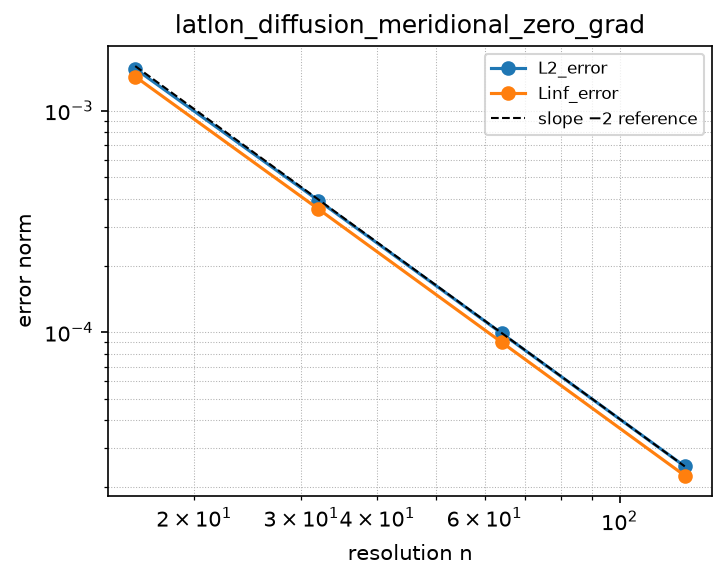
| n | L2_error | observed order | Linf_error | observed order |
|---|---|---|---|---|
| 16 | 1.546e-03 | — | 1.424e-03 | — |
| 32 | 3.932e-04 | 1.98 | 3.597e-04 | 1.99 |
| 64 | 9.897e-05 | 1.99 | 9.016e-05 | 2.00 |
| 128 | 2.482e-05 | 2.00 | 2.255e-05 | 2.00 |
Expected order: 2 (± 0.2).
central_D2_lon_periodic
Source: grids/latlon/rules/central_D2_lon_periodic.esm
Rewrites D(D(f)/Dlon)/Dlon at priority 10 — match pattern:
{"op": "D", "args": [{"op": "D", "args": ["f"], "wrt": "lon"}], "wrt": "lon"}
where): fires only when f is a bare field shaped [lon, lat]. Under import-edge renaming (§9.7.7) the wrt literal and this shape follow the renamed axis together, so the rule can be imported more than once (each instance scoped to its own grid) without a first-declared-wins collision. A consumer differentiating a compound inline expression must bind it to a declared shaped observed first.Discretization — one makearray tiling the output axes; boundary conditions live in the face regions of this same rule (esm-spec §9.6.8; later regions overwrite earlier, §4.3.2). Imported stencils appear as template applications name<param=value, ...>, defined in the Stencils section of this page:
Centered second derivative (per-degree diffusion / 1-D Laplacian) along longitude with periodic (wrap) boundary on the latlon grid — the physically natural rule for a closed zonal circle (global recipe: dlon_deg = 360/NLON; see grids/latlon/grid.esm). Compound match on D(D(f, wrt: lon), wrt: lon) at priority 10, so it fires on the whole second derivative before any plain-D rule could lower the inner longitudinal derivative (esm-spec 9.6.3 compound precedence); a PER-DEGREE operator (the physical eastward diffusion composes the (180/pi)^2 / (R_sphere coslat)^2 metric factors in the consuming equation — see grids/latlon/grid.esm; the full metric spherical Laplacian with cos(lat) weighting is a documented FOLLOW-UP, not this rule). Interior columns [2, NLON-1]: the imported 3-point centered stencil (f[i+1,j] - 2 f[i,j] + f[i-1,j]) / dlon_deg^2. The two face columns wrap explicitly, following the central_D_lon_periodic / cartesian upwind1_D_periodic precedent: i=1 gathers (f[2,j] - 2 f[1,j] + f[NLON,j]) / dlon_deg^2 and i=NLON gathers (f[1,j] - 2 f[NLON,j] + f[NLON-1,j]) / dlon_deg^2, so the scheme is the same O(dlon_deg^2) centered second difference at every column and conserves sum(f) exactly (each column of the operator telescopes to zero net weight). The face values are FULL-RANK aggregates (singleton output range on the lon axis) rather than the esm-spec 9.6.8 worked example’s rank-reduced form, so every binding’s simulator fills the (1 x NLAT) regions without rank promotion. dlon_deg is a free name resolving to the consuming model’s zonal spacing variable (consumer-supplied geometry contract); the rule itself never assumes the global extent, but composing it with a non-closing regional grid is a modeling error — use a zero-gradient lon second-derivative rule there. Match scoping: the pattern is the compound wrt: lon twice plus the constraint where: {f: {shape: [lon, lat]}} (esm-spec 9.6.1), so it fires only on the second longitudinal derivative of a bare field declared over this grid’s lon x lat index sets — not on any unrelated D(D(., wrt: lon), wrt: lon) reusing the axis name, and, under import-edge renaming (esm-spec 9.7.7), the wrt literals and the where shape follow the renamed axis together, so two latlon instances coexist scoped to their own meshes. The constraint requires a bare shaped variable; a consumer differentiating a compound inline expression must bind it to a declared lon x lat observed first.
References
- LeVeque, R. J. (2007). Finite Difference Methods for Ordinary and Partial Differential Equations. SIAM. Section 10.4 (centered differences on periodic domains) and Chapter 2 (the [1, -2, 1] second-difference operator).
Conformance fixtures
- ast:
central_D2_lon_periodic— statusactive - convergence:
latlon_diffusion_zonal_periodic— statusactive - simulation:
latlon_diffusion_zonal_periodic— statusactive
Convergence — case latlon_diffusion_zonal_periodic
Error norms read from the committed golden tests/conformance/convergence/latlon_diffusion_zonal_periodic/golden/errors.json
(binding: julia; nothing recomputed for display).
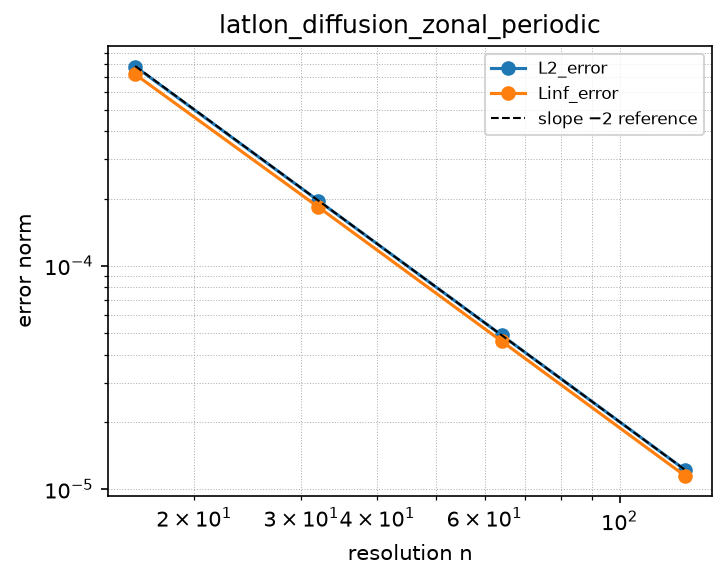
| n | L2_error | observed order | Linf_error | observed order |
|---|---|---|---|---|
| 16 | 7.792e-04 | — | 7.191e-04 | — |
| 32 | 1.955e-04 | 1.99 | 1.831e-04 | 1.97 |
| 64 | 4.892e-05 | 2.00 | 4.597e-05 | 1.99 |
| 128 | 1.223e-05 | 2.00 | 1.151e-05 | 2.00 |
Expected order: 2 (± 0.2).
central_D_lat_zero_grad_bc
Source: grids/latlon/rules/central_D_lat_zero_grad_bc.esm
Rewrites D(f)/Dlat — match pattern:
{"op": "D", "args": ["f"], "wrt": "lat"}
where): fires only when f is a bare field shaped [lon, lat]. Under import-edge renaming (§9.7.7) the wrt literal and this shape follow the renamed axis together, so the rule can be imported more than once (each instance scoped to its own grid) without a first-declared-wins collision. A consumer differentiating a compound inline expression must bind it to a declared shaped observed first.Discretization — one makearray tiling the output axes; boundary conditions live in the face regions of this same rule (esm-spec §9.6.8; later regions overwrite earlier, §4.3.2). Imported stencils appear as template applications name<param=value, ...>, defined in the Stencils section of this page:
Centered first derivative along latitude with zero-gradient boundary rows on the latlon grid. Matches D(f, wrt: lat), a PER-DEGREE derivative (see grids/latlon/grid.esm for the physical-units metric recipe). Interior rows [2, NLAT-1]: the imported centered-difference stencil. Boundary rows j=1 and j=NLAT: one-sided differences (f[i,2] - f[i,1]) / dlat_deg and (f[i,NLAT] - f[i,NLAT-1]) / dlat_deg encoding the zero-gradient condition; the three regions tile the axes, so the discretized derivative is fully defined with its BC (esm-spec 9.6.8). On the GLOBAL recipe (lat0_deg = -90, dlat_deg = 180/(NLAT-1)) the boundary rows are the poles themselves, and zero-gradient there is a deliberately CRUDE pole treatment — standard for exemplar transport, adequate for fields whose meridional gradient vanishes at the poles (any regular scalar field on the sphere has d f/d lat = 0 at the poles along every meridian), but it neither couples the pole rows across longitude nor conserves anything through the pole; proper pole handling (averaged polar caps, or an unstructured cap) is a different rule/grid. On a REGIONAL grid the same rule is an ordinary zero-gradient (homogeneous Neumann) frame boundary. The face values are FULL-RANK aggregates (singleton output range on the lat axis) so every binding’s simulator fills the (NLON x 1) regions without rank promotion — the rank-reduced face form of the esm-spec 9.6.8 worked example only fills leading-axis faces portably. dlat_deg is a free name resolving to the consuming model’s meridional spacing variable (consumer-supplied geometry contract). The one-sided faces are O(dlat_deg) locally, which preserves global 2nd-order convergence for boundary-compatible solutions (see the MMS problem problems/latlon_advection_meridional_zero_grad.esm). Match scoping: the pattern is wrt: lat plus the constraint where: {f: {shape: [lon, lat]}} (esm-spec 9.6.1), so it fires only on the meridional derivative of a bare field declared over this grid’s lon x lat index sets — not on any unrelated D(., wrt: lat) reusing the axis name, and, under import-edge renaming (esm-spec 9.7.7), the wrt literal and the where shape follow the renamed axis together, so two latlon instances coexist scoped to their own meshes. The constraint requires a bare shaped variable; a consumer differentiating a compound inline expression must bind it to a declared lon x lat observed first.
References
- LeVeque, R. J. (2007). Finite Difference Methods for Ordinary and Partial Differential Equations. SIAM. Section 2.12 (one-sided boundary treatment).
- Williamson, D. L., Drake, J. B., Hack, J. J., Jakob, R., & Swarztrauber, P. N. (1992). A standard test set for numerical approximations to the shallow water equations in spherical geometry. Journal of Computational Physics, 102(1), 211-224. (Context for pole treatments on latitude-longitude grids.)
Conformance fixtures
- ast:
central_D_lat_zero_grad_bc— statusactive - convergence:
latlon_advection_meridional_zero_grad— statusactive - simulation:
latlon_advection_meridional_zero_grad— statusactive
Convergence — case latlon_advection_meridional_zero_grad
Error norms read from the committed golden tests/conformance/convergence/latlon_advection_meridional_zero_grad/golden/errors.json
(binding: julia; nothing recomputed for display).
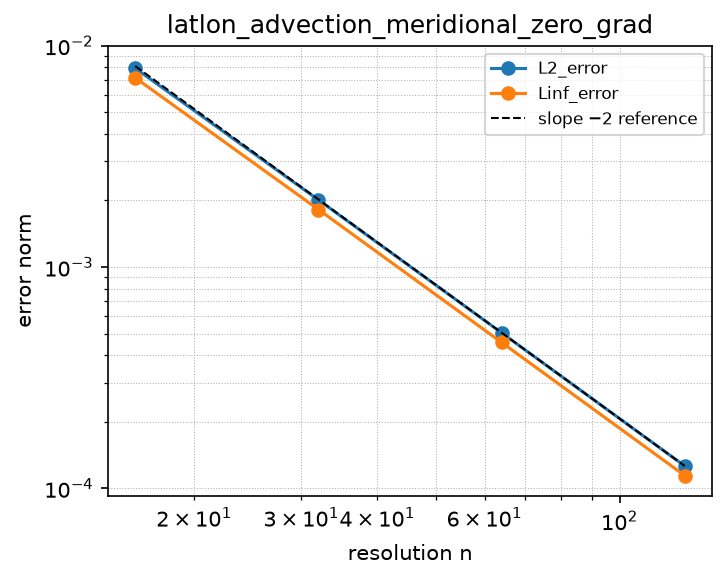
| n | L2_error | observed order | Linf_error | observed order |
|---|---|---|---|---|
| 16 | 7.907e-03 | — | 7.164e-03 | — |
| 32 | 2.010e-03 | 1.98 | 1.819e-03 | 1.98 |
| 64 | 5.048e-04 | 1.99 | 4.568e-04 | 1.99 |
| 128 | 1.263e-04 | 2.00 | 1.143e-04 | 2.00 |
Expected order: 2 (± 0.2).
central_D_lon_periodic
Source: grids/latlon/rules/central_D_lon_periodic.esm
Rewrites D(f)/Dlon — match pattern:
{"op": "D", "args": ["f"], "wrt": "lon"}
where): fires only when f is a bare field shaped [lon, lat]. Under import-edge renaming (§9.7.7) the wrt literal and this shape follow the renamed axis together, so the rule can be imported more than once (each instance scoped to its own grid) without a first-declared-wins collision. A consumer differentiating a compound inline expression must bind it to a declared shaped observed first.Discretization — one makearray tiling the output axes; boundary conditions live in the face regions of this same rule (esm-spec §9.6.8; later regions overwrite earlier, §4.3.2). Imported stencils appear as template applications name<param=value, ...>, defined in the Stencils section of this page:
Centered first derivative along longitude with periodic (wrap) boundary on the latlon grid — the physically natural rule for a closed zonal circle (global recipe: dlon_deg = 360/NLON; see grids/latlon/grid.esm). Matches D(f, wrt: lon), a PER-DEGREE derivative. Interior columns [2, NLON-1]: the imported centered-difference stencil. The two face columns wrap explicitly, following the cartesian upwind1_D_periodic / ESS pde_simulation fixture precedent for periodic boundaries: i=1 gathers (f[2,j] - f[NLON,j]) / (2 dlon_deg) and i=NLON gathers (f[1,j] - f[NLON-1,j]) / (2 dlon_deg), so the scheme is the same O(dlon_deg^2) centered difference at every column and conserves sum(f) exactly (the wrap telescopes). The face values are FULL-RANK aggregates (singleton output range on the lon axis) rather than the esm-spec 9.6.8 worked example’s rank-reduced form, so every binding’s simulator fills the (1 x NLAT) regions without rank promotion. dlon_deg is a free name resolving to the consuming model’s zonal spacing variable (consumer-supplied geometry contract); the rule itself never assumes the global extent, but composing it with a non-closing regional grid is a modeling error — use central_D_lon_zero_grad_bc there. Match scoping: the pattern is wrt: lon plus the constraint where: {f: {shape: [lon, lat]}} (esm-spec 9.6.1), so it fires only on the longitudinal derivative of a bare field declared over this grid’s lon x lat index sets — not on any unrelated D(., wrt: lon) reusing the axis name, and, under import-edge renaming (esm-spec 9.7.7), the wrt literal and the where shape follow the renamed axis together, so two latlon instances coexist scoped to their own meshes. The constraint requires a bare shaped variable; a consumer differentiating a compound inline expression must bind it to a declared lon x lat observed first.
References
- LeVeque, R. J. (2007). Finite Difference Methods for Ordinary and Partial Differential Equations. SIAM. Section 10.4 (centered differences on periodic domains).
Conformance fixtures
- ast:
central_D_lon_periodic— statusactive - convergence:
latlon_advection_zonal_periodic— statusactive - simulation:
latlon_advection_zonal_periodic— statusactive
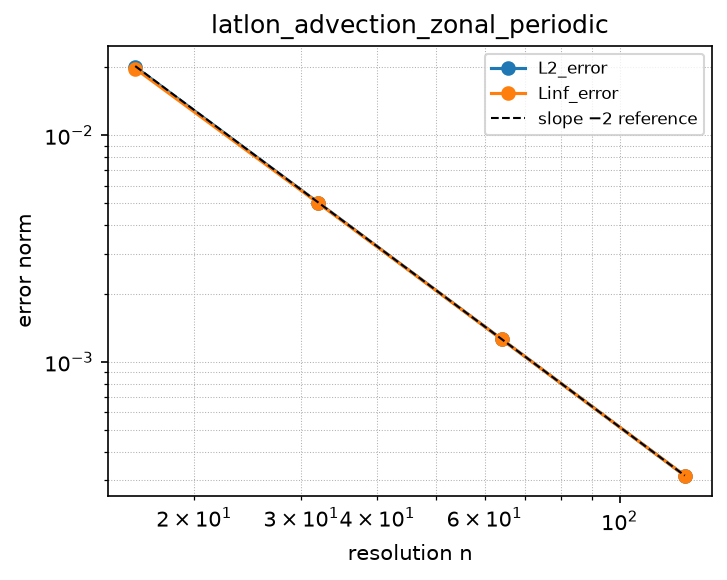
Convergence — case latlon_advection_zonal_periodic
Error norms read from the committed golden tests/conformance/convergence/latlon_advection_zonal_periodic/golden/errors.json
(binding: julia; nothing recomputed for display).
| n | L2_error | observed order | Linf_error | observed order |
|---|---|---|---|---|
| 16 | 2.003e-02 | — | 1.968e-02 | — |
| 32 | 5.037e-03 | 1.99 | 5.014e-03 | 1.97 |
| 64 | 1.261e-03 | 2.00 | 1.260e-03 | 1.99 |
| 128 | 3.154e-04 | 2.00 | 3.153e-04 | 2.00 |
Expected order: 2 (± 0.2).
central_D_lon_zero_grad_bc
Source: grids/latlon/rules/central_D_lon_zero_grad_bc.esm
Rewrites D(f)/Dlon — match pattern:
{"op": "D", "args": ["f"], "wrt": "lon"}
where): fires only when f is a bare field shaped [lon, lat]. Under import-edge renaming (§9.7.7) the wrt literal and this shape follow the renamed axis together, so the rule can be imported more than once (each instance scoped to its own grid) without a first-declared-wins collision. A consumer differentiating a compound inline expression must bind it to a declared shaped observed first.Discretization — one makearray tiling the output axes; boundary conditions live in the face regions of this same rule (esm-spec §9.6.8; later regions overwrite earlier, §4.3.2). Imported stencils appear as template applications name<param=value, ...>, defined in the Stencils section of this page:
Centered first derivative along longitude with zero-gradient boundary conditions on the latlon grid — the esm-spec 9.6.8 worked example, generalized over NLON/NLAT metaparameters and the consumer-supplied spacing free name. Matches D(f, wrt: lon), a PER-DEGREE derivative (see grids/latlon/grid.esm for the physical-units metric recipe). Interior columns [2, NLON-1]: the imported centered-difference stencil. Face columns i=1 and i=NLON: one-sided differences (f[2,j]-f[1,j])/dlon_deg and (f[NLON,j]-f[NLON-1,j])/dlon_deg encoding the zero-gradient condition. The three regions tile the axes, so the discretized derivative is fully defined with its BC (there is nowhere else a boundary condition could live). This is the REGIONAL boundary choice — a zero-gradient frame for a limited-area lon extent; on the global recipe the zonal circle closes and central_D_lon_periodic is the physical rule (a zero gradient on a closed circle is an artificial seam). dlon_deg is a free name resolving to the consuming model’s zonal spacing variable (consumer-supplied geometry contract) — the zero-gradient faces themselves are spacing-scale-invariant, so the rule serves any extent unchanged. The face values keep the rank-reduced aggregate form of the spec’s worked example (output over the lat axis only, filling the (1 x NLAT) leading-axis face regions); the lat-axis rules use full-rank faces instead because rank-reduced values only fill leading-axis faces portably across bindings. Match scoping: the pattern is wrt: lon plus the constraint where: {f: {shape: [lon, lat]}} (esm-spec 9.6.1), so it fires only on the longitudinal derivative of a bare field declared over this grid’s lon x lat index sets — not on any unrelated D(., wrt: lon) reusing the axis name, and, under import-edge renaming (esm-spec 9.7.7), the wrt literal and the where shape follow the renamed axis together, so two latlon instances coexist scoped to their own meshes. The constraint requires a bare shaped variable; a consumer differentiating a compound inline expression must bind it to a declared lon x lat observed first.
References
- LeVeque, R. J. (2007). Finite Difference Methods for Ordinary and Partial Differential Equations. SIAM. Section 2.12 (one-sided boundary treatment).
Conformance fixtures
- ast:
central_D_lon_zero_grad_bc— statusactive
laplace_beltrami_lon_periodic_lat_zero_grad
Source: grids/latlon/rules/laplace_beltrami_lon_periodic_lat_zero_grad.esm
Rewrites laplacian(u) — match pattern:
{"op": "laplacian", "args": ["u"]}
where): fires only when u is a bare field shaped [lon, lat]. Under import-edge renaming (§9.7.7) the wrt literal and this shape follow the renamed axis together, so the rule can be imported more than once (each instance scoped to its own grid) without a first-declared-wins collision. A consumer differentiating a compound inline expression must bind it to a declared shaped observed first.Discretization — one makearray tiling the output axes; boundary conditions live in the face regions of this same rule (esm-spec §9.6.8; later regions overwrite earlier, §4.3.2). Imported stencils appear as template applications name<param=value, ...>, defined in the Stencils section of this page:
METRIC spherical Laplacian (Laplace-Beltrami) of a scalar field on a REGIONAL latlon patch: matches the bare open-namespace rewrite-target {op: laplacian, args: [u]} (esm-spec 9.6.8/4.2 author sugar with no evaluable core) constrained by where {u:{shape:[lon,lat]}}, exactly mirroring grids/mpas/rules/fv_laplacian_cell – a rule MAY match laplacian directly and emit a one-shot scheme rather than route through the nested-D identity. Emits the metric-weighted makearray for lap u = (1/(R_sphere^2 cos^2 phi)) d2u/dlambda^2 + (1/(R_sphere^2 cos phi)) d/dphi(cos phi du/dphi) (lambda=lon, phi=lat, RADIANS: dlambda=(pi/180)dlon_deg, dphi=(pi/180)dlat_deg, pi=3.141592653589793). The doubly-interior region [2,NLON-1]x[2,NLAT-1] imports stencils/laplace_beltrami_interior; the eight boundary regions tile the frame with two independent, composable closures. LONGITUDE = PERIODIC (the patch spans the full zonal circle, NLON dlon_deg=360): the i=1 and i=NLON columns wrap the zonal second difference (i-1->NLON at i=1, i+1->1 at i=NLON), following the central_D2_lon_periodic precedent. LATITUDE = ZERO-GRADIENT (homogeneous Neumann band edges): the mimetic meridional flux through the outer face is dropped, giving one-sided rows j=1: cos(phi_{3/2})(u[i,2]-u[i,1])/(R_sphere^2 cos phi_1 dphi^2) and j=NLAT: cos(phi_{NLAT-1/2})(u[i,NLAT-1]-u[i,NLAT])/(R_sphere^2 cos phi_NLAT dphi^2), the cos-weighted analogue of central_D2_lat_zero_grad_bc’s ghost-elimination. cos(phi) at cell centers and faces is computed in the RUNTIME rule body from phi_j=(pi/180)(lat0_deg+(j-1)dlat_deg) and phi_{j+-1/2}=(pi/180)(lat0_deg+(j-1+-1/2)dlat_deg); the free names R_sphere, dlon_deg, dlat_deg, lat0_deg resolve in the consuming model’s scope (grids/latlon/grid.esm keyed-factor contract). POLE SINGULARITY (the crux, deliberately avoided here): the zonal weight 1/cos^2 phi diverges at phi=+-90, so this rule is DEFINED ONLY on a regional patch with lat in (lat0,lat1) strictly inside (-90,90) (a Laplace-Beltrami on a spherical band/cap where cos phi is bounded away from 0). The GLOBAL pole-cap Laplacian – an averaged polar-cap closure or an unstructured cap that removes the 1/cos^2 singularity – is a documented FOLLOW-UP, not this rule. ACCURACY: 2nd order in both L2 and Linf on a regional band with a pole-supercompatible (boundary-vanishing) field; annihilates constants (every second difference is zero) and the meridional flux form is discretely conservative through the band interior. Match scoping mirrors fv_laplacian_cell: the where shape constraint fires only on the laplacian of a bare field over THIS grid’s lon x lat index sets and, under esm-spec 9.7.7 import renaming, the shape follows the renamed axes so two latlon patches coexist; a consumer taking laplacian of a compound inline expression must first bind it to a declared lon x lat observed.
References
- Williamson, D. L., Drake, J. B., Hack, J. J., Jakob, R., & Swarztrauber, P. N. (1992). A standard test set for numerical approximations to the shallow water equations in spherical geometry. Journal of Computational Physics, 102(1), 211-224.
- LeVeque, R. J. (2007). Finite Difference Methods for Ordinary and Partial Differential Equations. SIAM. Section 2.12 (Neumann boundary by dropping the boundary flux) and Chapter 2 (the flux-form finite-volume Laplacian).
Conformance fixtures
- ast:
laplace_beltrami_lon_periodic_lat_zero_grad— statusactive - convergence:
laplace_beltrami_band_mms— statusactive - simulation:
laplace_beltrami_band_mms— statusactive
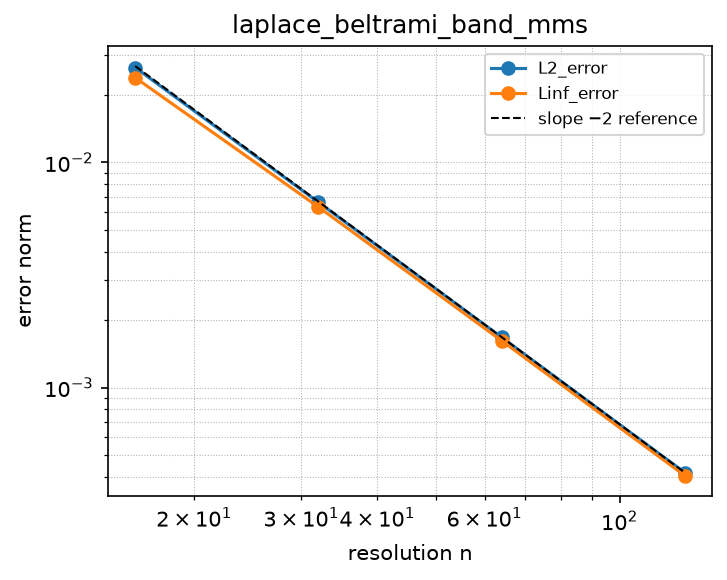
Convergence — case laplace_beltrami_band_mms
Error norms read from the committed golden tests/conformance/convergence/laplace_beltrami_band_mms/golden/errors.json
(binding: julia; nothing recomputed for display).
| n | L2_error | observed order | Linf_error | observed order |
|---|---|---|---|---|
| 16 | 2.642e-02 | — | 2.381e-02 | — |
| 32 | 6.653e-03 | 1.99 | 6.341e-03 | 1.91 |
| 64 | 1.671e-03 | 1.99 | 1.615e-03 | 1.97 |
| 128 | 4.188e-04 | 2.00 | 4.061e-04 | 1.99 |
Expected order: 2 (± 0.2).
upwind1_D_lon_periodic
Source: grids/latlon/rules/upwind1_D_lon_periodic.esm
Rewrites D(f)/Dlon — match pattern:
{"op": "D", "args": ["f"], "wrt": "lon"}
where): fires only when f is a bare field shaped [lon, lat]. Under import-edge renaming (§9.7.7) the wrt literal and this shape follow the renamed axis together, so the rule can be imported more than once (each instance scoped to its own grid) without a first-declared-wins collision. A consumer differentiating a compound inline expression must bind it to a declared shaped observed first.Discretization — one makearray tiling the output axes; boundary conditions live in the face regions of this same rule (esm-spec §9.6.8; later regions overwrite earlier, §4.3.2). Imported stencils appear as template applications name<param=value, ...>, defined in the Stencils section of this page:
First-order upwind (backward) first derivative along longitude with periodic (wrap) boundary on the latlon grid — the dissipative companion to grids/latlon/rules/central_D_lon_periodic for a closed zonal circle (global recipe: dlon_deg = 360/NLON; see grids/latlon/grid.esm), for zonal advection with non-negative angular velocity (flow toward increasing longitude). Matches D(f, wrt: lon), a PER-DEGREE derivative. Interior columns [2, NLON]: the imported backward-difference stencil (f[i,j] - f[i-1,j]) / dlon_deg. The single i=1 face column wraps explicitly to (f[1,j] - f[NLON,j]) / dlon_deg, following the cartesian upwind1_D_periodic / ESS pde_simulation fixture precedent for periodic boundaries, so the scheme is the same O(dlon_deg) backward difference at every column and conserves sum(f) exactly (the periodic wrap telescopes). Only one face column is special here — upwind needs a neighbor upstream (toward smaller lon), which every column but i=1 has — so the makearray tiles [lon, lat] with just two regions rather than the centered rule’s three. The face value is a FULL-RANK aggregate (singleton output range on the lon axis, output_idx [i, j] over the lat axis) rather than the esm-spec 9.6.8 worked example’s rank-reduced form, mirroring central_D_lon_periodic so every binding’s simulator fills the (1 x NLAT) region without rank promotion. dlon_deg is a free name resolving to the consuming model’s zonal spacing variable (consumer-supplied geometry contract); the rule itself never assumes the global extent, but composing it with a non-closing regional grid is a modeling error — use central_D_lon_zero_grad_bc there. Match scoping: the pattern is wrt: lon plus the constraint where: {f: {shape: [lon, lat]}} (esm-spec 9.6.1) at DEFAULT priority, so it fires only on the longitudinal derivative of a bare field declared over this grid’s lon x lat index sets — not on any unrelated D(., wrt: lon) reusing the axis name — and, under import-edge renaming (esm-spec 9.7.7), the wrt literal and the where shape follow the renamed axis together, so two latlon instances coexist scoped to their own meshes. The constraint requires a bare shaped variable; a consumer differentiating a compound inline expression must bind it to a declared lon x lat observed first. Sign convention: upwind for flow toward +lon; a westward variant belongs in a separate rule.
References
- LeVeque, R. J. (2002). Finite Volume Methods for Hyperbolic Problems. Cambridge University Press. Section 4.8 (upwind methods on periodic domains).
Conformance fixtures
- ast:
upwind1_D_lon_periodic— statusactive - convergence:
latlon_advection_zonal_upwind— statusactive - simulation:
latlon_advection_zonal_upwind— statusactive
Convergence — case latlon_advection_zonal_upwind
Error norms read from the committed golden tests/conformance/convergence/latlon_advection_zonal_upwind/golden/errors.json
(binding: julia; nothing recomputed for display).
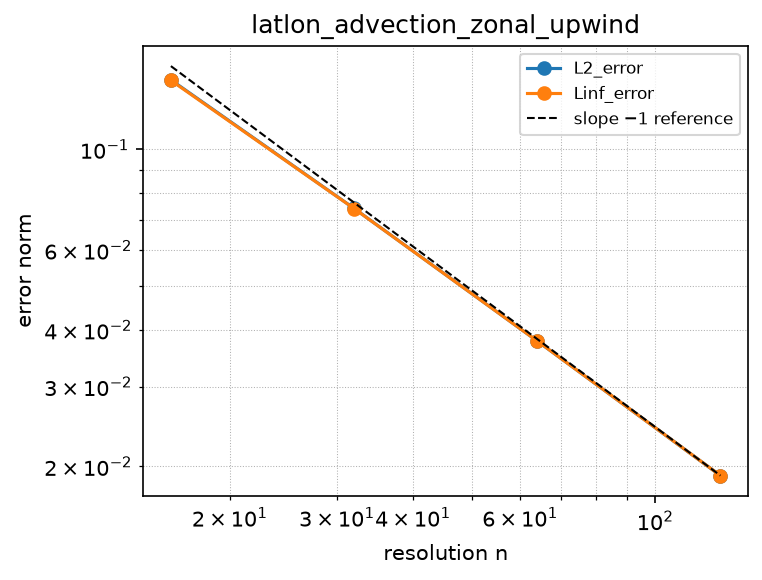
| n | L2_error | observed order | Linf_error | observed order |
|---|---|---|---|---|
| 16 | 1.424e-01 | — | 1.420e-01 | — |
| 32 | 7.414e-02 | 0.94 | 7.409e-02 | 0.94 |
| 64 | 3.781e-02 | 0.97 | 3.780e-02 | 0.97 |
| 128 | 1.909e-02 | 0.99 | 1.909e-02 | 0.99 |
Expected order: 1 (± 0.15).